Big South
March Madness in February? Yep that's right. On Tuesday February 28th, the Big South Conference Tournament begins. 8 of the 9 teams from the conference qualify for the tourney. VMI is the only team that is left out thanks to their last place conference finish. On Tuesday, the top 4 teams, Winthrop, Coastal Carolina, Birmingham Southern, and Radford all host quarterfinal games. The winners advance to the semifinals on Thursday in Rock Hill, and the title game is Saturday at high noon on ESPN2 at the home of the higher seeded team. Winthrop, Birmingham Southern, and Coastal Carolina are the favorites to grab the automatic bid to the NCAA tourney.
Winthrop University has always held a special place in my heart, as the campus is only about a half hour away from my hometown. It is also the first place where I had the pleasure of seeing Tim Duncan play in person when Wake Forest visited in January of 1995. What the Eagles have achieved under Gregg Marshall is amazing. In his 8 seasons at the school, Winthrop is 162-77. The Eagles have garnered 5 NCAA bids, including 4 in a row from 1999-2002 during his tenure. They finished in alone in first place with a 13-3 conferenc erecord this season. Before his arrival, the Eagles had zero NCAA appearances and were among the dregs of the Big South Conference. Surprisingly, he is almost never mentioned when up-and-coming coaches are discussed, but his credentials speak for themselves.
Birmingham Southern, in only their 5th season of Division I basketball finished in a tie for 2nd place at 12-4 with Coastal Carolina. The Chanticleers are coached by former Tennessee head man, Buzz Peterson and are the hottest team in the Big South. They have not lost since January 21st, a streak of 10 in a row. During that win streak they have defeated Winthrop twice. If the Eagles do not make it 6 for 8 in Big South titles under Gregg Marshall, expect Coastal Carolina to be the tourney Chants.
Ohio Valley
The Ohio Valley Conference also begins it's tournament on Tuesday with the top 4 seeds all hosting games. The winners advance to the semifinals on Friday at the Gaylord Entertainment Center in Nashville, Tennessee. The championship game is at 3 PM on Saturday and is also broadcast on ESPN2. Murray St. won the regular seaosn title with a record of 17-3. Samford (and Son), a team that plays the 3rd slowest pace in Division I (thanks Ken Pomeroy) finished second at 14-6, and Tennessee Tech finished 3rd, one game behind Samford. Expect one of those 3 teams to gain the automatic bid. If Samford wins, their methodical glacier-like pace could give a #2 or #3 seed fits for a little while come mid-March.
Horizon League
Finally, also on Tuesday, the Horizon League begins its conference tourney. The top 3 seeds, Wisconsin-Milwaukee, last years NCAA cinderella, Butle, and Wisconsin-Green Bay all have byes into the second round. Milwaukee and Butler also have byes into the semifinals. I like this policy of conferences protecting their best teams in the conference tourney. 3 months worth of work is probably more indicative of a team's ability than a 3 game tournament. Milwaukee hosts the quarter and semifinals, and the title game (9 PM on Tuesday March 2nd on ESPN) is hosted by the highest remaining seed. Milwaukee and Butler definitely appear to be the class of this conference. Milwaukee finsihed league play with a 12-4 mark, and Butler was only one game off the pace. No other team finished above .500, as 5 teams finished exactly 8-8.
Sunday, February 26, 2006

Tuesday, February 21, 2006
LA or South Beach?
The USC mini-dynasty we have witnessed in the last 3 seasons is very similar to the
W/L: 11-1
Points Scored: 506 42.2 per game
Points Allowed: 190 15.8 per game
Opponent’s Record: 80-51 .610
Miami played Division IAA McNeese St, and if we include their 8-4 record, then Miami’s opponent’s winning percentage goes up to .615 (88-55)
Record Against Winning Teams (excluding
Road Record: 4-1
Record in Close Games: 1-1
Miami 2001
W/L: 12-0
Points Scored: 512 42.7 per game
Points Allowed: 117 9.8 per game
Opponent’s Record: 81-60 .574
Record Against Winning Teams:
Road Record: 5-0
4 of the 5 road games were against teams with winning records.
Record in Close Games: 1-0
Another testament to
Miami 2002
W/L: 12-1
Points Scored: 527 40.5 per game
Points Allowed: 248 19.1 per game
Opponent’s Record: 91-64 .587
Record Against Winning Teams (excluding
Road Record: 6-0
3 of the road games were
Record in Close Games: 2-1
USC 2003
W/L: 12-1
Points Scored: 534 41.1 per game
Points Allowed: 239 18.4 per game
Opponent’s Record: 85-79 .518
Record Against Winning Teams: The Trojans went 5-1 against winning teams. They defeated
Road Record: 5-1
The Trojans best road win was
Record in Close Games: 0-1
One sign of greatness, USC was only really challenged by
USC 2004
W/L: 13-0
Points Scored: 496 38.2 per game
Points Allowed: 169 13 per game
Opponent’s Record: 82-70 .539
Record Against Winning Teams: The Trojans went 5-0 against winning teams. They beat
Road Record: 5-0
The Trojans best road win was
Record in Close Games: 4-0
The Trojans struggles in 3 road games against bad to mediocre team. They beat Stanford (4-7) by 3,
USC 2005
W/L: 12-1
Points Scored: 638 49.1 per game
Points Allowed: 297 22.8 per game
Opponent’s Record: 88-65 .575
Record Against Winning Teams: The Trojans went 6-1 against winning teams. They defeated
Road Record: 6-0
The Trojans best
Record in Close Games: 2-1
The Trojans beat Notre Dame by 3,
The cumulative stats:
W/L: 35-2 .946
Points Scored: 1545 41.8 per game
Points Allowed: 555 15 per game
Opponent’s Record: 252-175 .590
With
Record Against Winning Teams: 22-2 .917
Road Record: 15-1 .938
Record in Close Games: 4-2 .667
USC 2003-2005
W/L: 37-2 .949
Points Scored: 1668 42.8 per game
Points Allowed: 705 18.1 per game
Opponent’s Record: 255-214 .544
Record Against Winning Teams: 16-2 .889
Road Record: 17-1 .944 (includes the Virginia Tech game in
Record in Close Games: 6-2 .750
I am inclined to say
Tuesday, February 14, 2006
Homefield Advantage in the SEC
A few weeks ago I took a look at the cummulative Big 10 conference record of every team since 2000 to try and determine who had the biggest homefield advantage. So here’s a follow up with the same thing for the SEC teams. Again, I chose only conference records because each team has different non-conference schedules (both in quality and quantity). The sample size of 6 seasons gives us 48 total games (24 home and 24 road) for each team and helps eliminate some of the volatility of a conference season that does not include every opponent. It should be noted that Florida and Georgia screw up the data by playing one neutral site game against each other, so they will have only 42 games apiece. First up, the home record of each SEC team since 2000 from best to worst.
Auburn 20-4
Georgia 17-4
LSU 19-5
Florida 16-5
Tennessee 15-9
Alabama 13-11
Mississippi 13-11
South Carolina 13-11
Arkansas 12-12
Mississippi St. 9-15
Kentucky 4-20
Vanderbilt 3-21
Now the road warriors.
Georgia 17-4
Tennessee 18-6
Auburn 16-8
LSU 16-8
Florida 13-8
Alabama 11-13
South Carolina 11-13
Arkansas 9-15
Mississippi 9-15
Kentucky 4-20
Vanderbilt 3-21
Mississippi St. 1-23
Here are the leaders in delta points at home. Delta points are net points. Florida’s +331 means they have outscored their home opponents by 331 points (roughly 15.8 per game).
Florida 331
Auburn 279
Georgia 269
LSU 181
Tennessee 178
Alabama 123
Arkansas 64
South Carolina 42
Mississippi 2
Mississippi St. -217
Kentucky -228
Vanderbilt -270
Now the leaders in road delta points.
Georgia 217
LSU 198
Florida 141
Tennessee 124
Auburn 110
Alabama 101
Arkansas -113
South Carolina -126
Mississippi -181
Kentucky -322
Vanderbilt -422
Mississippi St. -477
Next up is a ranking of 'relative homefield advantage' by difference in home/road winning percentage. Mississippi St. has the largest discrepancy in home and road play in this category, winning at a .375 clip at home (9-15) versus an atrocious road record of 1-23 (.042) for a difference of .333.
Mississippi St. .333
Auburn .167
Mississippi .167
Florida .143
Arkansas .125
LSU .125
Alabama .083
South Carolina .083
Georgia 0
Kentucky 0
Vanderbilt 0
Tennessee -.125
Some observations. In the past half-decade Mississippi St. has been simply awful on the road. Their only road win in the 2000’s was in 2000 at Kentucky. They have won an unbelievable 9 times as many home conference games as road games in this time span. Surprisingly, Georgia, Kentucky, and Vanderbilt are just as likely to win at home as they are on the road. Of course this does not mean these teams similar. Georgia (along with Auburn and LSU) has been the class of the conference since 2000 and are a very good road team. Their homefield advantage is only relatively smaller because they win so many road contests. Kentucky and Vanderbilt on the other hand have been terrible both at home and on the road. Another surprise has Tennessee with a better road conference record in this six year span than home ocnference record.
Finally, here is a ranking of 'relative homefield advantage' by difference in delta points at home and on the road. Mississippi St. again has the largest discrepancy in home and road play in this category. They have -217 delta points at home and -477 on the road for a difference of 260 delta points.
Mississippi St. 260
Florida 190
Mississippi 183
Arkansas 177
Auburn 169
South Carolina 168
Vanderbilt 152
Kentucky 94
Tennessee 54
Georgia 52
Alabama 22
LSU -17
From this second set of data, the shocker is that LSU actually has more delta points on the road than at home. What this should mean is that they have a better record in close games at home than on the road. A quick stroll through the data reveals just that. At home in conference games decided by one score (8 points or less) they are a remarkable 10-1 since 2000. In similar road games, they still managed a winning record, but it was only 5-3. This is nothing endemic to this team’s character, they have probably just gotten the lucky bounces at home and not gotten as many on the road. This also shows that they have played more close games at home than on the road. Not something you would expect from the team that plays in a place called ‘Death Valley’. As usual, all coments and questions are welcome. Big 12 and Pac 10 studies coming soon.
Auburn 20-4
Georgia 17-4
LSU 19-5
Florida 16-5
Tennessee 15-9
Alabama 13-11
Mississippi 13-11
South Carolina 13-11
Arkansas 12-12
Mississippi St. 9-15
Kentucky 4-20
Vanderbilt 3-21
Now the road warriors.
Georgia 17-4
Tennessee 18-6
Auburn 16-8
LSU 16-8
Florida 13-8
Alabama 11-13
South Carolina 11-13
Arkansas 9-15
Mississippi 9-15
Kentucky 4-20
Vanderbilt 3-21
Mississippi St. 1-23
Here are the leaders in delta points at home. Delta points are net points. Florida’s +331 means they have outscored their home opponents by 331 points (roughly 15.8 per game).
Florida 331
Auburn 279
Georgia 269
LSU 181
Tennessee 178
Alabama 123
Arkansas 64
South Carolina 42
Mississippi 2
Mississippi St. -217
Kentucky -228
Vanderbilt -270
Now the leaders in road delta points.
Georgia 217
LSU 198
Florida 141
Tennessee 124
Auburn 110
Alabama 101
Arkansas -113
South Carolina -126
Mississippi -181
Kentucky -322
Vanderbilt -422
Mississippi St. -477
Next up is a ranking of 'relative homefield advantage' by difference in home/road winning percentage. Mississippi St. has the largest discrepancy in home and road play in this category, winning at a .375 clip at home (9-15) versus an atrocious road record of 1-23 (.042) for a difference of .333.
Mississippi St. .333
Auburn .167
Mississippi .167
Florida .143
Arkansas .125
LSU .125
Alabama .083
South Carolina .083
Georgia 0
Kentucky 0
Vanderbilt 0
Tennessee -.125
Some observations. In the past half-decade Mississippi St. has been simply awful on the road. Their only road win in the 2000’s was in 2000 at Kentucky. They have won an unbelievable 9 times as many home conference games as road games in this time span. Surprisingly, Georgia, Kentucky, and Vanderbilt are just as likely to win at home as they are on the road. Of course this does not mean these teams similar. Georgia (along with Auburn and LSU) has been the class of the conference since 2000 and are a very good road team. Their homefield advantage is only relatively smaller because they win so many road contests. Kentucky and Vanderbilt on the other hand have been terrible both at home and on the road. Another surprise has Tennessee with a better road conference record in this six year span than home ocnference record.
Finally, here is a ranking of 'relative homefield advantage' by difference in delta points at home and on the road. Mississippi St. again has the largest discrepancy in home and road play in this category. They have -217 delta points at home and -477 on the road for a difference of 260 delta points.
Mississippi St. 260
Florida 190
Mississippi 183
Arkansas 177
Auburn 169
South Carolina 168
Vanderbilt 152
Kentucky 94
Tennessee 54
Georgia 52
Alabama 22
LSU -17
From this second set of data, the shocker is that LSU actually has more delta points on the road than at home. What this should mean is that they have a better record in close games at home than on the road. A quick stroll through the data reveals just that. At home in conference games decided by one score (8 points or less) they are a remarkable 10-1 since 2000. In similar road games, they still managed a winning record, but it was only 5-3. This is nothing endemic to this team’s character, they have probably just gotten the lucky bounces at home and not gotten as many on the road. This also shows that they have played more close games at home than on the road. Not something you would expect from the team that plays in a place called ‘Death Valley’. As usual, all coments and questions are welcome. Big 12 and Pac 10 studies coming soon.
Sunday, February 12, 2006
Winter Olympics Rant
For the next few weeks NBC will be falling all over itself trying to convince you and I that the winter olympics are important and worth watching. In the process, instead of showing great comedies like My Name Is Earl and The Office, I will be subjected to watching some clowns I've never heard of ski, skate, and do something called curling. For crying out loud, the only 'real' sport included in these 'games' is hockey, and no one outside of Canada and douchebags from up North watch that. Just because some flaming, naked, Greek tools got together to make sport for their fake gods a few thousand years ago doesn't mean we should continue the practice today. Here's some other things those 'crazy' Greeks did.
I. Took dumps outside. Yes that's right, there was no indoor plumbing in Ancient Greece. They didn't mention that in Hercules.
II. Got conquered by Rome.
III. One of their greatest writers, Homer, wrote The Odyssey, that I had to read over summer vacation in 1998. That story is so long and full of plot holes. For example, after Odysseus is captured by the cyclops, he puts his eye out (kinda phat) and manages to escape by tying himself and his men to the undersides of the Cyclops' sheep. Yeah, whatever Homer. Now, I'm no farmer, but I have seen a few sheep in my lifetime. Unless this 'great hero' Odysseus and his men are all the size of 10-year old girls, he ain't escaping riding under some damn sheep. If you're intrigued and want to find out the rest of the story, I recommend the 1997 movie starring Armand Assante.
 Hid under sheep.
So anyway, back to my point. The Olympics suck and no one should watch them. Maybe they will go away. If I wanted to watch obscure winter sports, ESPN shows the X-games every year.
I. Took dumps outside. Yes that's right, there was no indoor plumbing in Ancient Greece. They didn't mention that in Hercules.
II. Got conquered by Rome.
III. One of their greatest writers, Homer, wrote The Odyssey, that I had to read over summer vacation in 1998. That story is so long and full of plot holes. For example, after Odysseus is captured by the cyclops, he puts his eye out (kinda phat) and manages to escape by tying himself and his men to the undersides of the Cyclops' sheep. Yeah, whatever Homer. Now, I'm no farmer, but I have seen a few sheep in my lifetime. Unless this 'great hero' Odysseus and his men are all the size of 10-year old girls, he ain't escaping riding under some damn sheep. If you're intrigued and want to find out the rest of the story, I recommend the 1997 movie starring Armand Assante.
 Hid under sheep.
So anyway, back to my point. The Olympics suck and no one should watch them. Maybe they will go away. If I wanted to watch obscure winter sports, ESPN shows the X-games every year.
Monday, February 06, 2006
Super Bowl XL Unanswered Questions
 Personal Foul.
I. Was Mr. Magoo officiating this game? I'll grant you that Roethlisberger may have been in on his TD run, and the interference against Darrell Jackson was a good call. But the hold on Locklear and the Hasselbeck personal foul call? Ridiculous.
 Herndon: Means slow-footed in Slavokian.
II. Is Kelly Herndon the slowest defensive back in history? It looked like he was running in molasses on his interception return.
 D'oh.
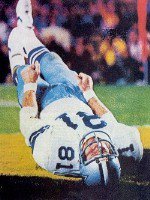
D'oh.III. Did Jackie Smith kidnap Seahawks Tight End Jerramy Stevens before the game? I counted at least 3 dropped passes by Stevens.
 You might as well face it, you're addicted to Lost.
IV. Is Robert Palmer rolling over in his grave right now?
 Satisfaction.
V. When did Mick Jagger become a 16-year old girl? Did he buy his shirt at Limited Too?
Sunday, February 05, 2006
Super Bowl XL Preview
Last Week: 1-1
Playoffs: 7-3
Super Bowl
Pittsburgh Vs. Seattle
Super Bowl XL pits a storied franchise against one that was not even in the league when Pittsburgh won it's first 2 Super Bowls. It also pits 2 of the game's best current coaches. Forgotten amidst the press clippings other coaches such as Bill Belichick, John Fox, Andy Reid, Bill Parcels, Joe Gibbs, and Marvin Lewis have received in the last few years are Bill Cowher and Mike Holmgren. Cowher has now coached the Steelers for 14 season full seasons. He has 141 victories, meaning he averages 10 wins a season. He had had but 3 losing seasons in his 14 years, and none worse than 6-10. His teams have won 8 division titles, made 10 postseason appearances, and played in one Super Bowl in his career. Mike Homgren has also been coaching for 14 straight seasons, albeit with 2 different franchises. In that time span, he has 138 victories, coupled with only 2 losing seasons. His teams have won 6 division titles, made 10 postseason appearances, and appeared in 2 Super Bowls, winning one of them. In this era of parity in the NFL where teams go from Super Bowl participant to 6-10 also ran in the span of 1 season, these men have stood the test of time. The irony is that the coach of the team that wins this game will probably be bound for Canton when he retires, while the loser may unfairly receive the label of choker, and with it the inferrence that he is incapable of winning the big one.
So what are the key matchups to watch? For Seattle to win, they must contain the Pittsburgh passing game. While Pittsburgh still runs a lot (leading the NFL in rushing attempts), they are one of the most prolific passing teams. They lead the league in yards per pass attempt, a much better indicator of passing strength than simply passing yards. The key matchup when Pittsburgh has the ball will not be Lofa Tatupu, LeRoy Hill, and D.D. Lewis against the Pittsburgh O-line and Jerome Bettis. It will be their French secondary of Jordan Babineaux and Marcus Trufant against Hines Ward and Antwaan Randle El. If they can contain, not stop, the Pittsburgh passing game, the Seahawks will be in good shape beacuse I do not believe Pittsburgh will be able to move the ball on the ground.
On offense, Seattle lead the league in points scored this season. They have not lost a meaningful game since Week 4 against the Washington Redskins. And yet somehow, they are underdogs, and columnists like Skip Bayless insist they are one of the worst Super Bowl teams of all time. Seems someone is not a student of NFL history. 1979 Rams ring a bell? But i digress. Seattle's strength is their offensive balance. The O-line lead by Walter Jones and Steve Hutchinson open up holes for Shaun Alexander and also give Matt Hasselbeck plenty of time to throw to his talented trio of receivers, Bobby Engram, Joe Jurevicius, and Darrell Jackson. The Pittsburgh defense may be able to contain Alexander, but the depth Seattle possesses at receiver will allow them to spread the field and beat Pittsburgh's blitzes.
Winner: Seattle
MVP: Bobby Engram
Playoffs: 7-3
Super Bowl
Pittsburgh Vs. Seattle
Super Bowl XL pits a storied franchise against one that was not even in the league when Pittsburgh won it's first 2 Super Bowls. It also pits 2 of the game's best current coaches. Forgotten amidst the press clippings other coaches such as Bill Belichick, John Fox, Andy Reid, Bill Parcels, Joe Gibbs, and Marvin Lewis have received in the last few years are Bill Cowher and Mike Holmgren. Cowher has now coached the Steelers for 14 season full seasons. He has 141 victories, meaning he averages 10 wins a season. He had had but 3 losing seasons in his 14 years, and none worse than 6-10. His teams have won 8 division titles, made 10 postseason appearances, and played in one Super Bowl in his career. Mike Homgren has also been coaching for 14 straight seasons, albeit with 2 different franchises. In that time span, he has 138 victories, coupled with only 2 losing seasons. His teams have won 6 division titles, made 10 postseason appearances, and appeared in 2 Super Bowls, winning one of them. In this era of parity in the NFL where teams go from Super Bowl participant to 6-10 also ran in the span of 1 season, these men have stood the test of time. The irony is that the coach of the team that wins this game will probably be bound for Canton when he retires, while the loser may unfairly receive the label of choker, and with it the inferrence that he is incapable of winning the big one.
So what are the key matchups to watch? For Seattle to win, they must contain the Pittsburgh passing game. While Pittsburgh still runs a lot (leading the NFL in rushing attempts), they are one of the most prolific passing teams. They lead the league in yards per pass attempt, a much better indicator of passing strength than simply passing yards. The key matchup when Pittsburgh has the ball will not be Lofa Tatupu, LeRoy Hill, and D.D. Lewis against the Pittsburgh O-line and Jerome Bettis. It will be their French secondary of Jordan Babineaux and Marcus Trufant against Hines Ward and Antwaan Randle El. If they can contain, not stop, the Pittsburgh passing game, the Seahawks will be in good shape beacuse I do not believe Pittsburgh will be able to move the ball on the ground.
On offense, Seattle lead the league in points scored this season. They have not lost a meaningful game since Week 4 against the Washington Redskins. And yet somehow, they are underdogs, and columnists like Skip Bayless insist they are one of the worst Super Bowl teams of all time. Seems someone is not a student of NFL history. 1979 Rams ring a bell? But i digress. Seattle's strength is their offensive balance. The O-line lead by Walter Jones and Steve Hutchinson open up holes for Shaun Alexander and also give Matt Hasselbeck plenty of time to throw to his talented trio of receivers, Bobby Engram, Joe Jurevicius, and Darrell Jackson. The Pittsburgh defense may be able to contain Alexander, but the depth Seattle possesses at receiver will allow them to spread the field and beat Pittsburgh's blitzes.
Winner: Seattle
MVP: Bobby Engram
Friday, February 03, 2006
Taking the Bus to Canton
In case you missed it, Jerome Bettis is in fact from Detroit. With Bettis playing in what is believed to be his final game on Sunday, many sportwriters have been harping on his place in football history. To be certain, Bettis is a Hall-of-Fame player, but where exactly does he rank? In the following paragraphs, I will try and shed light on the answer to this question.
If you didn't know this already, it may come as a shock to you. Jerome Bettis ranks 5th all time in rushing yards in NFL history with 13,662 yards. He is about 450 yards shy of Curtis Martin and 400 yards ahead of Eric Dickerson. He is tied for 8th all time in rushing touchdowns with 91. In a nice coincidence, he is tied with another Steeler legend, Franco Harris. Undoubtedly, he will fall on the all-time rushing touchdown list as soon as next year, as Curtis Martin has 90, Shaun Alexender has 89, Priest Holmes has 86, LaDainian Tomlinson has 72, and Corey Dillon has 69. Those numbers are nice and all, but is Jerome Bettis an 'inner-circle' running back, belonging in the Pantheon of all-time great backs? Here's an argument to the contrary.
Care to hazard a guess as to how many times Jerome Bettis has lead the NFL in rushing? The same number of times that you and I have. 0. Zero. Nada. In his rookie season of 1993, he finished 2nd to Emmitt. In 1996, he finished 3rd behind Barry Sanders and Terrell Davis. In 1997 he finished 3rd behind Sanders and Davis again. He's finished in the top 10 in rushing just twice more, a pair of 9th place finishes in 1994 and 2000. 5 top-10 rushing performances in 13 years.
Jerome Bettis has had 8 1,000 yard rushing seasons, but none since 2001. A very nice accomplishment, but not the feat it used to be. A runner only need average 62 and a half yards per game to reach this threshhold.
Of all the running backs in the top 25 for all-time rushing yards, only John Riggins (3.893) and Eddie George (3.644) have lower yard per rush averages than Jerome Bettis (3.927). In Jerome Bettis' 13-year career, he has average below 4.0 yards per rush 9 times, including 4 times in seasons in which he rushed for 1,000 yards.
Jerome Bettis is not a good receiver. For his career, he has 200 receptions for 1,449 yards and 3 touchdowns. With the St. Louis Rams in 1999, Marshall Faulk had 87 receptions for 1048 yards and 5 touchdowns. To put this in perspective, during a 16-game stint in his career, Marshall Faulk put up numbers that are roughly equivalent to what Jerome Bettis has done in 192 career games.
Does Jerome Bettis deserve the praise he has been given this week? Sure. He has been a very good running back for 13 seasons, but he lacks the great peak and all around game that the game's great backs have all had (Faulk, Sanders, Smith, Payton, Brown, Simpson, Taylor, etc.). Bettis belongs in the Hall of Fame for the durability he has shown and the numbers he has put up, but to confuse him with the aforementioned legends of the game is a foolish endeavor.
If you didn't know this already, it may come as a shock to you. Jerome Bettis ranks 5th all time in rushing yards in NFL history with 13,662 yards. He is about 450 yards shy of Curtis Martin and 400 yards ahead of Eric Dickerson. He is tied for 8th all time in rushing touchdowns with 91. In a nice coincidence, he is tied with another Steeler legend, Franco Harris. Undoubtedly, he will fall on the all-time rushing touchdown list as soon as next year, as Curtis Martin has 90, Shaun Alexender has 89, Priest Holmes has 86, LaDainian Tomlinson has 72, and Corey Dillon has 69. Those numbers are nice and all, but is Jerome Bettis an 'inner-circle' running back, belonging in the Pantheon of all-time great backs? Here's an argument to the contrary.
Care to hazard a guess as to how many times Jerome Bettis has lead the NFL in rushing? The same number of times that you and I have. 0. Zero. Nada. In his rookie season of 1993, he finished 2nd to Emmitt. In 1996, he finished 3rd behind Barry Sanders and Terrell Davis. In 1997 he finished 3rd behind Sanders and Davis again. He's finished in the top 10 in rushing just twice more, a pair of 9th place finishes in 1994 and 2000. 5 top-10 rushing performances in 13 years.
Jerome Bettis has had 8 1,000 yard rushing seasons, but none since 2001. A very nice accomplishment, but not the feat it used to be. A runner only need average 62 and a half yards per game to reach this threshhold.
Of all the running backs in the top 25 for all-time rushing yards, only John Riggins (3.893) and Eddie George (3.644) have lower yard per rush averages than Jerome Bettis (3.927). In Jerome Bettis' 13-year career, he has average below 4.0 yards per rush 9 times, including 4 times in seasons in which he rushed for 1,000 yards.
Jerome Bettis is not a good receiver. For his career, he has 200 receptions for 1,449 yards and 3 touchdowns. With the St. Louis Rams in 1999, Marshall Faulk had 87 receptions for 1048 yards and 5 touchdowns. To put this in perspective, during a 16-game stint in his career, Marshall Faulk put up numbers that are roughly equivalent to what Jerome Bettis has done in 192 career games.
Does Jerome Bettis deserve the praise he has been given this week? Sure. He has been a very good running back for 13 seasons, but he lacks the great peak and all around game that the game's great backs have all had (Faulk, Sanders, Smith, Payton, Brown, Simpson, Taylor, etc.). Bettis belongs in the Hall of Fame for the durability he has shown and the numbers he has put up, but to confuse him with the aforementioned legends of the game is a foolish endeavor.
Subscribe to:
Posts (Atom)