Monday, August 16, 2010

CUSA Preview

The home stretch is officially here. College football will be kicking off in only 17 days! To get you set for all the conference races, here now is the Conference USA Preview. If you want some background on what these projections are based on, here's the link to the ACC Preview that provides a little more explanation. Check back in a few days when we preview the Independents. That will be a short one, as there are only 3 left in all of major college football.


Conference USA Projections


East Carolina
Kings of Clutch
In the 5 years since Conference USA expanded to 12 teams, the Pirates from East Carolina have had quite a knack for winning the close ones.

Marshall
Half-a-Hundred
The Thundering Herd laid a couple of eggs in the 2009 season. In their second game, Virginia Tech destroyed them 52-10, and in their regular season finale, a UTEP team playing only for pride beat them 52-21. Marshall was one of just 14 teams to give up at least 50 points multiple times in 2009.The Herd kept even rarer company in that they were one of only 4 teams (Idaho, Fresno State, and Troy were the others) to give up at least 50 multiple times yet still post a winning record.


Memphis
Let's Kick It
On the whole, Memphis has been a pretty nondescript team the last two seasons. They went 6-7 in 2008, then 2-10 this past season. While they were average in 2008 and then bad in 2009, they weren't historically bad. There were no essays crowning them the worst team in football. They may not have even been the worst team in Conference USA (Rice certainly gave them a run for their money). They were just another bad team with dwindling attendance that made a coaching change. However, Memphis fans can point to one factor that made the team unique. Opposing kickers almost never missed field goals against the Tigers the past two seasons.Teams have very little control (if any) to make opposing kickers miss if they don't outright block the kick. Thus, most of this kicking misfortune can be chalked up to just that, bad luck. By some regression to the mean, opposing kickers should miss a few more field goals against the Tigers in 2010, and who knows, maybe that will mean an extra game or two in the win column.


Southern Miss
Missed It By that Much
If you didn't look closely, you might have thought Southern Miss was a pretty average team in 2009. They went 7-6, 5-3 versus Conference USA foes, and seemed to be the very definition of mediocrity. However, the Golden Eagles were amazing at one often overlooked aspect of football--kicking extra points. The Golden Eagles missed 10 extra point attempts in 2010, the most of any team since 2005.Obviously, missing extra points does not make you a bad team. In fact, it usually means you are pretty good, at least offensively. In order to miss a lot of extra points, you have to attempt a lot of extra points, which means you have to score a lot of touchdowns. Every team on this list averaged at least 30 points per game, and only New Mexico State finished with a losing record (combined record of 58-31). Heck, Texas even won the national title in 2005. So there you go, by recent standards, Southern Miss had a pretty incredible season in 2009.


UAB
Ummm.... Maybe We Should Have Kicked
UAB just missed out on a bowl game in 2009, finishing 5-7. They were led by do-it-all quarterback Joe Webb, who finished among the national leaders in passer rating (9th) and led all quarterbacks in rushing yards with 1424. However, one thing Webb could not help the Blazers do was convert on 4th down. UAB did not convert a single 4th down attempt in 2009. Obviously, this makes them easily the worst 4th down converting team since 2006.On the whole, defenses must have really buckled down in 2009, as 4 of the 6 worst conversion rates occurred this past season.


UCF
An Evening with Kevin Smith
UCF has been a contender from the moment they joined Conference USA in 2005. They have won the East division twice (2005 and 2007) and finished a strong second to East Carolina this past season. The Knights won the conference in 2007 on the broad shoulders of running back Kevin Smith. Smith racked up over 2500 yards on the ground and scored 29 rushing touchdowns, eclipsing 200 yards rushing in a single game 5 times. Smith left college early for the NFL Draft after the season, and the UCF offense has not been the same. The table below lists UCF's offensive and defensive SDPI numbers for each season since 2005, with rank within the conference (out of 12 teams) in parentheses. If you don't know what SDPI is, just have a stroll through the archives. I have written extensively about it, and it is the primary statistic the projection system is based around.UCF boasted pretty good offensive teams in their first 3 years in Conference USA. That was a good thing because it took their defense a few years to catch up. However, the defense has consistently been one of the best in the league the past 3 seasons, but with the loss of Smith and an inability to find an efficient quarterback, the offense has been the weak link of the team. If the offense can get just a little better, the Knights could make the Eastern half of Conference USA their stomping ground in 2010.


Houston
Screwy Splits
Houston had a very helter-skelter season in 2009. Against BCS-conference teams they went a combined 3-0. They won 2 of those games on the road, against Oklahoma State and Mississippi State. They also beat Texas Tech at home for good measure. However, against teams from the East Division of Conference USA (Southern Miss, Memphis, UCF, and East Carolina) and against a team from the Mountain West (Air Force) in their bowl game, the Cougars managed only a 2-3 record. How did this happen? Check the splits and the answer is easy to see.The yardage splits are almost identical versus both groups, but the big difference is turnovers. In their final 2 games (losses to East Carolina in the CUSA Championship Game and to Air Force in the Armed Forces Bowl), the Cougars committed 10 turnovers (with quarterback Case Keenum throwing 9 of his 15 interceptions) and forced only 1 for a margin of -9. Turnovers truly are The Great Equalizer.


Rice
No D in Rice
The past decade was relatively successful for the Rice Owls. They played in 2 bowl games (and qualified for another in 2001). In 2008, they won their first bowl game since the 1953 Cotton Bowl. However, one thing Rice did not do well this past decade was play defense.


SMU
Ponies Jump High, But How do They Land?
2009 was a special year to say the least for SMU Mustangs. The Ponies won 8 games, including 6 within the league to tie Houston for the CUSA West title, and participated in the postseason for the first time since 1984. In a nice twist, SMU won the Hawaii Bowl against Nevada in the same place they won their last bowl game (1984 Aloha Bowl versus Notre Dame). All the more impressive, the Mustangs did all this despite not winning a conference game in 2008. Their 6-game conference win improvement is one of the highest in recent memory. But what happens in the year after such a big jump? To answer that question, we need to look at other teams that experienced similar upticks in their conference performance. The table below lists the 9 teams (along with SMU) that improved their conference record by at least 5 games since 2004. It also lists their conference record in the season after their 'Jump Year'.
Before we delve into the results, I want to do some housekeeping. If you didn't notice, UCF has an asterisk in the table. That's because their records occurred in different conferences. In their first year under former disgraced Notre Dame coach George O'Leary, the Knights failed to win a single game (in the conference or otherwise) in 2004. That season, they played in the MAC. In 2005, they joined Conference USA and won 7 of their 8 league games. They won the East division, but fell to Tulsa in the CUSA Championship Game. Alright so with that out of the way, what does the table tell us? It's not necessarily good news for SMU. While 5 of the 9 teams posted at least a .500 conference record the following season, only one team (Western Michigan in 2006) actually improved. Taking the average of the performances the following season, SMU can expect to lose about 2.3 conference wins in 2010. That would put them back around .500 in the league. Now, I'm not saying SMU is predestined to finish with fewer league wins in 2010, but the odds are against them improving upon their 2009 performance. Look no further than Ole Miss, the ubiquitous 2009 preseason darling after their out of nowhere rise in 2008. The Rebels were solid in 2009, particularly when compared against the debacle that was the Ed Orgeron era, but they still lost as many as they won in conference play.


Tulane
Stuck in the Dark Ages
Since Conference USA began its present incarnation in 2005, the Green Wave have had the worst record within the league by far. Their 8-32 conference record is 5 games worse than the record posted by UAB. A big reason for this is the fact that Tulane plays in one of the most offensive divisions in college football. The other 5 teams that make up the western half of Conference USA are usually pretty formidable throwing the football. The table below lists the passing touchdowns thrown by each team's top quarterback for each season since 2005.As you can see, Tulane is well below the other schools when it comes to 21st Century offenses. In the 5 seasons from 2005-2009, their top seasonal passers have combined to throw 57 touchdowns. Meanwhile, 3 quarterbacks within their own division have thrown at least 44 touchdown passes in a single season (Case Keenum with Houston in 2008 and 2009, Paul Smith with Tulsa in 2007, and David Johnson with Tulsa in2008).


Tulsa
Home Ain't What it Used to Be
In 2009, Tulsa suffered through their first losing season since 2004 (last season in the WAC before joining CUSA). A big culprit was the Golden Hurricanes inability to win at home against their conference foes. In their first 4 seasons in the league, Tulsa was 14-2 against league opponents (excluding their loss to East Carolina in the 2008 CUSA Championship Game). They outscored their home opponents by 20 points per game. Their 2 losses in that span came against Houston in 2005 by 7 points and Rice in 2006 by 3 points in overtime. In 2009, Tulsa lost to SMU and East Carolina by a combined 41 points. They did play eventual West champ Houston tough, losing by only a single point. However, their lone home win came against Memphis, a team that won only a single game against IA competition, by 3 points. Methinks Tulsa's 2009 campaign will prove to be an aberration and their 2010 season will be more in line with what they accomplished between 2005-2008.


UTEP
Nothing Lasts Forever, Even Cold November Rain
Historically speaking, the Mike Price era at UTEP has been pretty successful. The Miners are 34-38 in 6 seasons under Price and have a pair of bowl appearances to their credit. However, after going 16-8 in his first 2 seasons, the Miners have yet to post a record better than 5-7 in any of the previous 4 seasons. A primary culprit for this has been the complete inability to win games in the month of November.Their November struggles have been even more pronounced the last 4 seasons, as they have gone just 4-13 in November since 2006. There is some good news for the Miners though, as they do not have a bye week in 2010, and thus play only 3 November games.

Thursday, August 12, 2010

WAC Preview

There are exactly 3 weeks (21 days) separating us from the return of college football. And after today, we only have 4 conferences left to review. Today we focus on the WAC. It should come as no surprise what team is projected to run roughshod over the WAC this season. However, next season should be an interesting one for the league as Boise State will make the shift to the tougher Mountain West conference. As always, if you want to know more about how these projections are created, here's the link to the ACC Preview to get you started. Check back in a few days for the Conference USA Preview.

WAC Projections


Boise State
Coming of Age
Boise State has been a successful program for more than a decade now, posting 12 consecutive winning seasons and playing in bowl games 10 of the past 11 years. However, their ascension as a true national power is much more recent, and has coincided entirely with Chris Petersen becoming the head coach. Here is how they have performed against teams from BCS conferences over the past 12 seasons, 4 under Petersen, and 8 under Dan Hawkins (now head coach at Colorad0, at least for the time being) and Dirk Koetter (former head coach at Arizona State).Under Petersen, the Broncos have double the wins over BCS conference teams in half the time. In addition, half of their wins have come away from the friendly confines of the smurf turf, and all have come against teams that won at least 10 games. Contrast that with the previous 8 seasons where the Broncos won 2 games against BCS conference foes. Those wins came in 2004 against a decent Oregon State team (finished 7-5) and an average Iowa State team in 2002 (finished 7-7). In addition, not only were the Broncos winless away from home, they were hammered by the opposition half the time. In 4 of their 8 road games, they lost by 7 points or fewer (average loss by 4.8 points). In the other 4 road games, they lost by an average of 28 points.


Fresno State
An Undeserved Rep
In the first game of the 2001 football season, an unheralded Fresno State team led by senior quarterback David Carr upset Colorado in the Jim Thorpe Classic in Boulder, Colorado. That Colorado team would go on to win the Big 12 and play in the Fiesta Bowl. The next week, those same Bulldogs hosted preseason darling Oregon State, and pounded the Beavers by 20. For good measure, they continued their giant-killing ways the next week, traveling to Wisconsin and beating the Badgers. Fresno State was David in the college football world, a young upstart chap, who would no doubt, soon be king. To this day, when Fresno State is mentioned on any college football pregame or preview show, the term giant-killer is often bandied about. But have the Bulldogs really been giant-killers? People often forget that while the Colorado win was truly a great one, Oregon State and Wisconsin did not have very good years in 2001. In fact, both had losing records. Below is a complete list of BCS conference teams beaten by Fresno State after their program-defining win over Colorado.There's not a lot of beef on that list. Fresno State has beaten 13 BCS conference teams since the first game of the 2001 season. However, most have been middling wins at best. Only 5 of their victories have come against teams that finished with winning records, and only one has come against a team that finished with fewer than 5 losses. Their best win in that span is either the 2004 MPC Computers Bowl win over a solid Virginia team or the 2008 win against a Rutgers team that salvaged their season after a 1-5 start. Of course, I don't mean to totally bash the Bulldogs. 10 of their 13 wins have either come on the road or at a neutral site. Give Pat Hill credit for taking on all-comers and challenging his team, but to be a giant-killer, you actually have to slay a giant. While the Bulldogs have had some near misses (the 2005 classic with Southern Cal comes to mind), they have not beaten any elite teams. Contrast that to Boise State, which in the same time span has only beaten 5 teams from BCS conferences. However, 4 of the Broncos 5 wins have come against teams that finished with at least 10 wins and 2 have come against champions of BCS leagues.


Hawaii
Where'd the 'O' Go?
When June Jones arrived at Hawaii prior to the 1999 season, the Warriors (then known as the Rainbow Warriors) had lost 18 straight games. Jones immediately set about crafting the team in his own image, building an offense that threw early and threw often, usually with great results. The Warriors lost their opener in 1999, but won 9 of their final 12 games including the Oahu Bowl over Oregon State. Jones spent 9 seasons on the Islands, failing to win more games than he lost in a season just twice. His career at Hawaii culminated in 2007 as the Warriors parlayed a soft schedule into an undefeated record and a spot in the Sugar Bowl. While the Warriors were no match for Georgia on the big stage (lost 41-10), the season was still wildly successful. Unfortunately for Hawaii, Jones was dissatisfied with the university's commitment to upgrading facilities and left shortly thereafter for another rebuilding project at SMU. The Warriors have floundered in his absence, going 7-7 in 2008 and 6-7 in 2009. Perhaps, even more alarming than their slide in wins and losses has been their offensive tumble.Hawaii's offensive output in 2008 was just a shade better than their worst season under Jones. They followed that up with an even lower offensive performance in 2009. The Warriors are a far cry from the offensive machine that averaged over 30 points per game for 7 consecutive seasons.


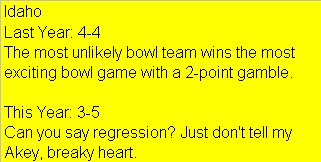
Idaho
The Progression of Nate Enderle
One of the biggest reasons for Idaho's jump from WAC afterthought (3-21 combined record in 2007 and 2008) to 8-win bowl team has been the progression of quarterback Nate Enderle. As the table below illustrates, Enderle has improved his rate stats with each passing (no pun intended) season.
Not coincidentally, the Idaho offense has also improved. Based on SDPI numbers, the Vandals were 8th in the WAC (a 9-team league) in offense in both 2007 and 2008. With Enderle's significant improvements, the Vandals were 3rd in the league in offense in 2009. That's vital because improvements on defense have not been as forthcoming. The Vandals were 6th in the WAC in defense in 2007, dead last in 2008, and 8th in 2009. Enderle's true level of performance is probably somewhere between his average 2008 and outstanding 2009 numbers. In other words, don't expect another significant jump where he completes 70% of his throws and averages 11 yards per pass.


Louisiana Tech
Got a Livas One
The Bulldogs have a very special player in lilliputian receiver Phillip Livas. During his 3 years in Ruston, Livas has been a beast on special teams. His career punt return average is 12.94 yards and his career kickoff return average is 26.33. He has brought 3 punts and 3 kickoffs back for touchdowns in his career, giving him 6 total special teams touchdowns. Ironically, he has 7 offensive (rushing and receiving) touchdowns in his career.


New Mexico State
Tough Transition
The New Mexico State Aggies didn't experience any overall success under former disgraced Kentucky coach and Mike Leach tutor Hal Mumme. The Aggies were 11-38 under Mumme's reign (2005-2008), which is actually worse than they were in the previous 4 seasons under Tony Samuel (20-27 from 2001-2004). However, if there is one thing the Aggies did well under Mumme, it was throw the forward pass. Take a look at the table below.The Aggies completed nearly 2/3rds of their passes in Mumme's tenure. If we remove his first season, during which time he had to totally revamp the offense, that completion percentage jumps to 68.5%! Mumme's teams also scored often via the pass. His 4 teams averaged 26 touchdowns passes per season, and again if we remove the first year, those numbers jump to 29 per season. Suffice it to say, the Aggies had a little drop off in the passing game in 2009. Under new coach DeWayne Walker, the Aggies completed less than half their passes and managed only 6 scoring tosses all season. Of course, Walker did win 3 games in his first season at the helm (Mumme went winless in his first), and also beat New Mexico (something Mumme did not accomplish in his tenure).


Nevada
Running Down a Dream
Last season, Nevada did something rather unprecedented in college football. They produced three 1000-yard rushers. Of course, this doesn't mean they were the best rushing team of all time, or even last season. It's more of a statistical anomaly. Nevada rushed for nearly 4500 yards as a team last season. What was unique about last year's team was not the total amount of yards, but the distribution of those yards, and the football fan's natural obsession with milestone numbers. If instead of three 1000-yard men, the Wolfpack had produced a pair of 1000-yard rushers and four players who gained at least 400 yards, the net results would have been about the same. However, it is interesting that Nevada produced three 1000-yard backs after only producing 4 over the previous 5 seasons (2004-2008).


San Jose State
Running Down a Dream Part II
Dick Tomey took over the San Jose State Spartans prior to the 2005 football season and led them to their first bowl game since 1990 in 2006. Fresh off a 9-win season, one would assume the Spartans would play in a few more bowls before Tomey retired. Alas, while the Spartan defense played well (by WAC standards) the next two seasons, the offense imploded and the team went 5-7 and 6-6 with no bowl bids. The defense proceeded to implode in 2009 and the offense continued to get worse resulting in a 2-10 campaign. Tomey stepped down in the midst of the lost season. Perhaps the biggest culprit in San Jose State's offensive ineptitude has been the disappearance of their running game.In 2006, Yonus Davis rushed for over 1000 yards at over 6 yards a pop. Since then, the Spartans have struggled to find a feature back or come close to having a top-flight running game. While the yards per rush compiled by Davis and Muldrow in 2008 and 2009 look gaudy, keep in mind that the median yards per rush average by the top-100 running backs has been between 5.36 and 5.84 yards since 2006. Thus Davis and Muldrow were actually between .75 and a whole yard below average when toting the ball in 2008 and 2009.


Utah State
Logan's Run
For Utah State, a team without a winning record since 1997 and owner of just a pair of bowl berths since 1961, there is reason for optimism heading into 2010. The man who could lead the Aggies to their first postseason appearance since 1997 is quarterback Diondre Borel. Borel came to Utah State as a wide receiver, but was converted to quarterback prior to the 2008 season. He split time with senior Sean Setzer in 2008, but managed to wrest the job away by midseason. While his passing numbers were relatively mild (56% completion, 11 touchdowns, 10 interceptions), he added another dimension on the ground, leading the Aggies with 627 yards rushing. Borel improved substantially last season, completing 58.5% of his passes, while throwing 17 touchdowns and just 4 interceptions. He also added 458 yards on the ground, cementing his status as a solid dual-threat quarterback. While one could expect his interception numbers to total more than 4 in 2010 (his completion percentage does not depict a pinpoint passer), Borel should be able to keep the Aggies in most of their WAC games with his arm and legs.

Tuesday, August 10, 2010

Mountain West Preview

Just 23 more days until all our mortal troubles are over. Well, maybe not quite, but still, the long and arduous offseason is almost over. And just in time too, as the season previews are hitting the home stretch. Thus far, we've looked at the 6 BCS conferences and now we turn our attention to a conference that could conceivably receive an automatic BCS bid in the next round of BCS negotiations. If you want some insight into how I arrived at these numbers, take a look at the ACC Preview. Come back in a few days for the WAC Preview.

Mountain West Projections


Air Force
Beat the Teams You Should
Since taking over as head coach prior to the 2007 season, Troy Calhoun has led the Falcons to 3 straight bowl games and a conference record of 16-8. The Falcons are the only team besides the Big 3 (BYU, TCU, and Utah) to post at least a .500 conference record in all 3 seasons, and they have the 4th best conference record in that span. They have been able to do this despite only going a combined 2-7 versus the Big 3 (beat both TCU and Utah in 2007). They have accomplished this by owning the rest of the conference.Their only loss to teams beside BYU, TCU, or Utah came in 2007 at New Mexico.


BYU
Helter Skelter
In 2008, BYU became only the second team since 2006 to have a game where they were at least +6 in turnovers margin and a game where they were at least -6 in turnover margin during the same season. BYU shut out Wyoming 44-0 when they forced 6 turnovers and did not commit one against the Cowboys. 2 months later, they coughed up 6 turnovers and did not force a single one when they fell to arch-rival Utah 48-24.


Colorado State
How Bad are Winless Teams?
I know what you're thinking. This is a worthless post. Winless teams all suck, else they wouldn't be winless. Bare with me for a moment though. First some caveats. By winless, I don't necessarily mean a winless regular season. I'm referring to a winless conference campaign, which Colorado State suffered through in 2009. The Rams actually began the season with 3 straight wins, including one over a BCS-conference foe (Colorado) and one over a bowl team (Nevada). The Rams then proceeded to lose 9 straight games, with 8 of them coming in Mountain West play. Take a look at the chart below. It lists the 12 IA teams that went winless in conference play from 2006-2008. First though, I'll define some of the columns. 'Pt Dif' stands for point differential and is the amount by which a team was outscored in their respective conference season. 'Pythag %' is the estimated Pythagorean winning percentage of each team in conference play. The Pythagorean winning percentage is a method developed by Bill James to estimate a baseball team's record based on their runs scored and runs allowed. Here's the link to the baseball formula. For the nerds and mathematicians out there, the exponent used here is 2.37. Since the Pythagorean winning percentage estimates a teams wins by taking into account the ratio of a team's scoring, it is usually a better indicator of strength (or lack thereof) than point differential. Take Florida International (FIU) from 2006 for example. Their scoring margin of -118 is very respectable for a team that went winless (3rd best differential of winless teams), but the Panthers only scored 54 points against the Sun Belt that season. Thus when compared to the 172 points they allowed, their Pythagorean winning percentage of .060 ranks 2nd to last. 'SDPI Rank' is the team's rank in SDPI (yardage version) in their conference. If you don't know what SDPI is, just scroll through some of the archives. I've written at length about it. 'Close Rec' is the team's record in one-score conference games (those decided by 8 points or less). 'Next Yr' is the team's conference record the following season. Teams with an asterisk (*) played in a bowl game the following season.
So how does Colorado State compare to these 12 teams? Pretty favorably. Their point differential (-118) would put them tied for 3rd, their Pythagorean winning percentage (.210) would rank 4th, and their SDPI rank of 6th in the Mountain West (9 teams) tops any other teams SDPI finish. 2 of the 3 teams with similar profiles to Colorado State (both iterations of SMU and Minnesota) went to bowl games the following season. It's not a sure thing that the Rams will be bowling in 2010, but the odds are better than you would think for a team coming off a winless conference season.


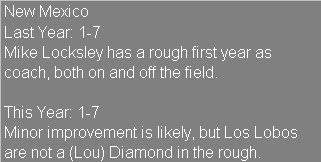
New Mexico
The Long Road Back to Respectability
Under former head coach Rocky Long, New Mexico had developed into a solid mid-major football team. They were not going to beat many BCS-conference teams in the non-conference schedule, but they were going to finish .500 or better in their own league and routinely compete for a bowl bid. Long coached the Lobos from 1998-2008, and qualified for bowl games 5 times, with all 5 coming in his final 7 seasons. Unfortunately, his successor Mike Locksley was not able to build upon his success. The Lobos went 1-11 in 2009, their worst record since going 2-10 in 1990. Not only did the Lobos lose a lot of games, they were also not terribly competitive in those losses. 8 of the 10 losses came by double digits and 4 came by 30 or more points. As a point of reference, Long's New Mexico teams lost 8 games by 30 or more points in his 11 seasons at the helm.


San Diego State
The Last Don
In their first year playing football at the IA level, the San Diego State Aztecs, coached by Don Coryell went 11-0. Coryell had been coaching the team since 1961 and had compiled a 68-11-2 at the small college level. In his 4 seasons coaching the Aztecs at the IA level, he never endured a losing season and posted an overall record of 36-8, with 3 PCAA (later Big West) conference titles. He would later go to have much success in the NFL as coach of the St Louis (don't call us Arizona) Cardinals and then the San Diego Chargers. After Coryell's departure, the Aztecs continued to enjoy success into the 80's under head coach Claude Gilbert, finishing with a 61-26-2 record in his 8 seasons. However, since Gilbert's ouster following only his second losing season in 1980, the Aztecs have struggled. They have gone through 6 coaches (Brady Hoke is currently coach #7) and only one, Al Luginbill has left with a winning record. What is even more amazing, is that if we only count Coryell's 36-8 record as Aztec coach once they moved to IA (and ignore his sterling 68-11 record prior), he still ranks 3rd on the all-time Aztec coaching wins list, behind Gilbert (61) and Ted Tollner (43).


TCU
The 'Normal' League
2009 marked a rare occurrence in college football. For the first time in a good while (at least since 2001), a conference finished with a perfectly 'normal' distribution of wins. If you were to graph the record of each team, you would have a perfect bell curve. TCU beat everyone. BYU beat everyone save TCU. Utah beat everyone save TCU and BYU, and so on, right down to Colorado State who beat no one.


UNLV
From Big Brother to Little Brother
The past 10 years were not exactly kind to the former Runnin' Rebels of UNLV. The Rebs posted just one winning season this decade and at one point in the middle of the aughts won 2 games for 4 straight seasons. They got a Hall of Fame coach canned (John Robinson) and ensured Mike Sanford will probably never get another head coaching gig. New head coach Bobby Hauck has quite a task in front of him, but one of the first tasks on his agenda should be beating the only other in-state IA school, Nevada. The Nevada Wolfpack brought back their own Hall of Fame coach, Chris Ault, prior to the 2004 season, and have been a perennial bowl threat since. In addition, they have also sprinted past their in-state rivals, both head-to-head and overall. Take a look at the table below.As you can see, neither team was burning up the football world in the early part of the decade. Both schools were also-rans in their respective conferences, but UNLV was a little better. However, over the past 5 seasons, its been no contest. UNLV has barely won a quarter of their games while Nevada has won nearly 60% while going to 5 straight bowl games. Now here's how the 2 teams have done head-to-head.UNLV won 5 straight games from 2000-2004, and Nevada never scored more than 17 points in either of the 5 games. Since 2005, Nevada has now won 5 in a row, never scoring fewer than 22 points in any single game. In fact, in their last meeting, Nevada scored more points (63) than they did in the entire series from 2000-2004.


Utah
Bowled Over
Since taking over the Utah program after Urban Meyer headed east for Gainesville following the 2004 season, Kyle Whittingham has been pretty successful. He's won at least 7 games each season, compiled a 47-17 record, and had the Utes as the lone unbeaten team in college football in 2008. However, his crowning achievement may be that he has won all 5 of his bowl games, with 3 coming against BCS schools (in which Utah was at least a marginal if not prohibitive underdog). Of course, this is nothing new for Utah. In his 2 seasons at the helm, Urban Meyer took the Utes to consecutive bowl games, including the Fiesta Bowl following the 2004 season. The Utes won both games, culminating with a systematic dismantling of Pitt in that Fiesta Bowl. Prior to Urban's arrival, the Utes won their final 2 bowl games of the Ron McBride era (2001 and 1999), beating Southern Cal from the Pac-10 in the 2001 Las Vegas Bowl. To recap, the Utes have won 9 straight bowl games, with 5 of them coming against teams from BCS conferences. Keep this in mind if you plan on making any wagers in the bowl season.


Wyoming
Winning Without an Offense
Last season, Wyoming managed a 7-6 record despite averaging only 18.3 points per game. That small figure ranked 109th in the nation. To calculate the average number of games a team with that type of offense usually wins, I looked at the record for each team ranked between 106th and 112th in scoring offense (3 teams above and below 109th) since 2007 (excluding last year's Wyoming). Those 20 teams combined for a record of 70-171, or roughly 3.5 wins over a 12 game regular season. No other team besides Wyoming finished with a winning record, and only 3 finished with at least 6 wins. Iowa went 6-6 in 2007, San Jose State went 6-6 in 2008, and Miami of Ohio went 6-6 in the 2007 regular season, but lost the MAC Championship Game to finish 6-7. The Cowboys were certainly in a league of their own when it came to winning without scoring.