Over the past three seasons, 210 teams have participated in bowl games.
47 of those teams had losing records in the years immediately preceding
their bowl game. This semi-regular piece will showcase the losers from
2013 who just might find themselves participating in Capital One Bowl
Week in 2014. In this installment, we head to the west Texas town of El Paso.
UTEP
2013 Record: 2-10 (1-7 Conference USA)
Summary:
After nine years and moderate success (three bowl appearances) under Mike Price, the Miners began a new era in 2014 when Sean Kugler took the reigns. The Miners opened 2013 with a high-scoring loss to New Mexico and followed that up with a high-scoring win over New Mexico State, giving them an even record against teams from the Land of Enchantment. 1-1 was as good as it would get for the Miners in 2013. They lost nine of their final ten games with each defeat save one, a 38-35 loss to Louisiana Tech, coming by double digits. The Miners did pound Florida International to earn their second win of the year in mid-November, but the season's shining moment may have been when they gained an early 7-0 lead on Johnny Manziel and Texas A&M in College Station. Alas, the Aggies scored the final 57 points of the game and were not seriously challenged.
What Did the Miners Do Well?
Beat the teams they were better than. No doubt about it, UTEP was awful in 2013. They ranked 116th in the Simple Rating System (SRS) metric. Only two teams on their schedule, New Mexico State and Florida International, were worse based on the SRS. UTEP pummeled those teams by a combined 44 points. They didn't win any other games, but they crushed the teams they were better than. Go Miners!
What Didn't the Miners Do Well?
Play defense. UTEP played twelve games in 2013. In eleven of those games, their opponents averaged at least six and a half yards per play. Only Florida International failed to bury the UTEP defense. The Miners also allowed at least 32 points in ten of their twelve games. Perhaps not surprisingly, in the two games where they held their opponents under 30, they won.
The Miners Over the Past Four Years:
The following table lists UTEP's performance (in conference play only)
in a few key categories and their respective conference rank in those
categories. To help you read the table here is a handy translator.
Conf: The Conference UTEP played in. With the ever-changing college football landscape, this is helpful.
Coach: Who was leading these yahoos into battle?
Rec: Conference Record
YPP: Yards per play. The number of yards per play the Miners averaged in conference play.
YPA: Yards per play allowed. The number of yards per play the Miners allowed in conference play.
Net: Yards per play net. The difference in YPP and YPA. Higher is better.
OTD: Offensive touchdowns. Touchdowns scored by the offense (no
kick, punt, interception, or other returns are counted) in conference
play.
DTD: Defensive touchdowns. Touchdowns allowed by the defense (no
kick, punt, interception, or other returns are counted) in conference
play.
Pythag: Adjusted Pythagorean Record. Take offensive touchdowns
and defensive touchdowns and plug them into a handy formula to estimate
the number of conference wins. For a full rundown of the APR, continue reading here.
As you can see from the table, UTEP has not been particularly good, even within the confines of Conference USA over the past four seasons. In their lone bowl season of 2010, UTEP leveraged an incredibly easy schedule to a bowl invitation. Their six wins that season came over Arkansas-Pine Bluff (IAA), New Mexico State (2-10 record), New Mexico (1-11), Memphis (1-11), Rice (4-8), and SMU (7-7). Plus, they also lost to esteemed outfits like UAB (4-8), Tulane (4-8), Houston (5-7), and Marshall (5-7). The Miners continued their below average play over the final two seasons of the Mike Price regime, but nearly garnered another bowl invitation in 2011 before losing four of their final five games to finish 5-7. The bottom continued to fall out under Sean Kugler, as UTEP posted their worst statistical season in a decade. We need to give Kugler a few years to right the proverbial ship, but early returns were not promising.
The 2014 Schedule:
Outside of Conference USA, UTEP plays a pair of familiar foes. The Miners have played some combination of New Mexico or New Mexico State each season since 2003. In that span, the Miners have been pretty successful against both schools, posting a stellar 8-2 mark against New Mexico State and a 3-2 record against New Mexico. In 2014, the Miners host the Aggies (State) and travel to Albuquerque to take on the Lobos. In their other two non-conference games, the Miners also have a home/road split, but these two figure to be tougher, as both teams come from the Big 12. The Miners visit Bill Snyder and Kansas State while hosting Ryan Gosling lookalike Kliff Kingsbury and Texas Tech. A split of those four games would be about the best UTEP could hope for and a 1-3 or even 1-4 mark would not be surprising. In conference play, the Miners host IA neophyte Old Dominion, Middle Tennessee, North Texas, and Southern Miss. Two of those teams were bowl eligible last season (Middle Tennessee and North Texas), while Old Dominion went 8-4 as they transitioned to IA football, and Southern Miss won the conference just three short years ago. The Miners will probably win at least one of their home games, but they could be betting underdogs in each one. When they hit the road in conference play, they will meet Louisiana Tech, Rice, Texas-San Antonio, and Western Kentucky. Rice, Texas-San Antonio, and Western Kentucky all finished with winning records last season and Louisiana Tech has won 21 games over the past three seasons. Suffice it to say, if UTEP posts a strong (or even mediocre) record in 2014, they will have earned it.
Reason for Optimism:
Jameill Showers. For those who may not know, Showers was beaten out by Johnny Manziel as the starting quarterback for Texas A&M prior to the 2012 season. Showers transferred to UTEP and posted decent numbers for the Miners before an injury against Rice in the seventh game forced him to miss the rest of the season. In the three conference games Showers saw significant action in, the Miners averaged 4.87 yards per play. Those are hardly imposing numbers. However, in the five games where he saw little to no action, the team averaged just 4.81 yards per play. If we ignore the victory over Florida International, the Miners averaged just 4.33 yards per play in conference games during which Showers did not participate or participated sparingly. If Showers can improve and stay healthy during his second season in El Paso, the Miner offense could conceivably move to middle of the pack in Conference USA.
Final Prognosis:
UTEP has not finished with a winning record since 2005, and that trend appears likely to continue nearly a decade later in 2014. The non-conference schedule, featuring a pair of Big 12 teams, is not conducive for a great start. There are also no IAA opponents on the slate, and while New Mexico and New Mexico State have struggled mightily in recent years, the Lobos actually beat the Miners last season. Even if the Miners beat both New Mexico teams, they would still need to break even in Conference USA to even qualify for a bowl. Five of their eight conference opponents were bowl eligible last season and Old Dominion has been a IAA power under Bobby Wilder and appears poised to make the most of their jump to IA. Finally, the two lightweights on their conference slate, Louisiana Tech and Southern Miss, have tasted success in the not too distant past, with both winning league crowns in 2011. I think the 2014 season has to be dubbed a success (or at least a mark of progress) if the Miners can double up last season's win total and earn a quartet of victories.
I use many stats. I use many stats. Let me tell you, you have stats that are far worse than the ones that I use. I use many stats.
Monday, June 23, 2014
Sunday, June 08, 2014
Even the Losers: Kent State
Over the past three seasons, 210 teams have participated in bowl games.
47 of those teams had losing records in the years immediately preceding
their bowl game. This semi-regular piece will showcase the losers from
2013 who just might find themselves participating in Capital One Bowl
Week in 2014. For our fourteenth installment, we will finally touch on the Mid-American Conference and the Kent State Golden Flashes.
Kent State
2013 Record: 4-8 (3-5 MAC)
Summary:
Fresh off their first bowl appearance since the Nixon administration, Kent State began 2013 with a new coach as Paul Haynes took over for Darrell Hazell, who migrated to Purdue after the successful. 2012 campaign. The Golden Flashes opened 2013 in rather inauspicious fashion, edging IAA Liberty 17-10. The Golden Flashes quickly turned their attention to MAC play the following week, when they hosted eventual MAC champion Bowling Green. The Falcons dimmed the Flashes 41-22. Even a Kent State homer realized the next two games would be ugly. And said homer would have been eerily prescient as LSU and Penn State beat the Golden Flashes by a combined score of 79-13. The Golden Flashes returned to MAC play the following week and unloaded their frustrations on Western Michigan in a 32-14 win. Entering October, the Golden Flashes were 2-3, but with a 1-1 league mark, still had designs on a solid finish and potential bowl bid. Alas, they would not win another game until after Veteran's Day, losing five consecutive games with three coming by double-digits. At 2-8, the Flashes had every right to phone it in and prepare for 2014, but they bludgeoned Miami of Ohio and Ohio by a combined score of 68-19 to end their season on a positive note.
What Did the Golden Flashes Do Well?
Not much. Kent State was not a terrible team in 2013, but they were embarrassingly mediocre in the MAC and nationally on both sides of the ball. As a cop out, why don't we go with make extra points. The Golden Flashes converted on each of their 29 extra points in 2013, becoming one of 37 teams to finish with a flawless extra point game. As an added bonus, they were also successful on both their two-point conversion attempts, proving that on untimed plays, the Flashes were fantastic.
What Didn't the Golden Flashes Do Well?
Kick field goals. While Kent State's kickers Anthony Melchiori and Brad Miller made all their extra points, they did not do so well when it came to making kicks worth three times as many points. As a team, the Golden Flashes made just 10 of 18 field goal attempts on the season. Their field goal percentage, just south of 56%, ranked 113th nationally in 2013.
The Golden Flashes Over the Past Four Years:
The following table lists Kent State's performance (in conference play only) in a few key categories and their respective conference rank in those categories. To help you read the table here is a handy translator.
Conf: The Conference Kent State played in. With the ever-changing college football landscape, this is helpful.
Coach: Who was leading these yahoos into battle?
Rec: Conference Record
YPP: Yards per play. The number of yards per play the Golden Flashes averaged in conference play.
YPA: Yards per play allowed. The number of yards per play the Golden Flashes allowed in conference play.
Net: Yards per play net. The difference in YPP and YPA. Higher is better.
OTD: Offensive touchdowns. Touchdowns scored by the offense (no kick, punt, interception, or other returns are counted) in conference play.
DTD: Defensive touchdowns. Touchdowns allowed by the defense (no kick, punt, interception, or other returns are counted) in conference play.
Pythag: Adjusted Pythagorean Record. Take offensive touchdowns and defensive touchdowns and plug them into a handy formula to estimate the number of conference wins. For a full rundown of the APR, continue reading here.
In 2010 and 2011, first under Doug Martin, and then under Darrell Hazell, the Golden Flashes fielded a phenomenal mid-major defense, but could not get over the proverbial hump thanks to some major incompetence on offense. The Golden Flashes fielded those strong defenses with the aid of just a single (thus far) NFL player, Ishmaa'ily Kitchen, a defensive lineman. That number may soon double with Roosevelt Nix, an undrafted defensive lineman who was signed by the Atlanta Falcons. In 2012, the offense roared to life, and while the defense regressed from superb to solid, the Golden Flashes enjoyed a dream season. As you can tell by the numbers though, the Golden Flashes were not quite as good as their undefeated record would indicate. A host of factors conspired to allow them to contend for a BCS bowl. For starters, they boasted an in-conference turnover margin of +9 which was second in the MAC. They also scored six unconventional (or non-offensive) touchdowns in their eight conference games. The electrifying Dri Archer (who makes defenses quiver) returned two kickoffs for touchdowns in MAC action (he added a third against Towson), the defense returned a pair of interceptions for touchdowns, and also a pair of fumbles, giving the Golden Flashes an additional three quarters of a touchdown per game over their MAC schedule. While huge plays by special teams and defense are certainly vital to winning football games, they are highly volatile and unpredictable events. Case in point, the team scored just one non-offensive touchdown in 2013 (another kickoff return by Archer). Thus, while the Golden Flashes were certainly a worse team in 2013, the drop off from their magical 2012 season was not as pronounced as the won/loss record would indicate.
The 2014 Schedule:
In non-conference play, the Golden Flashes can prepare for at least a pair of losses, as they travel to Ohio State and Virginia. The Ohio State game is a lost cause, and while a MAC team did beat Virginia in Charlottesville last year, the Cavaliers should be improved this season, and it would be hard to imagine it happening in consecutive years. Plus, the Golden Flashes are just 2-19 against BCS conference opponents in the last decade. In their other two non-conference games, Kent State will host Army and South Alabama. Kent State and Army have played three times in the past eight years, with Kent State winning the most recent edition in 2012. They have also played the Jaguars from South Alabama twice in the past three seasons, losing to them last season in Mobile, and beating the Jaguars (when they were still a IAA team) in 2011. Kent State should be favored over Army, but the South Alabama game is intriguing. In just their second year of IA football, the Jaguars finished 6-6 last season, with wins over the aforementioned Kent State, as well as bowl bound squads Tulane and Louisiana-Lafayette. The game is in Ohio, but Kent State will likely not be an overwhelming favorite. A 2-2 record in non-conference action should please even the most optimistic Kent State supporter. In conference play, the Golden Flashes host Akron, Massachusetts, Ohio, and Toledo. As far as home schedules go, that one is pretty solid. A 3-1 mark at home would not be surprising. However, their road schedule is a different matter. The Golden Flashes face last season's two MAC title game participants (Bowling Green and Northern Illinois) on the road, as well as another bowl participant (Buffalo), and Miami. The Golden Flashes will likely be underdogs, and perhaps prohibitively, in three of those games.
Reason for Optimism:
The Golden Flashes weren't that bad last year. Sure Kent State was noncompetitive against LSU and Penn State, but most MAC schools would struggle just as much against those two teams. In conference play, based on the number of touchdowns scored and allowed, the Golden Flashes should have finished with an additional conference win. Plus, the Golden Flashes did all this with a freshman under center and with Dri Archer limited by injuries. Last season's Kent State squad was on par with the 2010 and 2011 teams, so its not like they have a huge hole to climb out of to return to contention.
Final Prognosis:
We'll know early on in 2014 if Kent State has legitimate bowl aspirations in 2014. They open with a pair of home games, against Ohio and South Alabama. Win them both and a bowl game appears a likely proposition. Split the pair, and the Golden Flashes probably top out at 6-6. Lose them both, and it is probably time to start looking forward to 2015. The big key for 2014 will be how Kent State plays at home. The Golden Flashes play six home games, and if they can sweep both Army and South Alabama in non-conference play, they would only need to get win four league games to qualify for a bowl. I'm thinking in the ten games not involving Ohio State and Virginia, the Golden Flashes win six of them. That will get them to bowl eligibility, but a bowl bid will depend on how the other MAC schools perform.
Kent State
2013 Record: 4-8 (3-5 MAC)
Summary:
Fresh off their first bowl appearance since the Nixon administration, Kent State began 2013 with a new coach as Paul Haynes took over for Darrell Hazell, who migrated to Purdue after the successful. 2012 campaign. The Golden Flashes opened 2013 in rather inauspicious fashion, edging IAA Liberty 17-10. The Golden Flashes quickly turned their attention to MAC play the following week, when they hosted eventual MAC champion Bowling Green. The Falcons dimmed the Flashes 41-22. Even a Kent State homer realized the next two games would be ugly. And said homer would have been eerily prescient as LSU and Penn State beat the Golden Flashes by a combined score of 79-13. The Golden Flashes returned to MAC play the following week and unloaded their frustrations on Western Michigan in a 32-14 win. Entering October, the Golden Flashes were 2-3, but with a 1-1 league mark, still had designs on a solid finish and potential bowl bid. Alas, they would not win another game until after Veteran's Day, losing five consecutive games with three coming by double-digits. At 2-8, the Flashes had every right to phone it in and prepare for 2014, but they bludgeoned Miami of Ohio and Ohio by a combined score of 68-19 to end their season on a positive note.
What Did the Golden Flashes Do Well?
Not much. Kent State was not a terrible team in 2013, but they were embarrassingly mediocre in the MAC and nationally on both sides of the ball. As a cop out, why don't we go with make extra points. The Golden Flashes converted on each of their 29 extra points in 2013, becoming one of 37 teams to finish with a flawless extra point game. As an added bonus, they were also successful on both their two-point conversion attempts, proving that on untimed plays, the Flashes were fantastic.
What Didn't the Golden Flashes Do Well?
Kick field goals. While Kent State's kickers Anthony Melchiori and Brad Miller made all their extra points, they did not do so well when it came to making kicks worth three times as many points. As a team, the Golden Flashes made just 10 of 18 field goal attempts on the season. Their field goal percentage, just south of 56%, ranked 113th nationally in 2013.
The Golden Flashes Over the Past Four Years:
The following table lists Kent State's performance (in conference play only) in a few key categories and their respective conference rank in those categories. To help you read the table here is a handy translator.
Conf: The Conference Kent State played in. With the ever-changing college football landscape, this is helpful.
Coach: Who was leading these yahoos into battle?
Rec: Conference Record
YPP: Yards per play. The number of yards per play the Golden Flashes averaged in conference play.
YPA: Yards per play allowed. The number of yards per play the Golden Flashes allowed in conference play.
Net: Yards per play net. The difference in YPP and YPA. Higher is better.
OTD: Offensive touchdowns. Touchdowns scored by the offense (no kick, punt, interception, or other returns are counted) in conference play.
DTD: Defensive touchdowns. Touchdowns allowed by the defense (no kick, punt, interception, or other returns are counted) in conference play.
Pythag: Adjusted Pythagorean Record. Take offensive touchdowns and defensive touchdowns and plug them into a handy formula to estimate the number of conference wins. For a full rundown of the APR, continue reading here.
In 2010 and 2011, first under Doug Martin, and then under Darrell Hazell, the Golden Flashes fielded a phenomenal mid-major defense, but could not get over the proverbial hump thanks to some major incompetence on offense. The Golden Flashes fielded those strong defenses with the aid of just a single (thus far) NFL player, Ishmaa'ily Kitchen, a defensive lineman. That number may soon double with Roosevelt Nix, an undrafted defensive lineman who was signed by the Atlanta Falcons. In 2012, the offense roared to life, and while the defense regressed from superb to solid, the Golden Flashes enjoyed a dream season. As you can tell by the numbers though, the Golden Flashes were not quite as good as their undefeated record would indicate. A host of factors conspired to allow them to contend for a BCS bowl. For starters, they boasted an in-conference turnover margin of +9 which was second in the MAC. They also scored six unconventional (or non-offensive) touchdowns in their eight conference games. The electrifying Dri Archer (who makes defenses quiver) returned two kickoffs for touchdowns in MAC action (he added a third against Towson), the defense returned a pair of interceptions for touchdowns, and also a pair of fumbles, giving the Golden Flashes an additional three quarters of a touchdown per game over their MAC schedule. While huge plays by special teams and defense are certainly vital to winning football games, they are highly volatile and unpredictable events. Case in point, the team scored just one non-offensive touchdown in 2013 (another kickoff return by Archer). Thus, while the Golden Flashes were certainly a worse team in 2013, the drop off from their magical 2012 season was not as pronounced as the won/loss record would indicate.
The 2014 Schedule:
In non-conference play, the Golden Flashes can prepare for at least a pair of losses, as they travel to Ohio State and Virginia. The Ohio State game is a lost cause, and while a MAC team did beat Virginia in Charlottesville last year, the Cavaliers should be improved this season, and it would be hard to imagine it happening in consecutive years. Plus, the Golden Flashes are just 2-19 against BCS conference opponents in the last decade. In their other two non-conference games, Kent State will host Army and South Alabama. Kent State and Army have played three times in the past eight years, with Kent State winning the most recent edition in 2012. They have also played the Jaguars from South Alabama twice in the past three seasons, losing to them last season in Mobile, and beating the Jaguars (when they were still a IAA team) in 2011. Kent State should be favored over Army, but the South Alabama game is intriguing. In just their second year of IA football, the Jaguars finished 6-6 last season, with wins over the aforementioned Kent State, as well as bowl bound squads Tulane and Louisiana-Lafayette. The game is in Ohio, but Kent State will likely not be an overwhelming favorite. A 2-2 record in non-conference action should please even the most optimistic Kent State supporter. In conference play, the Golden Flashes host Akron, Massachusetts, Ohio, and Toledo. As far as home schedules go, that one is pretty solid. A 3-1 mark at home would not be surprising. However, their road schedule is a different matter. The Golden Flashes face last season's two MAC title game participants (Bowling Green and Northern Illinois) on the road, as well as another bowl participant (Buffalo), and Miami. The Golden Flashes will likely be underdogs, and perhaps prohibitively, in three of those games.
Reason for Optimism:
The Golden Flashes weren't that bad last year. Sure Kent State was noncompetitive against LSU and Penn State, but most MAC schools would struggle just as much against those two teams. In conference play, based on the number of touchdowns scored and allowed, the Golden Flashes should have finished with an additional conference win. Plus, the Golden Flashes did all this with a freshman under center and with Dri Archer limited by injuries. Last season's Kent State squad was on par with the 2010 and 2011 teams, so its not like they have a huge hole to climb out of to return to contention.
Final Prognosis:
We'll know early on in 2014 if Kent State has legitimate bowl aspirations in 2014. They open with a pair of home games, against Ohio and South Alabama. Win them both and a bowl game appears a likely proposition. Split the pair, and the Golden Flashes probably top out at 6-6. Lose them both, and it is probably time to start looking forward to 2015. The big key for 2014 will be how Kent State plays at home. The Golden Flashes play six home games, and if they can sweep both Army and South Alabama in non-conference play, they would only need to get win four league games to qualify for a bowl. I'm thinking in the ten games not involving Ohio State and Virginia, the Golden Flashes win six of them. That will get them to bowl eligibility, but a bowl bid will depend on how the other MAC schools perform.
Wednesday, May 28, 2014
Even the Losers: Utah
Over the past three seasons, 210 teams have participated in bowl games.
47 of those teams had losing records in the years immediately preceding
their bowl game. This semi-regular piece will showcase the losers from
2013 who just might find themselves participating in Capital One Bowl
Week in 2014. For our lucky thirteenth installment, I will finally shed my east coast bias and examine a Pac-12 team, the Utah Utes.
Utah
2013 Record: 5-7 (2-7 Pac-12)
Summary:
Coming off their first losing season since 2002, the Utah Utes began 2013 with an impressive home win over in-state rival and mid-major up and up-and-comer Utah State. They followed that up with an expected thrashing of IAA Weber State. Standing at 2-0, the Utes hosted Oregon State and fell in an overtime thriller 51-48. They rebounded and beat their big rival BYU the following weekend, marking their fourth consecutive win over the Cougars. They lost at home on Thursday night twelve days later when quarterback Travis Wilson threw six interceptions. Standing 0-2 in Pac-12 play the Utes pulled off a huge upset by beating Stanford in their next game. The win moved them to 4-2 overall, but after playing five of their first six games in the friendly confines of Rice-Eccles Stadium, four of their final six would be on the road. The Utes were not up to the road challenge, losing five consecutive games to fall out of bowl contention before beating listless Colorado in the season finale.
What Did the Utes Do Well?
Play well at home. While they only managed a 4-3 mark at home, including just a .500 record against IAA teams, the Utes beat a quality Utah State team and the eventual Pac-12 champion Stanford in Salt Lake City. Their three home losses all came by seven points or fewer, and each came to teams that qualified for bowls. Their loss to Oregon State was in overtime, their loss to UCLA was by just a touchdown despite six turnovers, and their loss to Pac-12 South champ Arizona State came by just a single point. By contrast, the Utes won just once on the road and each of their four road defeats came by at least eleven points.
What Didn't the Utes Do Well?
Protect the football. One of the main reasons for Utah's 2-7 league mark was their league-high 24 turnovers in Pac-12 play. The Utes were tied with Washington State for the most turnovers within the conference but the Cougars at least ran about 50 more plays over the course of the nine-game conference season. I've already highlighted their six-turnover debacle against UCLA, but they also coughed the ball up three times in the overtime loss to Oregon State (while forcing none of their own), three times in their close win over Colorado, and four times in their loss to Southern Cal.
The Utes Over the Past Four Years:
The following table lists Utah's performance (in conference play only) in a few key categories and their respective conference rank in those categories. To help you read the table here is a handy translator.
Conf: The Conference Utah played in. With the ever-changing college football landscape, this is helpful.
Coach: Who was leading these yahoos into battle?
Rec: Conference Record
YPP: Yards per play. The number of yards per play the Utes averaged in conference play.
YPA: Yards per play allowed. The number of yards per play the Utes allowed in conference play.
Net: Yards per play net. The difference in YPP and YPA. Higher is better.
OTD: Offensive touchdowns. Touchdowns scored by the offense (no kick, punt, interception, or other returns are counted) in conference play.
DTD: Defensive touchdowns. Touchdowns allowed by the defense (no kick, punt, interception, or other returns are counted) in conference play.
Pythag: Adjusted Pythagorean Record. Take offensive touchdowns and defensive touchdowns and plug them into a handy formula to estimate the number of conference wins. For a full rundown of the APR, continue reading here.
In 2010, the Utes began the year 8-0 and were ranked sixth in the country. In early November, they hosted TCU, ranked fourth at the time, in a pivotal mid-major clash. The Utes lost by 40. If I were a hack journalist, I would tell you that the loss to TCU demoralized the Utah program as they have gone just 20-22 since that great start in 2010. However, a more plausible account is that Utah moved into a more difficult conference and has faced a more arduous schedule. Using the SOS metric at college football reference, Utah has faced a progressively difficult schedule since joining the Pac-12 in 2011, culminating in the nation's most difficult schedule last season as detailed in the following table.
Whether or not you believe Utah absolutely had the most difficult schedule in the nation last year (I do) is not the point. By an objective measure, they had arguably the toughest schedule in the nation and still managed five wins. Replace a few of those Pac-12 squads with some Mountain West punching bags, and voila, welcome back to the postseason.
The 2014 Schedule:
The bad news for Utah fans is that the schedule does not get appreciably easier in 2014. The Utes open with a IAA jobber in Idaho State, but follow that up with a challenging mid-major opponent in Fresno State. The Bulldogs and Utes were once conference mates in the old Western Athletic Conference, but have not played since the 1999 Las Vegas Bowl. After a bye week, the Utes finish up their non-conference schedule by taking a trip to Michigan. The last time the Utes played in the Big House, they won, and finished the season unbeaten and ranked second in the country. You may notice one team conspicuously absent from Utah's non-conference schedule, BYU. The Utes and Cougars will not play this season marking the first time the arch-rivals have not faced off since 1945! Once conference play begins, the Utes will face the same Pac-12 teams they battled last season with the venues inverted. Their four league home games will include Arizona, Oregon, Southern Cal, and Washington State. The Utes lost to all four teams last season, but with the homefield advantage, should be able to find a win or two in 2014. The road schedule includes trips to Arizona State, Colorado, Oregon State, Stanford, and UCLA. The Utes only managed a 2-3 mark against those five teams in Salt Lake City last season, so expecting anything more than a pair of wins on the road might be pushing it.
Reason for Optimism:
The Utes were not that bad in 2013. By the SRS metric, the Utes were the 36th best team in college football last season. By the Sagarin Ratings, they were 34th. They beat three quality teams in BYU, Stanford, and Utah State. Every team they lost to, even Washington State went to a bowl game. That being said, as we already discussed in the section on the 2014 schedule, there are no real breathers on the upcoming slate. The Utes could once again beat a few quality teams, and lose seven games to bowl-eligible teams. The Pac-12 is just that deep. Still, it could be worse. The Utes could be a bad team facing a schedule this daunting.
Final Prognosis:
Will Utah miss out on the postseason for the third consecutive season in 2014 and push head coach Kyle Whittingham closer to the unemployment line? If they do, it would mark the first time they endured such ignominy since they were coached by Jim Fassel. Yes, that Jim Fassel. Moving from the Mountain West to the Pac-12 was always a calculated risk, but to paraphrase Super Chicken: They knew the job was dangerous when they took it. Methinks Utah will finish the 2014 regular season with either five, six, or seven wins depending on in no particular order, the health of quarterback Travis Wilson, their proclivity for turning the ball over, and their record in close game. Were I a betting man, I'd wager on the Utes getting to bowl eligibility, but not much more than that.
Utah
2013 Record: 5-7 (2-7 Pac-12)
Summary:
Coming off their first losing season since 2002, the Utah Utes began 2013 with an impressive home win over in-state rival and mid-major up and up-and-comer Utah State. They followed that up with an expected thrashing of IAA Weber State. Standing at 2-0, the Utes hosted Oregon State and fell in an overtime thriller 51-48. They rebounded and beat their big rival BYU the following weekend, marking their fourth consecutive win over the Cougars. They lost at home on Thursday night twelve days later when quarterback Travis Wilson threw six interceptions. Standing 0-2 in Pac-12 play the Utes pulled off a huge upset by beating Stanford in their next game. The win moved them to 4-2 overall, but after playing five of their first six games in the friendly confines of Rice-Eccles Stadium, four of their final six would be on the road. The Utes were not up to the road challenge, losing five consecutive games to fall out of bowl contention before beating listless Colorado in the season finale.
What Did the Utes Do Well?
Play well at home. While they only managed a 4-3 mark at home, including just a .500 record against IAA teams, the Utes beat a quality Utah State team and the eventual Pac-12 champion Stanford in Salt Lake City. Their three home losses all came by seven points or fewer, and each came to teams that qualified for bowls. Their loss to Oregon State was in overtime, their loss to UCLA was by just a touchdown despite six turnovers, and their loss to Pac-12 South champ Arizona State came by just a single point. By contrast, the Utes won just once on the road and each of their four road defeats came by at least eleven points.
What Didn't the Utes Do Well?
Protect the football. One of the main reasons for Utah's 2-7 league mark was their league-high 24 turnovers in Pac-12 play. The Utes were tied with Washington State for the most turnovers within the conference but the Cougars at least ran about 50 more plays over the course of the nine-game conference season. I've already highlighted their six-turnover debacle against UCLA, but they also coughed the ball up three times in the overtime loss to Oregon State (while forcing none of their own), three times in their close win over Colorado, and four times in their loss to Southern Cal.
The Utes Over the Past Four Years:
The following table lists Utah's performance (in conference play only) in a few key categories and their respective conference rank in those categories. To help you read the table here is a handy translator.
Conf: The Conference Utah played in. With the ever-changing college football landscape, this is helpful.
Coach: Who was leading these yahoos into battle?
Rec: Conference Record
YPP: Yards per play. The number of yards per play the Utes averaged in conference play.
YPA: Yards per play allowed. The number of yards per play the Utes allowed in conference play.
Net: Yards per play net. The difference in YPP and YPA. Higher is better.
OTD: Offensive touchdowns. Touchdowns scored by the offense (no kick, punt, interception, or other returns are counted) in conference play.
DTD: Defensive touchdowns. Touchdowns allowed by the defense (no kick, punt, interception, or other returns are counted) in conference play.
Pythag: Adjusted Pythagorean Record. Take offensive touchdowns and defensive touchdowns and plug them into a handy formula to estimate the number of conference wins. For a full rundown of the APR, continue reading here.
In 2010, the Utes began the year 8-0 and were ranked sixth in the country. In early November, they hosted TCU, ranked fourth at the time, in a pivotal mid-major clash. The Utes lost by 40. If I were a hack journalist, I would tell you that the loss to TCU demoralized the Utah program as they have gone just 20-22 since that great start in 2010. However, a more plausible account is that Utah moved into a more difficult conference and has faced a more arduous schedule. Using the SOS metric at college football reference, Utah has faced a progressively difficult schedule since joining the Pac-12 in 2011, culminating in the nation's most difficult schedule last season as detailed in the following table.
Whether or not you believe Utah absolutely had the most difficult schedule in the nation last year (I do) is not the point. By an objective measure, they had arguably the toughest schedule in the nation and still managed five wins. Replace a few of those Pac-12 squads with some Mountain West punching bags, and voila, welcome back to the postseason.
The 2014 Schedule:
The bad news for Utah fans is that the schedule does not get appreciably easier in 2014. The Utes open with a IAA jobber in Idaho State, but follow that up with a challenging mid-major opponent in Fresno State. The Bulldogs and Utes were once conference mates in the old Western Athletic Conference, but have not played since the 1999 Las Vegas Bowl. After a bye week, the Utes finish up their non-conference schedule by taking a trip to Michigan. The last time the Utes played in the Big House, they won, and finished the season unbeaten and ranked second in the country. You may notice one team conspicuously absent from Utah's non-conference schedule, BYU. The Utes and Cougars will not play this season marking the first time the arch-rivals have not faced off since 1945! Once conference play begins, the Utes will face the same Pac-12 teams they battled last season with the venues inverted. Their four league home games will include Arizona, Oregon, Southern Cal, and Washington State. The Utes lost to all four teams last season, but with the homefield advantage, should be able to find a win or two in 2014. The road schedule includes trips to Arizona State, Colorado, Oregon State, Stanford, and UCLA. The Utes only managed a 2-3 mark against those five teams in Salt Lake City last season, so expecting anything more than a pair of wins on the road might be pushing it.
Reason for Optimism:
The Utes were not that bad in 2013. By the SRS metric, the Utes were the 36th best team in college football last season. By the Sagarin Ratings, they were 34th. They beat three quality teams in BYU, Stanford, and Utah State. Every team they lost to, even Washington State went to a bowl game. That being said, as we already discussed in the section on the 2014 schedule, there are no real breathers on the upcoming slate. The Utes could once again beat a few quality teams, and lose seven games to bowl-eligible teams. The Pac-12 is just that deep. Still, it could be worse. The Utes could be a bad team facing a schedule this daunting.
Final Prognosis:
Will Utah miss out on the postseason for the third consecutive season in 2014 and push head coach Kyle Whittingham closer to the unemployment line? If they do, it would mark the first time they endured such ignominy since they were coached by Jim Fassel. Yes, that Jim Fassel. Moving from the Mountain West to the Pac-12 was always a calculated risk, but to paraphrase Super Chicken: They knew the job was dangerous when they took it. Methinks Utah will finish the 2014 regular season with either five, six, or seven wins depending on in no particular order, the health of quarterback Travis Wilson, their proclivity for turning the ball over, and their record in close game. Were I a betting man, I'd wager on the Utes getting to bowl eligibility, but not much more than that.
Thursday, May 15, 2014
Even the Losers: Arkansas
Over the past three seasons, 210 teams have participated in bowl games.
47 of those teams had losing records in the years immediately preceding
their bowl game. This semi-regular piece will showcase the losers from
2013 who just might find themselves participating in Capital One Bowl
Week in 2014. In our twelfth installment, we an examine our first SEC team, Arkansas.
Arkansas
2013 Record: 3-9 (0-8)
Summary:
While the 2013 season was among the worst in recent Arkansas history, the Razorbacks opened the year with perhaps their best performance in beating a bowl bound Louisiana-Lafayette squad by 20 points. They followed that up with a closer than expected win over IAA Samford (but no son) and won their final game of the season the following week against a Southern Miss team in the throes of a 23-game losing streak. In their final non-conference game, Arkansas raced out to a 17-point third quarter lead, but Rutgers scored the games final 21 points to eke out a win. Once conference play began, the results were mostly grisly. South Carolina and Alabama scored 52 points on the Hogs in consecutive weeks, and through their first six league games, Arkansas had been outscored by 157 points. However, the Hogs didn't quit on first year coach Bret Bielema, losing first to Mississippi State in overtime and then squandering a late lead to LSU to finish without a conference win for the first time since 1942!
What Did the Razorbacks Do Well?
Run the ball. Obviously, when you finish without a conference win, there is usually not a whole lot you do well. However, Arkansas was legitimately strong running the football. The Hogs nearly produced two 1000-yard rushers, and as a team averaged a healthy 5.28 yards per carry (tied for 17th nationally). Those rushing numbers are even more impressive when you consider that Arkansas had no semblance of a passing attack. As a team, Arkansas averaged under six yards per throw and completed fewer than 50% of their passes (118th in the nation).
What Didn't the Razorbacks Do Well?
Everything else. I've already touched on their putrid quarterback play (the worst among major conference teams outside of Kansas), but the Hogs also boasted the SEC's worst defense in terms of yards per play allowed. Conference foes very nearly rang up seven yards per play against the Hogs 'resistance' (6.86). Arkansas also fared poorly in the turnover department, giving the ball away a league high 19 times in conference play.
The Razorbacks Over the Past Four Years:
The following table lists Arkansas' performance (in conference play only) in a few key categories and their respective conference rank in those categories. To help you read the table here is a handy translator.
Conf: The Conference Arkansas played in. With the ever-changing college football landscape, this is helpful.
Coach: Who was leading these yahoos into battle?
Rec: Conference Record
YPP: Yards per play. The number of yards per play the Razorbacks averaged in conference play.
YPA: Yards per play allowed. The number of yards per play the Razorbacks allowed in conference play.
Net: Yards per play net. The difference in YPP and YPA. Higher is better.
OTD: Offensive touchdowns. Touchdowns scored by the offense (no kick, punt, interception, or other returns are counted) in conference play.
DTD: Defensive touchdowns. Touchdowns allowed by the defense (no kick, punt, interception, or other returns are counted) in conference play.
Pythag: Adjusted Pythagorean Record. Take offensive touchdowns and defensive touchdowns and plug them into a handy formula to estimate the number of conference wins. For a full rundown of the APR, continue reading here.
Before his famous motorcycle accident, Bobby Petrino had enjoyed solid success at Arkansas. His defenses over his final two seasons were nothing to write home about, but the offensive attacks keyed by future NFL draft picks Ryan Mallett, Joe Adams, Greg Childs, Knile Davis, and Tyler Wilson ran amok over the SEC. After Petrino lost his gig thanks to his indiscretions, noted maniac John L Smith took over. Even with Tyler Wilson still under center, the offense declined and the defense went from bad to worse. The Razorbacks stole a successful Big 10 coach after their disappointing season and were prepared to return to their competitive ways. Not only did the defense continue to decline, finishing as arguably the worst in the SEC, the offense also faded. Now the Razorbacks enter 2014 having won just a pair of conference games over the previous two seasons.
The 2014 Schedule:
Playing in the SEC West, its a given Arkansas will have a difficult slate in 2014. Aside from their conference dates, the Razorbacks also have a few tests outside the SEC. Arkansas plays the requisite IAA opponent in Nicholls State and a low-level mid-major in UAB, but they also face a strong mid-major (Northern Illinois) and travel to play a major conference team (Texas Tech). The Red Raiders are hardly an upper-crust Big 12 team, but Arkansas will likely be an underdog, particularly on the road. Arkansas should be expected to win their trio of home games, but an upset by Northern Illinois would not be the greatest shock in the world. A reasonable Arkansas fan should be happy with a 3-1 mark in non-conference action. That means the Hogs would need to scrounge up a trio of league wins to get to bowl eligibility. In SEC play, the Hogs host Alabama, Georgia, LSU, and Ole Miss. The Hogs could be underdogs in all four games, but a win in one or two is certainly a possibility. Optimistically, if Arkansas wins a pair, they would need to grab one conference road win to get to bowl eligibility. Their road conference slate includes trips to Auburn, Mississippi State, Missouri, and Texas A&M. Winning at Auburn would be a huge reach, but Mississippi State, Missouri, or Texas A&M would only qualify as a minor upset. While three conference wins is not inconceivable, Arkansas may in fact find themselves underdogs in all eight conference games!
Reason for Optimism:
Bret Bielema's track record. We'll see in a moment why his track record may not mean as much you think. Regardless, there is no denying the success Bielema had at Wisconsin. Over seven seasons, his teams went 68-24 overall, finished the season ranked in the AP Poll five times, and played in three consecutive Rose Bowls to close his tenure. Prior to Wisconsin's run, the last Big 10 team to appear in three consecutive Rose Bowls were fellow mustelidae, the Michigan Wolverines from 1976 through 1978.
Final Prognosis:
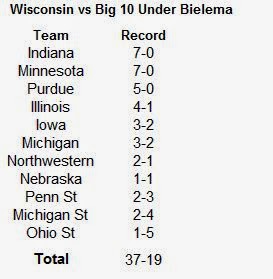
Full disclosure, the idea for what I am about to write came from an excellent piece by Matt Hinton on why recruiting rankings matter. During his time at Wisconsin, Brett Bielema went a collective 37-19 against Big 10 opponents (not including the Badger's pair of wins in the Big 10 Championship Game). But who did his Badger teams beat in those 37 victories? The answer is that more than half of those wins came against the trinity of Indiana, Minnesota, and Purdue. Against those three teams, Bielema's Badgers were 19-0. Against the rest of the Big 10, his teams were 18-19. The table below lists Wisconsin's record against each Big 10 team under Bielema.
There is something to be said for beating the teams you are supposed to beat, and Bielema's teams did just that, finishing 31-8 against Big 10 teams they were favored against. However, in the SEC, particularly, the SEC West, there are no Indianas, Minnesotas, or Purdues. A wise man once said, 'If you can't spot the fish at the table, you are the fish'. Fish is poker parlance for the weak player(s) that keeps everyone else in the black. Competing for conference wins against the likes of Alabama, Auburn, LSU, Mississippi, Mississippi State, and Texas A&M may mean Arkansas is the fish for the foreseeable future.
Arkansas
2013 Record: 3-9 (0-8)
Summary:
While the 2013 season was among the worst in recent Arkansas history, the Razorbacks opened the year with perhaps their best performance in beating a bowl bound Louisiana-Lafayette squad by 20 points. They followed that up with a closer than expected win over IAA Samford (but no son) and won their final game of the season the following week against a Southern Miss team in the throes of a 23-game losing streak. In their final non-conference game, Arkansas raced out to a 17-point third quarter lead, but Rutgers scored the games final 21 points to eke out a win. Once conference play began, the results were mostly grisly. South Carolina and Alabama scored 52 points on the Hogs in consecutive weeks, and through their first six league games, Arkansas had been outscored by 157 points. However, the Hogs didn't quit on first year coach Bret Bielema, losing first to Mississippi State in overtime and then squandering a late lead to LSU to finish without a conference win for the first time since 1942!
What Did the Razorbacks Do Well?
Run the ball. Obviously, when you finish without a conference win, there is usually not a whole lot you do well. However, Arkansas was legitimately strong running the football. The Hogs nearly produced two 1000-yard rushers, and as a team averaged a healthy 5.28 yards per carry (tied for 17th nationally). Those rushing numbers are even more impressive when you consider that Arkansas had no semblance of a passing attack. As a team, Arkansas averaged under six yards per throw and completed fewer than 50% of their passes (118th in the nation).
What Didn't the Razorbacks Do Well?
Everything else. I've already touched on their putrid quarterback play (the worst among major conference teams outside of Kansas), but the Hogs also boasted the SEC's worst defense in terms of yards per play allowed. Conference foes very nearly rang up seven yards per play against the Hogs 'resistance' (6.86). Arkansas also fared poorly in the turnover department, giving the ball away a league high 19 times in conference play.
The Razorbacks Over the Past Four Years:
The following table lists Arkansas' performance (in conference play only) in a few key categories and their respective conference rank in those categories. To help you read the table here is a handy translator.
Conf: The Conference Arkansas played in. With the ever-changing college football landscape, this is helpful.
Coach: Who was leading these yahoos into battle?
Rec: Conference Record
YPP: Yards per play. The number of yards per play the Razorbacks averaged in conference play.
YPA: Yards per play allowed. The number of yards per play the Razorbacks allowed in conference play.
Net: Yards per play net. The difference in YPP and YPA. Higher is better.
OTD: Offensive touchdowns. Touchdowns scored by the offense (no kick, punt, interception, or other returns are counted) in conference play.
DTD: Defensive touchdowns. Touchdowns allowed by the defense (no kick, punt, interception, or other returns are counted) in conference play.
Pythag: Adjusted Pythagorean Record. Take offensive touchdowns and defensive touchdowns and plug them into a handy formula to estimate the number of conference wins. For a full rundown of the APR, continue reading here.
Before his famous motorcycle accident, Bobby Petrino had enjoyed solid success at Arkansas. His defenses over his final two seasons were nothing to write home about, but the offensive attacks keyed by future NFL draft picks Ryan Mallett, Joe Adams, Greg Childs, Knile Davis, and Tyler Wilson ran amok over the SEC. After Petrino lost his gig thanks to his indiscretions, noted maniac John L Smith took over. Even with Tyler Wilson still under center, the offense declined and the defense went from bad to worse. The Razorbacks stole a successful Big 10 coach after their disappointing season and were prepared to return to their competitive ways. Not only did the defense continue to decline, finishing as arguably the worst in the SEC, the offense also faded. Now the Razorbacks enter 2014 having won just a pair of conference games over the previous two seasons.
The 2014 Schedule:
Playing in the SEC West, its a given Arkansas will have a difficult slate in 2014. Aside from their conference dates, the Razorbacks also have a few tests outside the SEC. Arkansas plays the requisite IAA opponent in Nicholls State and a low-level mid-major in UAB, but they also face a strong mid-major (Northern Illinois) and travel to play a major conference team (Texas Tech). The Red Raiders are hardly an upper-crust Big 12 team, but Arkansas will likely be an underdog, particularly on the road. Arkansas should be expected to win their trio of home games, but an upset by Northern Illinois would not be the greatest shock in the world. A reasonable Arkansas fan should be happy with a 3-1 mark in non-conference action. That means the Hogs would need to scrounge up a trio of league wins to get to bowl eligibility. In SEC play, the Hogs host Alabama, Georgia, LSU, and Ole Miss. The Hogs could be underdogs in all four games, but a win in one or two is certainly a possibility. Optimistically, if Arkansas wins a pair, they would need to grab one conference road win to get to bowl eligibility. Their road conference slate includes trips to Auburn, Mississippi State, Missouri, and Texas A&M. Winning at Auburn would be a huge reach, but Mississippi State, Missouri, or Texas A&M would only qualify as a minor upset. While three conference wins is not inconceivable, Arkansas may in fact find themselves underdogs in all eight conference games!
Reason for Optimism:
Bret Bielema's track record. We'll see in a moment why his track record may not mean as much you think. Regardless, there is no denying the success Bielema had at Wisconsin. Over seven seasons, his teams went 68-24 overall, finished the season ranked in the AP Poll five times, and played in three consecutive Rose Bowls to close his tenure. Prior to Wisconsin's run, the last Big 10 team to appear in three consecutive Rose Bowls were fellow mustelidae, the Michigan Wolverines from 1976 through 1978.
Final Prognosis:
Full disclosure, the idea for what I am about to write came from an excellent piece by Matt Hinton on why recruiting rankings matter. During his time at Wisconsin, Brett Bielema went a collective 37-19 against Big 10 opponents (not including the Badger's pair of wins in the Big 10 Championship Game). But who did his Badger teams beat in those 37 victories? The answer is that more than half of those wins came against the trinity of Indiana, Minnesota, and Purdue. Against those three teams, Bielema's Badgers were 19-0. Against the rest of the Big 10, his teams were 18-19. The table below lists Wisconsin's record against each Big 10 team under Bielema.
There is something to be said for beating the teams you are supposed to beat, and Bielema's teams did just that, finishing 31-8 against Big 10 teams they were favored against. However, in the SEC, particularly, the SEC West, there are no Indianas, Minnesotas, or Purdues. A wise man once said, 'If you can't spot the fish at the table, you are the fish'. Fish is poker parlance for the weak player(s) that keeps everyone else in the black. Competing for conference wins against the likes of Alabama, Auburn, LSU, Mississippi, Mississippi State, and Texas A&M may mean Arkansas is the fish for the foreseeable future.
Monday, April 28, 2014
Even the Losers: NC State
Over the past three seasons, 210 teams have participated in bowl games.
47 of those teams had losing records in the years immediately preceding
their bowl game. This semi-regular piece will showcase the losers from
2013 who just might find themselves participating in Capital One Bowl
Week in 2014. For our eleventh installment, we return to the ACC where we check in on the NC State Wolfpack.
NC State
2013 Record: 3-9 (0-8 ACC)
Summary: So you've decided to can your coach after three consecutive bowl bids. You're not into this mediocrity situation. No sir. You are NC State. You expect better things of yourself. Why, you last won the ACC in...1979. Wow, has it been that long? Three and half decades sure go by mighty quick. Regardless, you just hitched your wagon to a bright mid-major star. What could go wrong? The season began promisingly enough with a beatdown of a Louisiana Tech team that had won nine games the season before. However, a sign of trouble appeared on the horizon when the Wolfpack needed a late field goal to slip by IAA Richmond. Twelve days later, the Wolfpack shook off the Richmond game and hung tough with a strong Clemson team in a nationally televised Thursday night conference game. The Wolfpack followed that strong showing up with another mid-major bludgeoning in Raleigh, this time of Central Michigan. So after a quartet of games, the Wolfpack stood 3-1, with the lone loss coming to a Clemson team that would finish the season with a scant two defeats. And then...the Wolfpack would not win another game all season. They lost to great teams (Florida State beat them by 32), they lost to bad teams (Wake Forest beat them by 15), they lost to mid-majors (East Carolina beat them by 14), and they even lost to...Duke! All in all, it marked the first time an ACC team other than Duke went winless in the conference since Wake Forest in 1995. It should be noted, Virginia kept them company at the bottom of the standings, finishing without a conference win for the first time since 1981.
What Did the Wolfpack Do Well?
Return punts. You have to peruse a litany of statistics before you find something the Wolfpack was positively proficient at. However, punt returns is an area where NC State excelled. As a team, the Wolfpack averaged over 13 yards per return (fifteenth nationally). Senior receiver Rashard Smith did most of the damage, averaging a robust 14.12 yards per return and taking two punts to the house. If it weren't for the exploits of another Tar Heel state return man, Smith may have received a little more national notoriety.
What Didn't the Wolfpack Do Well?
Play defense. NC State allowed an in-conference worst 6.29 yards per play in 2013. After some early success against Clemson (surprising) and Wake Forest (not so surprising), the Wolfpack allowed 6.62 yards per play to their final six league opponents. In their final six games, five ACC clashes and an in-state battle with East Carolina, the Wolfpack allowed nearly 40 points per game (39.2).
The Wolfpack Over the Past Four Years:
The following table lists NC State's performance (in conference play only) in a few key categories and their respective conference rank in those categories. To help you read the table here is a handy translator.
Conf: The Conference NC State played in. With the ever-changing college football landscape, this is helpful.
Coach: Who was leading these yahoos into battle?
Rec: Conference Record
YPP: Yards per play. The number of yards per play the Wolfpack averaged in conference play.
YPA: Yards per play allowed. The number of yards per play the Wolfpack allowed in conference play.
Net: Yards per play net. The difference in YPP and YPA. Higher is better.
OTD: Offensive touchdowns. Touchdowns scored by the offense (no kick, punt, interception, or other returns are counted) in conference play.
DTD: Defensive touchdowns. Touchdowns allowed by the defense (no kick, punt, interception, or other returns are counted) in conference play.
Pythag: Adjusted Pythagorean Record. Take offensive touchdowns and defensive touchdowns and plug them into a handy formula to estimate the number of conference wins. For a full rundown of the APR, continue reading here.
In their final three seasons under Tom O'Brien, the Wolfpack were essentially a shade below average. However, the path they took to get their each season was different. After being average on both sides of the ball in 2010, the Wolfpack let Russell Wilson pick up and move to Wisconsin. With future Tampa Bay draft pick (and statue) Mike Glennon under center, the offense cratered, falling to second to last in the ACC. The defense picked up the slack though, ranking second in the conference. A testament to the strength of that defense is that four players were taken in the following spring's NFL draft. Perhaps not surprisingly, with the loss of so much talent, the Wolfpack defense faltered in 2012, ranking in the bottom third of the league. In his second season as a starter, Mike Glennon and the Wolfpack offense improved, ensuring the team did not endure a disastrous season. That would happen in 2013. Losing Glennon to the draft, the offense regressed again and with with the loss of star defensive back David Amerson and to a lesser extent Earl Wolff, the defense ended up being the worst in the ACC.
The 2014 Schedule:
The Wolfpack have taken the SEC route in terms of non-conference scheduling in 2014. Their opponents include a IAA school (Presbyterian), a pair of IA neophytes (Georgia Southern and Old Dominion), and South Florida. Old Dominion was a solid IAA program and finished 8-4 in their transitional year in 2013, but against the four IA teams on their schedule, they were outscored by over 20 points per game. Georgia Southern did memorably beat Florida last season, but were just 4-4 in their final season of play in the Southern Conference. South Florida could be a tricky game since it is on the road and Willie Taggart will have had an additional year to get the Bulls in gear, but anything less than a 3-1 mark in non-conference action would be a massive disappointment. The Wolfpack will likely need all the wins they can muster outside the conference because their ACC slate is not very forgiving. The Wolfpack host Boston College, Florida State, Georgia Tech, and Wake Forest in ACC play. The Wolfpack should be solid favorites against Boston College and Wake, and they have beaten Florida State three out of the last four times in Raleigh, but these Seminoles appear to have returned to elite status. NC State will probably also be an underdog to Georgia Tech meaning a split of their conference home games could be the best case scenario. On the road, the Wolfpack face Clemson, Louisville, North Carolina, and Syracuse. The Wolfpack will likely be prohibitive underdogs at Clemson, Louisville, and North Carolina, meaning their tilt in the Carrier Dome with Syracuse could be the difference between a bowl invite and another losing season.
Reason for Optimism:
(Almost) every team that beat NC State in 2013 was good. NC State lost nine times in 2013. However, eight of those losses came to teams that played in bowl games. Wake Forest was the only team with a losing record to beat the Wolfpack in 2013. True, only three of those teams finished the season ranked (Clemson, Duke, and Florida State), but East Carolina won ten games, and North Carolina finished the season with a nice run after a 1-5 start. Don't get me wrong, NC State did not play an NFL-caliber schedule in 2013, but there were very few terrible teams on the schedule (and NC State crushed those teams for the most part). The Wolfpack were not your typical woebegone winless conference team in 2013. Duke teams of the previous decade would have killed to be as good as this NC State team.
Final Prognosis:
One thing is for certain, NC State will not go winless in the ACC in 2014. I have the utmost confidence in that. Realistically, NC State should finish at least 3-1 in their non-conference games, and a clean sweep of that slate would not be surprising. Once conference play begins, the Wolfpack face a quartet of very difficult games: Florida State, at Clemson, at Louisville, and at North Carolina. A return to the postseason will hing on whether NC State can continue their home dominance of Wake Forest (just one home loss to the Deacons since 1984) and Boston College (3-1 versus the Eagles in Raleigh as conference opponents). I think the Wolfpack will take that pair of games and pull off at least one other upset in their remaining six conference matchups (home to Georgia Tech or at Syracuse appear the most likely to me). Based on their non-conference performance, this will leave NC State with another six or seven win regular season, or exactly where they were under Tom O'Brien.
NC State
2013 Record: 3-9 (0-8 ACC)
Summary: So you've decided to can your coach after three consecutive bowl bids. You're not into this mediocrity situation. No sir. You are NC State. You expect better things of yourself. Why, you last won the ACC in...1979. Wow, has it been that long? Three and half decades sure go by mighty quick. Regardless, you just hitched your wagon to a bright mid-major star. What could go wrong? The season began promisingly enough with a beatdown of a Louisiana Tech team that had won nine games the season before. However, a sign of trouble appeared on the horizon when the Wolfpack needed a late field goal to slip by IAA Richmond. Twelve days later, the Wolfpack shook off the Richmond game and hung tough with a strong Clemson team in a nationally televised Thursday night conference game. The Wolfpack followed that strong showing up with another mid-major bludgeoning in Raleigh, this time of Central Michigan. So after a quartet of games, the Wolfpack stood 3-1, with the lone loss coming to a Clemson team that would finish the season with a scant two defeats. And then...the Wolfpack would not win another game all season. They lost to great teams (Florida State beat them by 32), they lost to bad teams (Wake Forest beat them by 15), they lost to mid-majors (East Carolina beat them by 14), and they even lost to...Duke! All in all, it marked the first time an ACC team other than Duke went winless in the conference since Wake Forest in 1995. It should be noted, Virginia kept them company at the bottom of the standings, finishing without a conference win for the first time since 1981.
What Did the Wolfpack Do Well?
Return punts. You have to peruse a litany of statistics before you find something the Wolfpack was positively proficient at. However, punt returns is an area where NC State excelled. As a team, the Wolfpack averaged over 13 yards per return (fifteenth nationally). Senior receiver Rashard Smith did most of the damage, averaging a robust 14.12 yards per return and taking two punts to the house. If it weren't for the exploits of another Tar Heel state return man, Smith may have received a little more national notoriety.
What Didn't the Wolfpack Do Well?
Play defense. NC State allowed an in-conference worst 6.29 yards per play in 2013. After some early success against Clemson (surprising) and Wake Forest (not so surprising), the Wolfpack allowed 6.62 yards per play to their final six league opponents. In their final six games, five ACC clashes and an in-state battle with East Carolina, the Wolfpack allowed nearly 40 points per game (39.2).
The Wolfpack Over the Past Four Years:
The following table lists NC State's performance (in conference play only) in a few key categories and their respective conference rank in those categories. To help you read the table here is a handy translator.
Conf: The Conference NC State played in. With the ever-changing college football landscape, this is helpful.
Coach: Who was leading these yahoos into battle?
Rec: Conference Record
YPP: Yards per play. The number of yards per play the Wolfpack averaged in conference play.
YPA: Yards per play allowed. The number of yards per play the Wolfpack allowed in conference play.
Net: Yards per play net. The difference in YPP and YPA. Higher is better.
OTD: Offensive touchdowns. Touchdowns scored by the offense (no kick, punt, interception, or other returns are counted) in conference play.
DTD: Defensive touchdowns. Touchdowns allowed by the defense (no kick, punt, interception, or other returns are counted) in conference play.
Pythag: Adjusted Pythagorean Record. Take offensive touchdowns and defensive touchdowns and plug them into a handy formula to estimate the number of conference wins. For a full rundown of the APR, continue reading here.
In their final three seasons under Tom O'Brien, the Wolfpack were essentially a shade below average. However, the path they took to get their each season was different. After being average on both sides of the ball in 2010, the Wolfpack let Russell Wilson pick up and move to Wisconsin. With future Tampa Bay draft pick (and statue) Mike Glennon under center, the offense cratered, falling to second to last in the ACC. The defense picked up the slack though, ranking second in the conference. A testament to the strength of that defense is that four players were taken in the following spring's NFL draft. Perhaps not surprisingly, with the loss of so much talent, the Wolfpack defense faltered in 2012, ranking in the bottom third of the league. In his second season as a starter, Mike Glennon and the Wolfpack offense improved, ensuring the team did not endure a disastrous season. That would happen in 2013. Losing Glennon to the draft, the offense regressed again and with with the loss of star defensive back David Amerson and to a lesser extent Earl Wolff, the defense ended up being the worst in the ACC.
The 2014 Schedule:
The Wolfpack have taken the SEC route in terms of non-conference scheduling in 2014. Their opponents include a IAA school (Presbyterian), a pair of IA neophytes (Georgia Southern and Old Dominion), and South Florida. Old Dominion was a solid IAA program and finished 8-4 in their transitional year in 2013, but against the four IA teams on their schedule, they were outscored by over 20 points per game. Georgia Southern did memorably beat Florida last season, but were just 4-4 in their final season of play in the Southern Conference. South Florida could be a tricky game since it is on the road and Willie Taggart will have had an additional year to get the Bulls in gear, but anything less than a 3-1 mark in non-conference action would be a massive disappointment. The Wolfpack will likely need all the wins they can muster outside the conference because their ACC slate is not very forgiving. The Wolfpack host Boston College, Florida State, Georgia Tech, and Wake Forest in ACC play. The Wolfpack should be solid favorites against Boston College and Wake, and they have beaten Florida State three out of the last four times in Raleigh, but these Seminoles appear to have returned to elite status. NC State will probably also be an underdog to Georgia Tech meaning a split of their conference home games could be the best case scenario. On the road, the Wolfpack face Clemson, Louisville, North Carolina, and Syracuse. The Wolfpack will likely be prohibitive underdogs at Clemson, Louisville, and North Carolina, meaning their tilt in the Carrier Dome with Syracuse could be the difference between a bowl invite and another losing season.
Reason for Optimism:
(Almost) every team that beat NC State in 2013 was good. NC State lost nine times in 2013. However, eight of those losses came to teams that played in bowl games. Wake Forest was the only team with a losing record to beat the Wolfpack in 2013. True, only three of those teams finished the season ranked (Clemson, Duke, and Florida State), but East Carolina won ten games, and North Carolina finished the season with a nice run after a 1-5 start. Don't get me wrong, NC State did not play an NFL-caliber schedule in 2013, but there were very few terrible teams on the schedule (and NC State crushed those teams for the most part). The Wolfpack were not your typical woebegone winless conference team in 2013. Duke teams of the previous decade would have killed to be as good as this NC State team.
Final Prognosis:
One thing is for certain, NC State will not go winless in the ACC in 2014. I have the utmost confidence in that. Realistically, NC State should finish at least 3-1 in their non-conference games, and a clean sweep of that slate would not be surprising. Once conference play begins, the Wolfpack face a quartet of very difficult games: Florida State, at Clemson, at Louisville, and at North Carolina. A return to the postseason will hing on whether NC State can continue their home dominance of Wake Forest (just one home loss to the Deacons since 1984) and Boston College (3-1 versus the Eagles in Raleigh as conference opponents). I think the Wolfpack will take that pair of games and pull off at least one other upset in their remaining six conference matchups (home to Georgia Tech or at Syracuse appear the most likely to me). Based on their non-conference performance, this will leave NC State with another six or seven win regular season, or exactly where they were under Tom O'Brien.
Sunday, April 20, 2014
Even the Losers: Northwestern
Over the past three seasons, 210 teams have participated in bowl games.
47 of those teams had losing records in the years immediately preceding
their bowl game. This semi-regular piece will showcase the losers from
2013 who just might find themselves participating in Capital One Bowl
Week in 2014. The tenth team we will examine is the Northwestern Wildcats.
Northwestern:
2013 Record: 5-7 (1-7 Big 10)
Summary: Fresh off their first bowl win since 1948, Northwestern began the 2013 season 4-0 and climbed to number sixteen in the polls. In early October, they hosted Ohio State (Gameday was there) and the Wildcats lost a back-and-forth battle to the Buckeyes that was much closer than the misleading final score. The Wildcats followed up that loss with a blowout at the hands of the Wisconsin Badgers. Sitting at 0-2 in the Big 10, their conference title hopes were effectively kaput, but the Wildcats still had a great shot getting to eight or nine regular season wins. Over the next four games, Northwestern would suffer heart break after heart break. First, they lost by three to Minnesota. Then they fell in overtime to Iowa. Then just when it looked like they were about to upset Nebraska in Lincoln, this happened:
After a bye week, Northwestern hosted Michigan and nearly had the Wolverines beat until a hectic field goal forced overtime. The game would last three overtimes before the Wildcats were once again vanquished, extending their losing streak to six. There would be no bad breaks the following Saturday when Michigan State pummeled the Wildcats. Playing for pride in their final game, the Wildcats managed to finally eke out a close win, beating Illinois by three to finish 5-7.
What Did the Wildcats Do Well?
Score in the red zone. While the Wildcats featured one of the worst offenses in their recent vintage, they at least did a solid job of scoring once they got into the Red Zone. Only two teams, Florida State and Boston College, scored on a larger percentage of their red zone drives. However, while the Wildcats only failed to score on red zone trip twice all season, their scores were disproportionately field goals. 20 of their 46 red zone trips resulted in successful field goals. At over 43%, the Wildcats had the highest red zone field goal scoring rate of any team in the country. Leaving all those extra points on the field probably had a great deal to do with their 1-4 mark in one-score games.
What Didn't the Wildcats Do Well?
Score. Northwestern averaged 26.2 points per game in 2013. While this number compares favorably to their scoring averages in 2008 (24.4), 2009 (25.9), and 2010 (26.4), during which time they managed a cumulative 24-15 mark (13-11 in the Big 10), it is a bit deceiving. In their four non-conference games, the Wildcats averaged 41.3 points per game. Once conference play began, their scoring margin dipped to 18.6 points per game. After scoring 30 in their conference opener against Ohio State, the Wildcats averaged just 17 points per game through the rest of Big 10 play (13.7 points against teams not named Illinois). Bookending Big 10 play against Ohio State and Illinois, the Wildcats scored seven offensive touchdowns. In their other six league games, they also scored seven offensive touchdowns.
The Wildcats Over the Past Four Years:
The following table lists Northwestern's performance (in conference play only) in a few key categories and their respective conference rank in those categories. To help you read the table here is a handy translator.
Conf: The Conference Northwestern played in. With the ever-changing college football landscape, this is helpful.
Coach: Who was leading these yahoos into battle?
Rec: Conference Record
YPP: Yards per play. The number of yards per play the Wildcats averaged in conference play.
YPA: Yards per play allowed. The number of yards per play the Wildcats allowed in conference play.
Net: Yards per play net. The difference in YPP and YPA. Higher is better.
OTD: Offensive touchdowns. Touchdowns scored by the offense (no kick, punt, interception, or other returns are counted) in conference play.
DTD: Defensive touchdowns. Touchdowns allowed by the defense (no kick, punt, interception, or other returns are counted) in conference play.
Pythag: Adjusted Pythagorean Record. Take offensive touchdowns and defensive touchdowns and plug them into a handy formula to estimate the number of conference wins. For a full rundown of the APR, continue reading here.
Notice anything about the final yards per play numbers from Northwestern? In 2010, 2011, and 2013, the Wildcats pretty much fielded the same team on a per play basis. Sure, the offense was stronger in both 2010 and 2011 than 2013, while the defense was stronger in 2013, but the overall performance was about the same. The difference between being 3-5 in the Big 10 and 1-7 in the Big 10 was pretty much close game randomness. The Wildcats were 3-2 in one-score conference games in 2010. They were 1-1 in such games in 2011. In 2013, they were 1-4. For those of you mathematics types out there, that means the Wildcats were 0-3 in conference games decided by more than a touchdown in 2010, 2-4 in such games in 2011, and 0-3 in 2013. A break here or there in 2013, and Northwestern's bowl streak is going strong at six. Other interesting Wildcat factoids? While Northwestern has hardly truly contended for a Big 10 title over the past four seasons, they have won 28 games, and played in the postseason thrice despite producing just two draft picks in that span. Who were those esteemed gentlemen you may ask? Tight end Drake Dunsmore and wide receiver Jeremy Ebert, who were both selected in the seventh round in 2012. In the meritocracy of college football, you don't get extra credit for doing more with less, but it should be noted that Illinois has had twelve players drafted (including a trio of first rounders) and has but a scant seven Big 10 wins in that span (compared to twelve Big 10 wins for the Wildcats).
The 2014 Schedule:
The 2014 non-conference schedule has its share of pitfalls for the Wildcats. Northwestern opens the 2014 season by hosting Cal. Last season the Wildcats beat Cal in Berkley by two touchdowns. However, the Golden Bears will be in their second season under Sonny Dykes and should improve on their 1-11 mark last season. The Wildcats then host Northern Illinois, a strong mid-major team with a 46-10 record over the past four seasons. The Huskies will certainly miss Heisman trophy finalist Jordan Lynch, but this game will be much more challenging than facing a low-level team from the Sun Belt. Northwestern's third non-conference foe is Western Illinois. The Leathernecks, despite their imposing nickname, are a IAA school and should move Northwestern one win closer to bowl eligibility. The Wildcats play their final non-conference game late in the season when they travel to South Bend to face the Fighting Irish. Notre Dame and Northwestern have not played since the magical 1995 season. Northwestern will probably need a little more magic to beat the Irish on their home field. Realistically, a sweep of all four non-conference games is unlikely. Grounded Northwestern fans should be content with a 3-1 mark in non-conference action. Once conference play begins, the Wildcats,will host Illinois, Michigan, Nebraska, and Wisconsin. While the Wildcats will likely be underdogs in three of those games (all but Illinois), they have played Michigan and Nebraska tight in recent seasons. While they are just 1-5 against the Wolverines and Cornhuskers since 2011, four of their five losses have come by a touchdown or less. At worst, the Wildcats should split their home conference games. Their road Big 10 games come against Iowa, Minnesota, Penn State, and Purdue. Once again, Northwestern will likely only be favored in one of these games (Purdue), but the other three are hardly lost causes. Three league wins should be the floor for this team, and with the right maturation and a few breaks, the Wildcats could win more than they lose in conference play.
Reason for Optimism:
Track record and luck. Prior to 2013, the Northwestern Wildcats had been bowl eligible for six consecutive seasons (they missed out despite six wins in 2007). The worst SRS score they have compiled since 2007 is -3.70, meaning they would be an underdog by a little more than a field goal on a neutral field against an average college football team. In fact, their SRS in 2013 was 3.97, the third highest of the Pat Fitzgerald era. With a little better luck, and a better job of finishing drives, the Wildcats can return to the postseason in 2014. That being said, how likely are the Wildcats to do a better job of finishing drives? Read on!
Final Prognosis:
As mentioned earlier, the Wildcats led the nation by having over 43% of their red zone drives end in field goals. Since 2008, seven teams in addition to Northwestern have seen more than forty percent of their red zone drives end in successful field goals. They are listed below, along with their scoring averages for the year in question, and their scoring averages the following season.
What does this portend for Northwestern? Well, the picture is a little muddy. Four of the seven teams improved their scoring average the following season and three saw their average decline. However, most of the losses and gains were relatively miniscule. Only Virginia in 2009-2010 and Colorado State in 2010-2011 saw their averages climb significantly. The good news for Northwestern fans is they are unlikely to see a significant decline in their scoring averages. 26 points, even in today's environment, will win you some games. The schedule is somewhat daunting with just a single layup on paper, but the Wildcats have been a consistent winner over the last decade. Look for the Wildcats to be back in the postseason and who knows, perhaps they can run their bowl win streak to two.
Northwestern:
2013 Record: 5-7 (1-7 Big 10)
Summary: Fresh off their first bowl win since 1948, Northwestern began the 2013 season 4-0 and climbed to number sixteen in the polls. In early October, they hosted Ohio State (Gameday was there) and the Wildcats lost a back-and-forth battle to the Buckeyes that was much closer than the misleading final score. The Wildcats followed up that loss with a blowout at the hands of the Wisconsin Badgers. Sitting at 0-2 in the Big 10, their conference title hopes were effectively kaput, but the Wildcats still had a great shot getting to eight or nine regular season wins. Over the next four games, Northwestern would suffer heart break after heart break. First, they lost by three to Minnesota. Then they fell in overtime to Iowa. Then just when it looked like they were about to upset Nebraska in Lincoln, this happened:
After a bye week, Northwestern hosted Michigan and nearly had the Wolverines beat until a hectic field goal forced overtime. The game would last three overtimes before the Wildcats were once again vanquished, extending their losing streak to six. There would be no bad breaks the following Saturday when Michigan State pummeled the Wildcats. Playing for pride in their final game, the Wildcats managed to finally eke out a close win, beating Illinois by three to finish 5-7.
What Did the Wildcats Do Well?
Score in the red zone. While the Wildcats featured one of the worst offenses in their recent vintage, they at least did a solid job of scoring once they got into the Red Zone. Only two teams, Florida State and Boston College, scored on a larger percentage of their red zone drives. However, while the Wildcats only failed to score on red zone trip twice all season, their scores were disproportionately field goals. 20 of their 46 red zone trips resulted in successful field goals. At over 43%, the Wildcats had the highest red zone field goal scoring rate of any team in the country. Leaving all those extra points on the field probably had a great deal to do with their 1-4 mark in one-score games.
What Didn't the Wildcats Do Well?
Score. Northwestern averaged 26.2 points per game in 2013. While this number compares favorably to their scoring averages in 2008 (24.4), 2009 (25.9), and 2010 (26.4), during which time they managed a cumulative 24-15 mark (13-11 in the Big 10), it is a bit deceiving. In their four non-conference games, the Wildcats averaged 41.3 points per game. Once conference play began, their scoring margin dipped to 18.6 points per game. After scoring 30 in their conference opener against Ohio State, the Wildcats averaged just 17 points per game through the rest of Big 10 play (13.7 points against teams not named Illinois). Bookending Big 10 play against Ohio State and Illinois, the Wildcats scored seven offensive touchdowns. In their other six league games, they also scored seven offensive touchdowns.
The Wildcats Over the Past Four Years:
The following table lists Northwestern's performance (in conference play only) in a few key categories and their respective conference rank in those categories. To help you read the table here is a handy translator.
Conf: The Conference Northwestern played in. With the ever-changing college football landscape, this is helpful.
Coach: Who was leading these yahoos into battle?
Rec: Conference Record
YPP: Yards per play. The number of yards per play the Wildcats averaged in conference play.
YPA: Yards per play allowed. The number of yards per play the Wildcats allowed in conference play.
Net: Yards per play net. The difference in YPP and YPA. Higher is better.
OTD: Offensive touchdowns. Touchdowns scored by the offense (no kick, punt, interception, or other returns are counted) in conference play.
DTD: Defensive touchdowns. Touchdowns allowed by the defense (no kick, punt, interception, or other returns are counted) in conference play.
Pythag: Adjusted Pythagorean Record. Take offensive touchdowns and defensive touchdowns and plug them into a handy formula to estimate the number of conference wins. For a full rundown of the APR, continue reading here.
Notice anything about the final yards per play numbers from Northwestern? In 2010, 2011, and 2013, the Wildcats pretty much fielded the same team on a per play basis. Sure, the offense was stronger in both 2010 and 2011 than 2013, while the defense was stronger in 2013, but the overall performance was about the same. The difference between being 3-5 in the Big 10 and 1-7 in the Big 10 was pretty much close game randomness. The Wildcats were 3-2 in one-score conference games in 2010. They were 1-1 in such games in 2011. In 2013, they were 1-4. For those of you mathematics types out there, that means the Wildcats were 0-3 in conference games decided by more than a touchdown in 2010, 2-4 in such games in 2011, and 0-3 in 2013. A break here or there in 2013, and Northwestern's bowl streak is going strong at six. Other interesting Wildcat factoids? While Northwestern has hardly truly contended for a Big 10 title over the past four seasons, they have won 28 games, and played in the postseason thrice despite producing just two draft picks in that span. Who were those esteemed gentlemen you may ask? Tight end Drake Dunsmore and wide receiver Jeremy Ebert, who were both selected in the seventh round in 2012. In the meritocracy of college football, you don't get extra credit for doing more with less, but it should be noted that Illinois has had twelve players drafted (including a trio of first rounders) and has but a scant seven Big 10 wins in that span (compared to twelve Big 10 wins for the Wildcats).
The 2014 Schedule:
The 2014 non-conference schedule has its share of pitfalls for the Wildcats. Northwestern opens the 2014 season by hosting Cal. Last season the Wildcats beat Cal in Berkley by two touchdowns. However, the Golden Bears will be in their second season under Sonny Dykes and should improve on their 1-11 mark last season. The Wildcats then host Northern Illinois, a strong mid-major team with a 46-10 record over the past four seasons. The Huskies will certainly miss Heisman trophy finalist Jordan Lynch, but this game will be much more challenging than facing a low-level team from the Sun Belt. Northwestern's third non-conference foe is Western Illinois. The Leathernecks, despite their imposing nickname, are a IAA school and should move Northwestern one win closer to bowl eligibility. The Wildcats play their final non-conference game late in the season when they travel to South Bend to face the Fighting Irish. Notre Dame and Northwestern have not played since the magical 1995 season. Northwestern will probably need a little more magic to beat the Irish on their home field. Realistically, a sweep of all four non-conference games is unlikely. Grounded Northwestern fans should be content with a 3-1 mark in non-conference action. Once conference play begins, the Wildcats,will host Illinois, Michigan, Nebraska, and Wisconsin. While the Wildcats will likely be underdogs in three of those games (all but Illinois), they have played Michigan and Nebraska tight in recent seasons. While they are just 1-5 against the Wolverines and Cornhuskers since 2011, four of their five losses have come by a touchdown or less. At worst, the Wildcats should split their home conference games. Their road Big 10 games come against Iowa, Minnesota, Penn State, and Purdue. Once again, Northwestern will likely only be favored in one of these games (Purdue), but the other three are hardly lost causes. Three league wins should be the floor for this team, and with the right maturation and a few breaks, the Wildcats could win more than they lose in conference play.
Reason for Optimism:
Track record and luck. Prior to 2013, the Northwestern Wildcats had been bowl eligible for six consecutive seasons (they missed out despite six wins in 2007). The worst SRS score they have compiled since 2007 is -3.70, meaning they would be an underdog by a little more than a field goal on a neutral field against an average college football team. In fact, their SRS in 2013 was 3.97, the third highest of the Pat Fitzgerald era. With a little better luck, and a better job of finishing drives, the Wildcats can return to the postseason in 2014. That being said, how likely are the Wildcats to do a better job of finishing drives? Read on!
Final Prognosis:
As mentioned earlier, the Wildcats led the nation by having over 43% of their red zone drives end in field goals. Since 2008, seven teams in addition to Northwestern have seen more than forty percent of their red zone drives end in successful field goals. They are listed below, along with their scoring averages for the year in question, and their scoring averages the following season.
What does this portend for Northwestern? Well, the picture is a little muddy. Four of the seven teams improved their scoring average the following season and three saw their average decline. However, most of the losses and gains were relatively miniscule. Only Virginia in 2009-2010 and Colorado State in 2010-2011 saw their averages climb significantly. The good news for Northwestern fans is they are unlikely to see a significant decline in their scoring averages. 26 points, even in today's environment, will win you some games. The schedule is somewhat daunting with just a single layup on paper, but the Wildcats have been a consistent winner over the last decade. Look for the Wildcats to be back in the postseason and who knows, perhaps they can run their bowl win streak to two.
Tuesday, April 08, 2014
Even the Losers: Wyoming
Over the past three seasons, 210 teams have participated in bowl games.
47 of those teams had losing records in the years immediately preceding
their bowl game. This semi-regular piece will showcase the losers from
2013 who just might find themselves participating in Capital One Bowl
Week in 2014. For our ninth installment, we'll stay in the Mountain West and examine the Wyoming Cowboys.
Wyoming
2013 Record: 5-7 (3-5 Mountain West)
Summary: The first four games of the 2013 season played out about as well as any practical Wyoming fan could have hoped. The Cowboys opened the season losing by a mere field goal at Nebraska. Their previous five run-ins with BCS conference foes under Dave Christensen had all resulted in grisly defeats, with each coming by at least 20 points. Shaking off the tight loss, the Cowboys returned home and shredded Idaho and Northern Colorado (IAA) by 32 and 28 points respectively. They then opened Mountain West play on the road against Air Force, a team they were just 1-6 against since 2005. They scored 56 points against the Falcons, the high-water mark under Christensen at the time, and won by 33. A third of the way through the season, the Cowboys seemed at worse to be a bowl team, and at best a contender in the conference for the first time since the days of Joe Tiller. The exuberance surrounding the team would last exactly one week. In their fifth game, the Cowboys traveled to San Marcos to face Texas State, a team in just its second year of IA football. In a sign of defensive deficiencies to come, the Cowboys allowed 42 points to the Bobcats and dropped to 3-2. They beat New Mexico in a high-scoring affair the following week, and then things got ugly. Over their final six games, the Cowboys allowed more 50 points than three times (two other times they allowed 48), scored ten points or fewer three times, and won just once more. The win came in overtime, at home, against a Hawaii team that won just once all season. The Cowboys canned Christensen and hired a IAA wunderkind in Craig Bohl. Alright, maybe he isn't a wunderkind, but he has been quite successful.
What Did the Cowboys Do Well?
Score...sometimes. The 2013 Cowboys were the highest scoring team of the Dave Christensen era. His charges averaged 31.3 points per game, about four and a half more than they averaged in 2012. However, outside of the Hawaii game, the Cowboys struggled on that side of the ball in the season's final month. In their other three November contests, they scored ten against Fresno State, seven against Boise State, and seven against Utah State. Over the first two months of the season, the Cowboys had been averaging a robust 36.5 points per game.
What Didn't the Cowboys Do Well?
Stop the pass. The Wyoming defense ranked eighth in yards per play allowed in the Mountain West. With twelve teams in the conference, that is not a terrible rating. However, when it came to stopping opposing quarterbacks, Wyoming was among the worst in the nation. For starters, they allowed 32 touchdown passes on the season. Only two teams, Colorado State (33) and Idaho (40) allowed more, and Colorado State played an extra game. In terms of yards per pass, the Cowboys ranked 101st, allowing 7.9 yards per throw. In terms of quarterback rating, a flawed, but useful statistic, the Cowboys ranked 115th. The pass defense was particularly atrocious in the final eight games, over which the Cowboys allowed 27 touchdown passes and a nearly unheard of 8.8 yards per pass.
The Cowboys Over the Past Four Years:
The following table lists Wyoming's performance (in conference play only) in a few key categories and their respective conference rank in those categories. To help you read the table here is a handy translator.
Conf: The Conference Wyoming played in. With the ever-changing college football landscape, this is helpful.
Coach: Who was leading these yahoos into battle?
Rec: Conference Record
YPP: Yards per play. The number of yards per play the Cowboys averaged in conference play.
YPA: Yards per play allowed. The number of yards per play the Cowboys allowed in conference play.
Net: Yards per play net. The difference in YPP and YPA. Higher is better.
OTD: Offensive touchdowns. Touchdowns scored by the offense (no kick, punt, interception, or other returns are counted) in conference play.
DTD: Defensive touchdowns. Touchdowns allowed by the defense (no kick, punt, interception, or other returns are counted) in conference play.
Pythag: Adjusted Pythagorean Record. Take offensive touchdowns and defensive touchdowns and plug them into a handy formula to estimate the number of conference wins. For a full rundown of the APR, continue reading here.
Despite the vast difference in their overall record, the 2010 and 2011 Cowboys were basically the same team on a yards per play basis. They were a little worse than average in comparison to their Mountain West brethren in both seasons (remember the league had nine and eight teams in both seasons, not the twelve it currently counts as members). How did they achieve such divergent results? The 2010 team was 0-3 in one-score conference games, while the 2011 team was 3-0. In addition, while the 2010 team was hardly unlucky in regards to turnovers (an in-conference margin of +2), the 2011 team was +10 in just seven games. Despite the winning record, the Cowboys were a good bet to decline in 2012 thanks to their performance in one-score games and their resplendent turnover margin. Sure enough, their record fell, but perhaps more troubling, the underlying performance also cratered. Their yards per play margin befitted a team that was probably worse than the 3-5 mark they achieved. Judging by how far they fell on a play by play basis in 2012, 2013 could certainly be deemed a success. The Cowboys improved on both sides of the ball, including quite substantially on offense. Despite the late-season struggles, an argument could be made to give Christensen another year. Still, with a coach like Bohl on the market, it's hard to blame Wyoming for the decision they made.
The 2014 Schedule:
The Cowboys four non-conference opponents in 2014 feature a little bit of everything. There is the requisite IAA school (Montana), a fellow mid-major (Florida Atlantic), and a pair of potential Rose Bowl teams (Oregon and Michigan State). The games against the Ducks and Spartans both come on the road, and even if they were in Laramie, a win would be a major upset. Montana is a strong IAA team, but the Cowboys should win. Florida Atlantic may hold the key to bowl eligibility for the Cowboys. The Owls surged late in 2013, winning their final four games to improve to 6-6, despite some coaching upheaval. The game is at home, so a win would not be a massive shock across the college football landscape. In league play, the Cowboys host Air Force, Boise State, San Jose State, and Utah State. Three of those squads were bowl eligible last season (all save Air Force). On the road, the Cowboys play Colorado State, Fresno State, Hawaii, and New Mexico. Colorado State and Fresno State were bowl participants last season, while Hawaii and New Mexico won just four total games between them. In order to attain bowl eligibility, the Cowboys will need to win at least four and potentially five (depending on the outcome of the Florida Atlantic game) league contests. Accomplishing this likely requires the Cowboys to split their four road non-conference games. Hawaii and New Mexico appear to be the most likely candidates for road wins, but as stated (so eloquently I might add) in the Nevada preview, shifting the venue of a few of these games would be beneficial to Wyoming's bowl chances.
Reason For Optimism:
Craig Bohl. The most visible, and perhaps the most important person on any football team is the head coach. Bohl comes fresh from North Dakota State where he led the Bison to three consecutive IAA national championships. Perhaps more impressive than the three consecutive titles, was that Bohl did this while shepherding the Bison up from Division II. During his eleven years in Fargo, the Bison suffered just a single losing season and won more than three quarters of their games.
Final Prognosis:
A winning season and bowl game are certainly not a given, but Craig Bohl has the potential to be a slam dunk hire at Wyoming. Bohl has a great track record at IAA, and the bigger question could end up being, how long will he stay at Wyoming? Still, everything is not rosy headed into his first season. The defense was a major issue, particularly down the stretch in 2013, and his star signal caller decided to turn pro with a year of eligibility remaining. The non-conference schedule virtually guarantees two losses, but I think the Cowboys will at least manage a 6-6 mark in 2014 with bigger things to come down the road.
Wyoming
2013 Record: 5-7 (3-5 Mountain West)
Summary: The first four games of the 2013 season played out about as well as any practical Wyoming fan could have hoped. The Cowboys opened the season losing by a mere field goal at Nebraska. Their previous five run-ins with BCS conference foes under Dave Christensen had all resulted in grisly defeats, with each coming by at least 20 points. Shaking off the tight loss, the Cowboys returned home and shredded Idaho and Northern Colorado (IAA) by 32 and 28 points respectively. They then opened Mountain West play on the road against Air Force, a team they were just 1-6 against since 2005. They scored 56 points against the Falcons, the high-water mark under Christensen at the time, and won by 33. A third of the way through the season, the Cowboys seemed at worse to be a bowl team, and at best a contender in the conference for the first time since the days of Joe Tiller. The exuberance surrounding the team would last exactly one week. In their fifth game, the Cowboys traveled to San Marcos to face Texas State, a team in just its second year of IA football. In a sign of defensive deficiencies to come, the Cowboys allowed 42 points to the Bobcats and dropped to 3-2. They beat New Mexico in a high-scoring affair the following week, and then things got ugly. Over their final six games, the Cowboys allowed more 50 points than three times (two other times they allowed 48), scored ten points or fewer three times, and won just once more. The win came in overtime, at home, against a Hawaii team that won just once all season. The Cowboys canned Christensen and hired a IAA wunderkind in Craig Bohl. Alright, maybe he isn't a wunderkind, but he has been quite successful.
What Did the Cowboys Do Well?
Score...sometimes. The 2013 Cowboys were the highest scoring team of the Dave Christensen era. His charges averaged 31.3 points per game, about four and a half more than they averaged in 2012. However, outside of the Hawaii game, the Cowboys struggled on that side of the ball in the season's final month. In their other three November contests, they scored ten against Fresno State, seven against Boise State, and seven against Utah State. Over the first two months of the season, the Cowboys had been averaging a robust 36.5 points per game.
What Didn't the Cowboys Do Well?
Stop the pass. The Wyoming defense ranked eighth in yards per play allowed in the Mountain West. With twelve teams in the conference, that is not a terrible rating. However, when it came to stopping opposing quarterbacks, Wyoming was among the worst in the nation. For starters, they allowed 32 touchdown passes on the season. Only two teams, Colorado State (33) and Idaho (40) allowed more, and Colorado State played an extra game. In terms of yards per pass, the Cowboys ranked 101st, allowing 7.9 yards per throw. In terms of quarterback rating, a flawed, but useful statistic, the Cowboys ranked 115th. The pass defense was particularly atrocious in the final eight games, over which the Cowboys allowed 27 touchdown passes and a nearly unheard of 8.8 yards per pass.
The Cowboys Over the Past Four Years:
The following table lists Wyoming's performance (in conference play only) in a few key categories and their respective conference rank in those categories. To help you read the table here is a handy translator.
Conf: The Conference Wyoming played in. With the ever-changing college football landscape, this is helpful.
Coach: Who was leading these yahoos into battle?
Rec: Conference Record
YPP: Yards per play. The number of yards per play the Cowboys averaged in conference play.
YPA: Yards per play allowed. The number of yards per play the Cowboys allowed in conference play.
Net: Yards per play net. The difference in YPP and YPA. Higher is better.
OTD: Offensive touchdowns. Touchdowns scored by the offense (no kick, punt, interception, or other returns are counted) in conference play.
DTD: Defensive touchdowns. Touchdowns allowed by the defense (no kick, punt, interception, or other returns are counted) in conference play.
Pythag: Adjusted Pythagorean Record. Take offensive touchdowns and defensive touchdowns and plug them into a handy formula to estimate the number of conference wins. For a full rundown of the APR, continue reading here.
Despite the vast difference in their overall record, the 2010 and 2011 Cowboys were basically the same team on a yards per play basis. They were a little worse than average in comparison to their Mountain West brethren in both seasons (remember the league had nine and eight teams in both seasons, not the twelve it currently counts as members). How did they achieve such divergent results? The 2010 team was 0-3 in one-score conference games, while the 2011 team was 3-0. In addition, while the 2010 team was hardly unlucky in regards to turnovers (an in-conference margin of +2), the 2011 team was +10 in just seven games. Despite the winning record, the Cowboys were a good bet to decline in 2012 thanks to their performance in one-score games and their resplendent turnover margin. Sure enough, their record fell, but perhaps more troubling, the underlying performance also cratered. Their yards per play margin befitted a team that was probably worse than the 3-5 mark they achieved. Judging by how far they fell on a play by play basis in 2012, 2013 could certainly be deemed a success. The Cowboys improved on both sides of the ball, including quite substantially on offense. Despite the late-season struggles, an argument could be made to give Christensen another year. Still, with a coach like Bohl on the market, it's hard to blame Wyoming for the decision they made.
The 2014 Schedule:
The Cowboys four non-conference opponents in 2014 feature a little bit of everything. There is the requisite IAA school (Montana), a fellow mid-major (Florida Atlantic), and a pair of potential Rose Bowl teams (Oregon and Michigan State). The games against the Ducks and Spartans both come on the road, and even if they were in Laramie, a win would be a major upset. Montana is a strong IAA team, but the Cowboys should win. Florida Atlantic may hold the key to bowl eligibility for the Cowboys. The Owls surged late in 2013, winning their final four games to improve to 6-6, despite some coaching upheaval. The game is at home, so a win would not be a massive shock across the college football landscape. In league play, the Cowboys host Air Force, Boise State, San Jose State, and Utah State. Three of those squads were bowl eligible last season (all save Air Force). On the road, the Cowboys play Colorado State, Fresno State, Hawaii, and New Mexico. Colorado State and Fresno State were bowl participants last season, while Hawaii and New Mexico won just four total games between them. In order to attain bowl eligibility, the Cowboys will need to win at least four and potentially five (depending on the outcome of the Florida Atlantic game) league contests. Accomplishing this likely requires the Cowboys to split their four road non-conference games. Hawaii and New Mexico appear to be the most likely candidates for road wins, but as stated (so eloquently I might add) in the Nevada preview, shifting the venue of a few of these games would be beneficial to Wyoming's bowl chances.
Reason For Optimism:
Craig Bohl. The most visible, and perhaps the most important person on any football team is the head coach. Bohl comes fresh from North Dakota State where he led the Bison to three consecutive IAA national championships. Perhaps more impressive than the three consecutive titles, was that Bohl did this while shepherding the Bison up from Division II. During his eleven years in Fargo, the Bison suffered just a single losing season and won more than three quarters of their games.
Final Prognosis:
A winning season and bowl game are certainly not a given, but Craig Bohl has the potential to be a slam dunk hire at Wyoming. Bohl has a great track record at IAA, and the bigger question could end up being, how long will he stay at Wyoming? Still, everything is not rosy headed into his first season. The defense was a major issue, particularly down the stretch in 2013, and his star signal caller decided to turn pro with a year of eligibility remaining. The non-conference schedule virtually guarantees two losses, but I think the Cowboys will at least manage a 6-6 mark in 2014 with bigger things to come down the road.
Thursday, March 20, 2014
Even the Losers: Nevada
Over the past three seasons, 210 teams have participated in bowl games.
47 of those teams had losing records in the years immediately preceding
their bowl game. This semi-regular piece will showcase the losers from
2013 who just might find themselves participating in Capital One Bowl
Week in 2014. In our eighth installment, we return to the mid-majors and examine the prospects of the Nevada Wolfpack.
Nevada
2013 Record: 4-8 (3-5 Mountain West)
Summary: New head coach Brian Polian had some huge shoes to fill when he took the reigns of the Wolfpack program from hall of fame coach, and 'Pistol' purveyor Chris Ault. All Ault had done was take the Wolfpack to eight consecutive bowls since beginning his second stint as head coach in 2004. The Polian era got off to a rough start as the Wolfpack traveled to UCLA and lost by 38. They returned home and administered a beating of their own against IAA UC-Davis. The next week, they traveled across the country to take on eventual national champion Florida State, and the results were rather grisly. Returning home to lick their wounds, the Wolfpack opened Mountain West play with consecutive wins over Hawaii and Air Force and seemed poised to play in their ninth consecutive bowl despite the non-conference struggles. The Wolfpack lost their next two games, at San Diego State and Boise State to fall to 2-2 in the league before returning home to face in-state foe UNLV. The Wolfpack had beaten the Rebels eight consecutive times by an average of 20 points. That streak would come to an end in a 27-22 Wolfpack loss. The Wolfpack then lost their next two games against eventual league champion Fresno State and bowl winner Colorado State. The Wolfpack did break a five game conference losing streak in their penultimate contest against San Jose State and played BYU tough in their finale. However, the end result was a 4-8 mark and their first losing season since 2004.
What Did the Wolfpack Do Well?
Play well at home. The Wolfpack went 3-1 in Mountain West play at home, including beating a six-win San Jose State team by three touchdowns. They did lose at home to UNLV, but the game was close, and they also gave a solid BYU squad a run for their money in their only other home loss. Suffice it to say, there were not a great deal of positives in 2013.
What Didn't the Wolfpacks Do Well?
Run the ball, at least as compared to their recent historical trends. From 2007 through 2012, the final six seasons of the Chris Ault era, Nevada never finished lower than twelfth in rushing yards per game. They finished in the top ten in rushing yards per game five times. Proving their runs were as nearly as efficient as they were voluminous, they also never finished worse than 19th in yards per rush. They also finished in the top ten thrice in yards per rush. Without the virtuoso Ault calling the plays, the Wolfpack dipped to 49th in rushing yards and 87th in yards per rush. Their rushing average of 3.90 marked the first time it dipped under four since 2002.
The Wolfpack Over the Past Four Years:
The following table lists Nevada's performance (in conference play only) in a few key categories and their respective conference rank in those categories. To help you read the table here is a handy translator.
Conf: The Conference Nevada played in. With the ever-changing college football landscape, this is helpful.
Coach: Who was leading these yahoos into battle?
Rec: Conference Record
YPP: Yards per play. The number of yards per play the Wolfpack averaged in conference play.
YPA: Yards per play allowed. The number of yards per play the Wolfpack allowed in conference play.
Net: Yards per play net. The difference in YPP and YPA. Higher is better.
OTD: Offensive touchdowns. Touchdowns scored by the offense (no kick, punt, interception, or other returns are counted) in conference play.
DTD: Defensive touchdowns. Touchdowns allowed by the defense (no kick, punt, interception, or other returns are counted) in conference play.
Pythag: Adjusted Pythagorean Record. Take offensive touchdowns and defensive touchdowns and plug them into a handy formula to estimate the number of conference wins. For a full rundown of the APR, continue reading here.
Nevada enjoyed their best season in school history (at least as a IA program) in 2010 with the help of a certain senior quarterback you may have heard of. Perhaps surprisingly, Kaepernick and tight end Virgil Green were the only offensive players drafted from that team. The Wolfpack ended that 2010 season with just a single loss and a number eleven ranking in the AP Poll. Sans Kaepernick, and as expected, the Wolfpack declined the following season, but still returned to the postseason on the strength of their offense. The Wolfpack left the smoldering wreckage of the WAC following the 2011 season and began life in the Mountain West. The Wolfpack found life a little more difficult in their new conference, but sent their coach off into the sunset with another postseason bid. The offense remained one of the best in the league, but the defense continued a disturbing trend of diminishing returns. Without Ault calling the shots, the offense failed to pull its weight in 2013. The defense was unable to pick up the slack, continuing its downward trend and resigning the Wolfpack to a losing season.
The 2014 Schedule:
If the Wolfpack are to return to the postseason in 2014, they will have to perform well in Mountain West play because there do not appear to be a great deal of wins available in the non-conference schedule. Nevada opens play against IAA Southern Utah, but the level of competition ratchets up soon after with a home date against Mike Leach and the Washington State Cougars. The Cougars have been a pretty sorry program for the last decade or so, but appear to be back on the upswing under Leach. The Wolfpack then travel to Tucson to stage a rematch of the 2012 New Mexico Bowl, a thrilling Arizona comeback that also happened to be Ault's last game as head coach. Their final non-conference game comes midway through the season when they travel to Provo to take on BYU. The Wolfpack are likely to be underdogs in each of their final three non-conference games, so even salvaging a split in non-conference play would be an accomplishment. In Mountain West action, the Wolfpack have the unenviable task of hosting four bowl participants from last season: Boise State, Colorado State, Fresno State, and San Diego State. While the Wolfpack should win at least one, and perhaps more of those games, hosting some of the weaker conference members would be preferable in terms of qualifying for a bowl. Their road conference games include trips to Air Force, Hawaii, San Jose State, and UNLV. Air Force suffered a losing season last year, but had played in six consecutive bowl games prior to last season's implosion. Hawaii did not win a single Mountain West game last year, but was better than their record indicated (five of their eight league losses came by a touchdown or less) and playing on the islands is never easy. San Jose State and UNLV both finished bowl eligible last season, with UNLV actually playing in the postseason.
Reason for Optimism:
The offense can improve. Nevada will enter the 2014 campaign with a senior quarterback, Cody Fajardo under center. No one will confuse Fajardo with his predecessor, but he has thrown for over 7000 yards and rushed for more than 2400 in his career. Fajardo does lose his number one target, Brandon Wimberly, but a pair of senior receivers, Richy Turner and Aaron Bradley return. The Wolfpack had a solid track record of offensive success prior to 2013, so a return to the upper reaches of the Mountain West on that side of the ball would not be unheard of.
Final Prognosis:
Sometimes we assign simple and specious answers to complex questions. Why did Nevada's offense decline in 2013? Obviously because the newbie coach was not able to fell the legendary shoe's of his predecessor. What about the loss of three starting offensive linemen from the 2012 team? What about a tougher schedule (all eight teams that beat Nevada went to bowl games)? And what about total randomness? Personally, I think the loss of Ault played a role, but a confluence of multiple events including the three mentioned earlier, also conspired to sink the Wolfpack. So with better luck, a more experienced line, and more seasoning under Polian, are the Wolfpack due for a rebound? Possibly, if not for the schedule. The non-conference slate is daunting by mid-major standards, with the just one near certain victory. In conference play, the Wolfpack have the misfortune of playing the teams likely to be near the top of the Mountain West at home and the mediocre to bad teams on the road. A little more variety in their home and road schedule would be more conducive to a bowl bid. Consider the following thought experiment. Let's say Nevada ends up as about the 80th best college football team in 2014 (not too far fetched since they were rated 84th by the SRS method in 2013). Now let's pretend they host a team rated about 40th (Fresno State perhaps) and travel to face a team rated 95th (what about Hawaii?). The Wolfpack will certainly stand a chance of beating Fresno at home, but the Bulldogs are a stronger team. In addition, while Nevada is a better team than Hawaii, the difference is not large, and this game is on the road. Now let's reverse the venues. Nevada would continue to be an underdog versus Fresno State (albeit more prohibitively), but they also stand a much better chance of beating Hawaii at home. In the second scenario, they have better odds of earning a split. I'll leave the math to better minds (and bigger nerds). This is how Nevada's 2014 schedule will play out, but on a much larger scale. If the venues for some of their conference games were reversed, a bowl game would be more likely. As it stands, I think Nevada will improve, but it will not be reflected in their final record.
Nevada
2013 Record: 4-8 (3-5 Mountain West)
Summary: New head coach Brian Polian had some huge shoes to fill when he took the reigns of the Wolfpack program from hall of fame coach, and 'Pistol' purveyor Chris Ault. All Ault had done was take the Wolfpack to eight consecutive bowls since beginning his second stint as head coach in 2004. The Polian era got off to a rough start as the Wolfpack traveled to UCLA and lost by 38. They returned home and administered a beating of their own against IAA UC-Davis. The next week, they traveled across the country to take on eventual national champion Florida State, and the results were rather grisly. Returning home to lick their wounds, the Wolfpack opened Mountain West play with consecutive wins over Hawaii and Air Force and seemed poised to play in their ninth consecutive bowl despite the non-conference struggles. The Wolfpack lost their next two games, at San Diego State and Boise State to fall to 2-2 in the league before returning home to face in-state foe UNLV. The Wolfpack had beaten the Rebels eight consecutive times by an average of 20 points. That streak would come to an end in a 27-22 Wolfpack loss. The Wolfpack then lost their next two games against eventual league champion Fresno State and bowl winner Colorado State. The Wolfpack did break a five game conference losing streak in their penultimate contest against San Jose State and played BYU tough in their finale. However, the end result was a 4-8 mark and their first losing season since 2004.
What Did the Wolfpack Do Well?
Play well at home. The Wolfpack went 3-1 in Mountain West play at home, including beating a six-win San Jose State team by three touchdowns. They did lose at home to UNLV, but the game was close, and they also gave a solid BYU squad a run for their money in their only other home loss. Suffice it to say, there were not a great deal of positives in 2013.
What Didn't the Wolfpacks Do Well?
Run the ball, at least as compared to their recent historical trends. From 2007 through 2012, the final six seasons of the Chris Ault era, Nevada never finished lower than twelfth in rushing yards per game. They finished in the top ten in rushing yards per game five times. Proving their runs were as nearly as efficient as they were voluminous, they also never finished worse than 19th in yards per rush. They also finished in the top ten thrice in yards per rush. Without the virtuoso Ault calling the plays, the Wolfpack dipped to 49th in rushing yards and 87th in yards per rush. Their rushing average of 3.90 marked the first time it dipped under four since 2002.
The Wolfpack Over the Past Four Years:
The following table lists Nevada's performance (in conference play only) in a few key categories and their respective conference rank in those categories. To help you read the table here is a handy translator.
Conf: The Conference Nevada played in. With the ever-changing college football landscape, this is helpful.
Coach: Who was leading these yahoos into battle?
Rec: Conference Record
YPP: Yards per play. The number of yards per play the Wolfpack averaged in conference play.
YPA: Yards per play allowed. The number of yards per play the Wolfpack allowed in conference play.
Net: Yards per play net. The difference in YPP and YPA. Higher is better.
OTD: Offensive touchdowns. Touchdowns scored by the offense (no kick, punt, interception, or other returns are counted) in conference play.
DTD: Defensive touchdowns. Touchdowns allowed by the defense (no kick, punt, interception, or other returns are counted) in conference play.
Pythag: Adjusted Pythagorean Record. Take offensive touchdowns and defensive touchdowns and plug them into a handy formula to estimate the number of conference wins. For a full rundown of the APR, continue reading here.
Nevada enjoyed their best season in school history (at least as a IA program) in 2010 with the help of a certain senior quarterback you may have heard of. Perhaps surprisingly, Kaepernick and tight end Virgil Green were the only offensive players drafted from that team. The Wolfpack ended that 2010 season with just a single loss and a number eleven ranking in the AP Poll. Sans Kaepernick, and as expected, the Wolfpack declined the following season, but still returned to the postseason on the strength of their offense. The Wolfpack left the smoldering wreckage of the WAC following the 2011 season and began life in the Mountain West. The Wolfpack found life a little more difficult in their new conference, but sent their coach off into the sunset with another postseason bid. The offense remained one of the best in the league, but the defense continued a disturbing trend of diminishing returns. Without Ault calling the shots, the offense failed to pull its weight in 2013. The defense was unable to pick up the slack, continuing its downward trend and resigning the Wolfpack to a losing season.
The 2014 Schedule:
If the Wolfpack are to return to the postseason in 2014, they will have to perform well in Mountain West play because there do not appear to be a great deal of wins available in the non-conference schedule. Nevada opens play against IAA Southern Utah, but the level of competition ratchets up soon after with a home date against Mike Leach and the Washington State Cougars. The Cougars have been a pretty sorry program for the last decade or so, but appear to be back on the upswing under Leach. The Wolfpack then travel to Tucson to stage a rematch of the 2012 New Mexico Bowl, a thrilling Arizona comeback that also happened to be Ault's last game as head coach. Their final non-conference game comes midway through the season when they travel to Provo to take on BYU. The Wolfpack are likely to be underdogs in each of their final three non-conference games, so even salvaging a split in non-conference play would be an accomplishment. In Mountain West action, the Wolfpack have the unenviable task of hosting four bowl participants from last season: Boise State, Colorado State, Fresno State, and San Diego State. While the Wolfpack should win at least one, and perhaps more of those games, hosting some of the weaker conference members would be preferable in terms of qualifying for a bowl. Their road conference games include trips to Air Force, Hawaii, San Jose State, and UNLV. Air Force suffered a losing season last year, but had played in six consecutive bowl games prior to last season's implosion. Hawaii did not win a single Mountain West game last year, but was better than their record indicated (five of their eight league losses came by a touchdown or less) and playing on the islands is never easy. San Jose State and UNLV both finished bowl eligible last season, with UNLV actually playing in the postseason.
Reason for Optimism:
The offense can improve. Nevada will enter the 2014 campaign with a senior quarterback, Cody Fajardo under center. No one will confuse Fajardo with his predecessor, but he has thrown for over 7000 yards and rushed for more than 2400 in his career. Fajardo does lose his number one target, Brandon Wimberly, but a pair of senior receivers, Richy Turner and Aaron Bradley return. The Wolfpack had a solid track record of offensive success prior to 2013, so a return to the upper reaches of the Mountain West on that side of the ball would not be unheard of.
Final Prognosis:
Sometimes we assign simple and specious answers to complex questions. Why did Nevada's offense decline in 2013? Obviously because the newbie coach was not able to fell the legendary shoe's of his predecessor. What about the loss of three starting offensive linemen from the 2012 team? What about a tougher schedule (all eight teams that beat Nevada went to bowl games)? And what about total randomness? Personally, I think the loss of Ault played a role, but a confluence of multiple events including the three mentioned earlier, also conspired to sink the Wolfpack. So with better luck, a more experienced line, and more seasoning under Polian, are the Wolfpack due for a rebound? Possibly, if not for the schedule. The non-conference slate is daunting by mid-major standards, with the just one near certain victory. In conference play, the Wolfpack have the misfortune of playing the teams likely to be near the top of the Mountain West at home and the mediocre to bad teams on the road. A little more variety in their home and road schedule would be more conducive to a bowl bid. Consider the following thought experiment. Let's say Nevada ends up as about the 80th best college football team in 2014 (not too far fetched since they were rated 84th by the SRS method in 2013). Now let's pretend they host a team rated about 40th (Fresno State perhaps) and travel to face a team rated 95th (what about Hawaii?). The Wolfpack will certainly stand a chance of beating Fresno at home, but the Bulldogs are a stronger team. In addition, while Nevada is a better team than Hawaii, the difference is not large, and this game is on the road. Now let's reverse the venues. Nevada would continue to be an underdog versus Fresno State (albeit more prohibitively), but they also stand a much better chance of beating Hawaii at home. In the second scenario, they have better odds of earning a split. I'll leave the math to better minds (and bigger nerds). This is how Nevada's 2014 schedule will play out, but on a much larger scale. If the venues for some of their conference games were reversed, a bowl game would be more likely. As it stands, I think Nevada will improve, but it will not be reflected in their final record.
Subscribe to:
Posts (Atom)