Saturday, March 31, 2018

College Basketball Tiers

A significant portion of my readership was likely concerned for my safety. Like clockwork, I have posted YPP and APR recaps of each FBS conference every Thursday. However, this week in honor of the Final Four I want to do something a little different. Don’t worry, we’ll pick back up with the MAC APR next Thursday and continue unabated through the remainder of the FBS conferences.

Last year over this same weekend, I wrote that conference expansion (driven primarily by football) has been making March less mad. That trend continued in the 2017-2018 season. Shortly after that post, Wichita State officially joined the American Athletic Conference further consolidating power into eight conferences (ACC, American, Atlantic 10, Big East, Big 10, Big 12, Pac-12, and SEC). Those eight leagues each sent multiple representatives to the 2018 NCAA tournament and accounted for all of the at-large bids save one. Teams like Saint Mary’s and Middle Tennessee State were passed over in favor of teams from those eight conferences like Syracuse and Arizona State. Of course, St Mary’s and Middle Tennessee were not perfect at-large candidates, especially considering St Mary’s non-conference schedule and Middle Tennessee’s stumbles to close the season, but it was indicative of a disappointing (in my opinion anyway) trend. Read that previous post for a full numerical analysis of recent at-large bids. But I digress. That lone additional bid went to Nevada of the Mountain West Conference. And speaking of the Mountain West, rumors are presently swirling the league will add Gonzaga from the West Coast Conference. The move would be great for Gonzaga and the Mountain West, but it would make garnering an at-large bid for other West Coast Conference teams (like St Mary’s) infinitely more difficult. Anyway, I don’t have a whole lot more to say about mid-major teams getting at-large bids. Nothing much has changed since last season. However, I still wanted to do a numbers based basketball post.

A few weeks ago, I was listening to sports talk radio and somehow the name Fran McCaffery came up. I remembered McCaffery from his time at Siena in the late 00’s. I did not remember him at all from his time at UNCG and Lehigh prior to that. I knew he was at Iowa and I reckoned he had probably been there close to a decade. I remembered seeing Iowa in my NCAA tournament bracket a few times and thought McCaffery had done a decent job at Iowa. Has he? Iowa has made three NCAA tournament appearances (three straight from 2014-2016) in his eight season at the helm. Is this good? Or, more accurately I suppose, does this qualify as success at Iowa? Does making the tournament not quite half the time qualify as success? Obviously, McCaffery would have been run out of town were he the coach at Duke, Kansas, Kentucky or some other literal or figurative blueblood program. At Iowa though, that seems like a decent track record. Looking at McCaffery’s record made me wonder what would be considered ‘success’ at every major conference school? Since those eight conferences I mentioned in the previous paragraph account for pretty much all the at-large bids nowadays, I decided to calculate the total number of NCAA tournament appearances for each program in those eight conferences (Super Eight?) and divide them into tiers based on how often they qualified for the NCAA tournament. Fans and aspiring athletic directors can use this data to determine if it might be time to make a change at the top.

Before we dive into the results, here a few housekeeping notes. I looked at all NCAA tournament appearances since 2001. The 2001 season provides a nice arbitrary starting point since that is the year the NCAA instituted the (don’t call it a) play-in game pitting the lowest rated automatic qualifiers to determine who would advance to the main bracket as the final 16 seed. A decade later, the tournament again expanded, adding three additional play-in games and dubbing them the ‘First Four’. Going back to 2001 gives us a large cross-section of data (18 seasons), but keeps us grounded in relatively recent history. There are 101 teams in those eight conferences. Fastidious readers will notice I have only included 99 of them in the following tables. As conference membership has been quite volatile since 2001, I included any current member of a Super Eight conference as long as they were a member of a conference in the past that could at least conceivably receive an at-large bid. Thus, the only teams that were eliminated were UCF, which spent time in the low-major Atlantic Sun during this time period, and Davidson, which was a long-time member of the Southern Conference. The Southern Conference certainly has a great history, but the league has never produced an at-large NCAA tournament team. Using these criteria, UCF and Davidson are excluded, but a school like East Carolina, which has not had any recent success on the basketball court, but did play in the CAA and Conference USA before joining the American is included. If you are mad about that, well, you probably don’t have a lot to be mad about in your life, so I envy you. Finally, I included total tournament appearances and not percentage of times making the tournament. If a team was ineligible for the tournament, those extenuating circumstances did not factor into the results listed here. If you are disappointed with that decision, I recommend your team either stop cheating or start cheating better.

Anyway, with this long intro out of the way, let’s start with a list of teams that are main stays in the NCAA tournament. Teams highlighted in yellow (in each table) have appeared in at least one Final Four.
Duke, Kansas, and Michigan State. Those are the only three major conference teams (I see you waving frantically Gonzaga) to have appeared in every single NCAA tournament since 2001. If I had compiled the data before this season, Wisconsin would have joined them, but the Badgers missed out on the tournament for the first time since 1998. The other mainstays include one surprise (at least to me). Xavier has been a consistent NCAA tournament force this century despite losing four coaches to ‘better’ jobs. Going back even further, their last six coaches all won enough at Xavier to merit jobs at ‘better’ locales. Has Xavier been that good at nailing their hires or is there something in the university’s culture and infrastructure that allows them to continuously put good basketball teams on the floor regardless of the man in charge?

These next few teams have been consistent NCAA tournament participants, missing a tournament here or there, but for the most part you can expect them to appear on Selection Sunday.
It’s funny a team that just finished up a winless conference season appears as a consistent NCAA tournament team, but the Pitt Panthers have a solid history this century. This list has a vintage Big East flavor, with five teams (Cincinnati, Louisville, Pittsburgh, Syracuse, and Villanova) spending significant portions of their time in that conference.

These teams miss a tournament here or there, but more often than not, they wind up in the Big Dance.
To me, the most interesting team on this list is Connecticut. The Huskies have participated in eleven tournaments since 2001, or exactly one more than Creighton, but they have made the most of their appearances. They have won three championships (2004, 2011, and 2014) and have another Final Four appearance (2009). Along with Maryland (2002), they are the only team in the third tier or lower to win a national title since 2001.

Now we come to your ‘average’ major conference team. These teams make the tournament about half the time.
Unlike the previous three tiers, there are not a lot of Final Four participants to be found here. Whereas over 78% (25 out of 32) of the teams in Tiers 1-3 had played in a Final Four, just a quarter of the teams in Tier 4 have made it to a national semifinal.

This next group of teams sometimes makes the tournament. Casual fans know they have a basketball team, but probably don’t give them much thought.
The impetus for this exercise, Fran McCaffery’s Iowa team, appears on this list. I would say McCaffery has slightly exceeded expectations based on Iowa’s recent history, but he’s no Tom Davis. Remember when Georgia Tech made a run to the national title game? Me neither, but it did buy Paul Hewitt seven more years in Atlanta. That’s more time than a deep tourney run bought John Brady though. He was out of a job less than two years after leading LSU to the Final Four in 2006.

These schools make sporadic appearances in the NCAA tournament, but you would probably be surprised to see them in your bracket.
Most of the teams on this list are either football schools (or schools that typically invest more in football) or members of the Atlantic 10.

Finally we come to the chaffiest of the chaff. These teams have made at most one appearance in the last 18 tournaments.
Thankfully Ray Meyer and George Mikan are not around to see how much the DePaul program has imploded. The Blue Demons along with other woebegone programs in major cities like Northwestern, TCU, Fordham, and Rutgers have failed to utilize their proximity to elite talent in building their basketball programs. There is evidence that some of the teams on this list are at least trying now. TCU just made their first NCAA tournament appearance in two decades, Northwestern made their first ever appearance last season, and Tulane has a former NBA coach on the bench (though he might be past his sell by date).

So there you have it. You can tell a lot about your team by the company they keep. Which tier does your college basketball program fall under? Is the new coach pushing your team into another tier or is he dragging them down? Or do you not even know the basketball coach’s name? These tiers can serve as a starting point to determine if your coach is meeting expectations. We’ll return to our regularly scheduled programming next week. Thanks for reading.

Thursday, March 22, 2018

2017 Yards Per Play: MAC

Hard to believe, but we are now halfway through our conference recaps. Next up is the MAC. Here are the 2017 MAC standings.
So we know what each team achieved, but how did they perform? To answer that, here are the Yards Per Play (YPP), Yards Per Play Allowed (YPA) and Net Yards Per Play (Net) numbers for each MAC team. This includes conference play only, championship game excluded. The teams are sorted by division by Net YPP with conference rank in parentheses.
College football teams play either eight or nine conference games. Consequently, their record in such a small sample may not be indicative of their quality of play. A few fortuitous bounces here or there can be the difference between another ho-hum campaign or a special season. Randomness and other factors outside of our perception play a role in determining the standings. It would be fantastic if college football teams played 100 or even 1000 games. Then we could have a better idea about which teams were really the best. Alas, players would miss too much class time, their bodies would be battered beyond recognition, and I would never leave the couch. As it is, we have to make do with the handful of games teams do play. In those games, we can learn a lot from a team’s YPP. Since 2005, I have collected YPP data for every conference. I use conference games only because teams play such divergent non-conference schedules and the teams within a conference tend to be of similar quality. By running a regression analysis between a team’s Net YPP (the difference between their Yards Per Play and Yards Per Play Allowed) and their conference winning percentage, we can see if Net YPP is a decent predictor of a team’s record. Spoiler alert. It is. For the statistically inclined, the correlation coefficient between a team’s Net YPP in conference play and their conference record is around .66. Since Net YPP is a solid predictor of a team’s conference record, we can use it to identify which teams had a significant disparity between their conference record as predicted by Net YPP and their actual conference record. I used a difference of .200 between predicted and actual winning percentage as the threshold for ‘significant’. Why .200? It is a little arbitrary, but .200 corresponds to a difference of 1.6 games over an eight game conference schedule and 1.8 games over a nine game one. Over or under-performing by more than a game and a half in a small sample seems significant to me. In the 2017 season, which teams in the MAC met this threshold? Here are MAC teams sorted by performance over what would be expected from their Net YPP numbers.
No MAC teams significantly under-performed relative to their YPP numbers, but Akron and Northern Illinois finished a little higher in the standings that we might otherwise expect. The Zips and Huskies combined to finish 6-1 in one-score conference games, with Akron finishing 3-0 in such contests, including a pair of one-point wins and a three-point win against Ohio that ultimately gave them the division title. Both teams also scored in unconventional ways, as they combined to score seven more non-offensive touchdowns in MAC play than they allowed. Northern Illinois finished +4 (scored five and allowed one) while the Zips finished +3 (three scored and none allowed). Finally, Akron led the MAC in in-conference turnover margin (+10) on their way to their first division title since 2005.

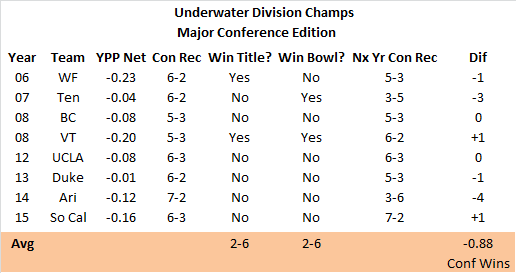
Speaking of division titles, you may have noticed Akron won the MAC East despite being ‘underwater’ in terms on their Net YPP. How often do teams with negative per play differentials win their divisions? I’m glad you asked. I have YPP data back to 2005, so I fired up the Excel spreadsheet and perused the data to find out. Since 2005, there have been seven such instances (including Akron in 2017) of mid-major teams finishing with negative in-conference YPP numbers and winning their division. They are listed chronologically in the table below.
There was a bit of a hiatus following the 2008 season, but since 2014, an average of one mid-major division champion per season has finished with a negative per play differential. As we might expect, those underwater division champs have seen their luck run out in the conference championship games. Buffalo and East Carolina in 2008 are the only teams to win their respective conference championships. This cohort has also performed quite poorly in their bowls games, winning just once in seven games. And finally, the teams tend to decline the next season, although there are some notable exceptions in East Carolina and Bowling Green. The Pirates repeated as Conference USA champions in 2009 while Bowling Green improved dramatically in their second season under Dino Babers en route to a MAC title in 2015. However, despite those examples of improvement, I would expect the Zips to perform closer to the average underwater division champ and experience at least a modest decline in 2018.

To satisfy my own curiosity, I decided to look at major conference (BCS and Power Five) division winners that finished underwater. Surprisingly, since 2005, there were actually more division champs from major conferences that finished with negative in-conference YPP differentials. I figured the more egalitarian nature of mid-major conferences would produce more underwater division winners, but at least in this thirteen year sample, that did not occur. And interestingly, none of the underwater division champs got that way via technicality. I figured UCLA in 2011 or Georgia Tech in 2012, winners due to postseason bans of their division mates, would be on this list, but they actually posted positive Net YPP numbers.
Once again, the underwater division winners do not have a good record in conference title games. My alma mater closed the deal in 2006 and the 2008 ACC Championship Game pitted two underwater teams, so one of them had to prevail, but overall the division winners are 2-6 in title games and 2-6 in bowl games. The major conference division winners did not decline as much as their mid-major counterparts on average the next season, but we are dealing with a pretty small sample size here, so I wouldn’t draw any major conclusions from that. I’ll keep my fingers crossed for an underwater major conference division champ in 2018.

Thursday, March 15, 2018

2017 Adjusted Pythagorean Record: Conference USA

Last week, we looked at how Conference USA teams fared in terms of yards per play. This week, we turn our attention to how the season played out in terms of the Adjusted Pythagorean Record, or APR. For an in-depth look at APR, click here. If you didn’t feel like clicking, here is the Reader’s Digest version. APR looks at how well a team scores and prevents touchdowns. Non-offensive touchdowns, field goals, extra points, and safeties are excluded. The ratio of offensive touchdowns to touchdowns allowed is converted into a winning percentage. Pretty simple actually.

Once again, here are the 2017 Conference USA standings.
And here are the APR standings sorted by division with conference rank in offensive touchdowns, touchdowns allowed, and APR in parentheses. This includes conference games only with the championship game excluded.
Finally, Conference USA teams are sorted by the difference between their actual number of wins and their expected number of wins according to APR.
I use a game and a half as a line of demarcation to determine if teams drastically over or under perform their APR. By that standard three teams (North Texas, Florida International, and Old Dominion) exceeded their expected record and two (Marshall and Rice) finished with fewer wins than we would expect given their APR. North Texas and Florida International also finished with more wins than we might expect based on YPP and we discussed why last week. What about Old Dominion? How did they exceed their expected record? Old Dominion posted a decent record in close conference games, winning three of five, but the Monarchs finished with a poor APR because they were blown out often. The Monarchs lost three conference games by at least thirty points. Consistently finishing on the wrong end of blowouts typically indicates a team is not very good (groundbreaking analysis) and the Monarchs were no stranger to that in 2017. On the other side of things, Rice also finished with fewer wins than we would expect based on YPP and we discussed some reasons for that last week. But why did Marshall underperform? The Thundering Herd finished 1-3 in close conference games, with their last two losses coming by a combined three points. They also finished second to last in the league with an in-conference turnover margin of -6. Switch a few plays here and there, and the Herd finish with double-digit wins.

Last week, we talked about teams that improved significantly, and what to expect from them moving forward. Conference USA had the distinction of featuring two teams that won at least four more conference games in 2017 than they had in 2016. The conference was also home to a team that lost four more conference games in 2017 than it did in 2016. Old Dominion finished the 2016 season with a 7-1 conference record. Their head-to-head loss to Western Kentucky meant they were denied a shot at the conference title, but this was still a phenomenal season for a team that did not exist a decade ago. In 2017, the Monarchs finished just 3-5 on Conference USA. Which result are we more likely to see in 2018? Are the Monarchs likely to bounce back or should Old Dominion fans get used to finishing with more losses than wins? To answer that question, I examined every mid-major (non BCS or Group of Five) team that lost at least four additional conference games than they had the previous season since 2005. This query yielded 30 teams, not including the four that experienced this regression in 2017 (in addition to Old Dominion, New Mexico, Tulsa, and Western Michigan also lost at least four more conference games in 2017 than they had in 2016). How did those 30 teams perform the following season? The results are summarized below.
More than 70% of those teams saw their conference record improve the following season and exactly half improved their conference record by at least two games. Only ten percent saw their conference record further erode and about 17% finished with the same conference record. Overall, the average team improved by 1.75 conference wins.

Old Dominion did outperform their APR by over one and a half wins in 2017, which typically portends regression the following season. Their large number of blowout losses (including non-conference games, the Monarchs lost five times by at least thirty points) also concerns me when projecting their 2018 record. However, as evidenced by similar mid-major squads that suffered dramatic one-year declines, improvement is hardly out of the question. The Monarchs have a quality head coach and dealt with a host of injuries last season. I wouldn’t expect another co-division title, but a return to postseason play is certainly within reach.

Thursday, March 08, 2018

2017 Yards Per Play: Conference USA

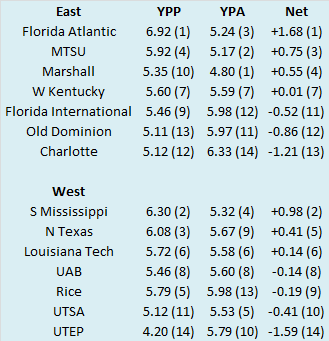
After six straight weeks of major conference teams, let's show some live to the Group of Five. Next up is Conference USA. Here are the 2017 Conference USA standings.
So we know what each team achieved, but how did they perform? To answer that, here are the Yards Per Play (YPP), Yards Per Play Allowed (YPA) and Net Yards Per Play (Net) numbers for each Conference USA team. This includes conference play only, championship game excluded. The teams are sorted by division by Net YPP with conference rank in parentheses.
College football teams play either eight or nine conference games. Consequently, their record in such a small sample may not be indicative of their quality of play. A few fortuitous bounces here or there can be the difference between another ho-hum campaign or a special season. Randomness and other factors outside of our perception play a role in determining the standings. It would be fantastic if college football teams played 100 or even 1000 games. Then we could have a better idea about which teams were really the best. Alas, players would miss too much class time, their bodies would be battered beyond recognition, and I would never leave the couch. As it is, we have to make do with the handful of games teams do play. In those games, we can learn a lot from a team’s YPP. Since 2005, I have collected YPP data for every conference. I use conference games only because teams play such divergent non-conference schedules and the teams within a conference tend to be of similar quality. By running a regression analysis between a team’s Net YPP (the difference between their Yards Per Play and Yards Per Play Allowed) and their conference winning percentage, we can see if Net YPP is a decent predictor of a team’s record. Spoiler alert. It is. For the statistically inclined, the correlation coefficient between a team’s Net YPP in conference play and their conference record is around .66. Since Net YPP is a solid predictor of a team’s conference record, we can use it to identify which teams had a significant disparity between their conference record as predicted by Net YPP and their actual conference record. I used a difference of .200 between predicted and actual winning percentage as the threshold for ‘significant’. Why .200? It is a little arbitrary, but .200 corresponds to a difference of 1.6 games over an eight game conference schedule and 1.8 games over a nine game one. Over or under-performing by more than a game and a half in a small sample seems significant to me. In the 2017 season, which teams in Conference USA met this threshold? Here are Conference USA teams sorted by performance over what would be expected from their Net YPP numbers.
While our last conference (Big 12) saw its standings pretty much conform to YPP, Conference USA presents us with a few outliers. North Texas, UAB, and Florida International exceeded their expected record and Rice under-performed relative to their peripherals. North Texas, UAB, and Florida International all posted solid records in close games, combining to finish 10-3 in one-score conference games. However, North Texas was the only team with an unsustainable record, as the Mean Green finished 4-0 in such contests. The Blazers (3-2) and Panthers (3-1) were well within the standard deviation for close games in such a small sample as an eight game conference season. UAB also boasted the second best in-conference turnover margin among Conference USA teams (+8), while North Texas (-6) and Florida International (+1) were not propped up by fantastic turnover margins. Finally, North Texas and Florida International can attribute some of their success to the kicking game. The Mean Green and Panthers combined to make 25 of 27 field goals in conference games. No coach or fan wants to settle for a field goal attempt in lieu of a touchdown, but making them is always preferable to missing them. As for Rice, they were 0-2 in one-score conference games, had the worst in-conference turnover margin of any team in Conference USA (-11), and were one of the worst teams in the nation at finishing drives. Rice attempted just five field goals all season (four in conference play) and converted just three (two in conference play). They also converted less than 40% of their fourth down attempts. These turnovers, missed kicks, and failed conversions all combined to make Rice look much worse than their bad, but hardly debilitating peripherals.

If you follow Conference USA closely, you probably noticed the 2017 standings looked markedly different from the ones of the prior year. The two participants in the 2017 conference championship game both finished with losing conference records the previous year. The 2016 co-champs from the east (Old Dominion and Western Kentucky) finished four and three games worse respectively in conference play. Marshall shared the east cellar with Florida Atlantic in 2016, but rebounded to win half their conference games in 2017. UAB didn’t even play football in 2016, yet they nearly won the west in 2017. In short 2017 was mass hysteria, dogs and cats living together, real wrath of god type stuff. What can we expect from those teams moving forward? Were their gains and losses a signal of where they will be in 2018 or were they just a lot of noise? Specifically, I want to examine the three teams that saw significant differences in their 2016 and 2017 conference records. I’ll define significant as a difference of at least four conference games. Since the conference season is only eight games long, finishing four or more games better or worse makes a profound difference in the standings. Three teams in Conference USA finished with a conference record at least four games different from 2016.
This week I want to focus on the two teams that improved significantly in 2017, and also matched up in the Conference USA Championship Game. We’ll look at Old Dominion next week. To get an idea of what to expect from the Owls and Mean Green going forward, I looked to the past. I examined every mid-major (non BCS or Group of Five) team that won at least four additional conference games than they had the previous season since 2005. This query yielded 33 teams, not including the four that accomplished the feat in 2017 (in addition to Florida Atlantic and North Texas, Fresno State and the national champions from UCF also improved their conference record by at least four games). How did those 33 teams perform the following season? The results are summarized below.
More than three quarters of those teams saw their conference record decline the following season and nearly 58% of the teams saw their conference record decline by at least two games. Only about nine percent of the teams further solidified their gains and improved their conference record. Overall, the average team declined by nearly two conference wins.

Of course, I would be remiss if I did not mention one extreme outlier. UCF finished conference play 0-8 in 2015. They hired Scott Frost and improved significantly in 2016, finishing 4-4. Frost and his charges scoffed at regression’s magnetic pull and further improved to 8-0 in 2017. As the previous table shows, only three teams saw continued improvement after their one season of significant improvement. Those other two teams both improved by one game apiece (UCF from 2012 to 2013 and Air Force from 2013 to 2014 if you were curious). In the interest of full disclosure, this is what the averages would look like if Scott Frost’s UCF team did not exist.
Suffice it to say, Florida Atlantic and North Texas face an uphill battle to return to the championship game in 2018. Obviously, it would be impossible for Florida Atlantic to improve upon their conference record in 2018, but don’t just assume the Lane Train will keep barreling along. There may be trouble ahead or even trouble behind. Similarly, North Texas will also face challenges in defending their division title. And when you consider they were probably a little lucky to win the division in the first place, at least according to YPP, they would be my bet to not meet expectations in 2018.

Thursday, March 01, 2018

2017 Adjusted Pythagorean Record: Big 12

Last week, we looked at how Big 12 teams fared in terms of yards per play. This week, we turn our attention to how the season played out in terms of the Adjusted Pythagorean Record, or APR. For an in-depth look at APR, click here. If you didn’t feel like clicking, here is the Reader’s Digest version. APR looks at how well a team scores and prevents touchdowns. Non-offensive touchdowns, field goals, extra points, and safeties are excluded. The ratio of offensive touchdowns to touchdowns allowed is converted into a winning percentage. Pretty simple actually.

Once again, here are the 2017 Big 12 standings.
And here are the APR standings sorted by division with conference rank in offensive touchdowns, touchdowns allowed, and APR in parentheses. This includes conference games only with the championship game excluded.
Finally, Big 12 teams are sorted by the difference between their actual number of wins and their expected number of wins according to APR.
I use a game and a half as a line of demarcation to determine if teams drastically over or under perform their APR. By that standard no team drastically over or under-performed relative to their APR. Since we don't have anything interesting to talk about here, let's talk about one of the most interesting teams in the Big 12: Kansas.

For anyone who has followed Kansas football the last few seasons, let me start by offering my heartfelt apologies. Since 2010, Kansas football has been a dumpster fire. While the basketball team just won their fourteenth consecutive Big 12 title, the football team has managed a grand total of four conference wins in that span! Some might argue Kansas has been atrocious since 2009, and while its true the Jayhawks won just a single conference game in 2009, that team was at least competitive. The 2009 Kansas team actually scored more points (353) than they allowed (341) and were unlucky to finish with just one conference win, losing three games by a touchdown or less. The Jayhawks ended the year on a seven-game losing streak. This made it much easier to fire their successful, player-abusing coach. Since Mark Mangino’s departure, the program has cratered. Kansas has now won three or fewer games for eight consecutive seasons. This got me to thinking, how does Kansas stack up with other woeful power conference teams? Are the Jayhawks currently in the midst of one of the worst runs in recent college football history or do they have company in the gutter? To answer that question, first I needed to identify a reasonable time period to examine. College football has been played for a long time, but the game looked pretty different in the early 1900s, so comparing Kansas to the 1901 Bowdoin Polar Bears doesn’t provide much value. However, in 1984 a pretty significant event occurred that revolutionized college football. The SCOTUS ruled that individual conferences and schools could negotiate their own television deals. Using this watershed moment as a clear delineation, we’ll define post-1984 as the ‘modern era’ of college football. So, with three and a half decades of history, I looked at power conference teams (this includes the current Power 5 and former BCS conferences as well as those teams in the old Southwest Conference prior to the formation of the Big 12) that won three or fewer games in at least six consecutive seasons with a negative SRS score. SRS measures how many points a team is above or below average and ensures that our query captures teams that were truly bad, and not those that were simply unlucky.

In addition to Kansas, five other teams met these criteria. They are listed below.
The good news for Kansas is that most of these teams experienced at least a modicum of success shortly after their sojourn through the wilderness. Baylor almost qualified for a bowl game in 2005, hired Art Briles a few years later, and reached unfathomable heights (with no off field troubles whatsoever). Iowa State saw outstanding individual achievement even in the core of their struggles. It took Dan McCarney a few years to find traction, but the Cyclones played in five bowls in six seasons between 2000 and 2005. During their miserable run in the 80’s Kansas State hired the best coach in college football history and nearly played for the national title in 1998. After a brief retirement, The Wizard is still in Manhattan working miracles. Northwestern played in the Rose Bowl in 1995 and have been annual bowl contenders since. It took Temple longer than the other four teams to reach respectability, but even after they were booted from the Big East, the Owls managed to play in a bowl game within a decade and even won their conference in 2016. Yes Kansas fans, things may look bleak now, but climbing out of the muck can happen quicker than you might expect. Of course, the Jayhawks have produced their worst SRS scores in their current run of inefficacy under head coach David Beatty, so he may not be the man to coach the next bowl bound Jayhawk team.

One thing that surprised me when gathering this data was the teams that did not appear on this list. I figured ACC punching bags Wake Forest and Duke as well as SEC bottom dweller Vanderbilt would meet the criteria for inclusion. While all have fielded bad teams since the mid-80’s, they have always managed to intersperse those years of futility with moments of competency.

Thursday, February 22, 2018

2017 Yards Per Play: Big 12

Three conferences down, seven to go. Next up is the Big 12. Here are the 2017 Big 12 standings.
So we know what each team achieved, but how did they perform? To answer that, here are the Yards Per Play (YPP), Yards Per Play Allowed (YPA) and Net Yards Per Play (Net) numbers for each Big 12 team. This includes conference play only, championship game excluded. The teams are sorted by Net YPP with conference rank in parentheses.
College football teams play either eight or nine conference games. Consequently, their record in such a small sample may not be indicative of their quality of play. A few fortuitous bounces here or there can be the difference between another ho-hum campaign or a special season. Randomness and other factors outside of our perception play a role in determining the standings. It would be fantastic if college football teams played 100 or even 1000 games. Then we could have a better idea about which teams were really the best. Alas, players would miss too much class time, their bodies would be battered beyond recognition, and I would never leave the couch. As it is, we have to make do with the handful of games teams do play. In those games, we can learn a lot from a team’s YPP. Since 2005, I have collected YPP data for every conference. I use conference games only because teams play such divergent non-conference schedules and the teams within a conference tend to be of similar quality. By running a regression analysis between a team’s Net YPP (the difference between their Yards Per Play and Yards Per Play Allowed) and their conference winning percentage, we can see if Net YPP is a decent predictor of a team’s record. Spoiler alert. It is. For the statistically inclined, the correlation coefficient between a team’s Net YPP in conference play and their conference record is around .66. Since Net YPP is a solid predictor of a team’s conference record, we can use it to identify which teams had a significant disparity between their conference record as predicted by Net YPP and their actual conference record. I used a difference of .200 between predicted and actual winning percentage as the threshold for ‘significant’. Why .200? It is a little arbitrary, but .200 corresponds to a difference of 1.6 games over an eight game conference schedule and 1.8 games over a nine game one. Over or under-performing by more than a game and a half in a small sample seems significant to me. In the 2017 season, which teams in the Big 12 met this threshold? Here are Big 12 teams sorted by performance over what would be expected from their Net YPP numbers.
No team significantly over or under-performed their YPP numbers in 2017. Oh well. However, that does give us more bandwidth to discuss other facets of the Big 12.

The Big 12 began play in 1996 and continued along in flyover country unfettered until 2010. By that point, the conference was in turmoil. Concerned that the Big 12 was looking out for Texas at the expense of the other members, several teams left the conference. Colorado, Missouri, Nebraska, and Texas A&M all left prior to the 2012 season and the Big 12 replaced them with TCU and West Virginia. The current ten-team version of the Big 12 has existed for six seasons and since a reasonable amount of time has passed, I thought it would be interesting to look at how the member teams have performed. Here are the cumulative Big 12 conference standings since 2012.
Even casual fans could have predicted the Sooners would have the best conference record in that span, but some may have been surprised that their in-state rivals have the second best record, and perhaps even more surprised that five teams have a better conference record than Texas. In addition, the depths to which the Jayhawks have fallen are stark when laid out next to their conference mates. Three conference wins in six seasons is bordering on relegation territory. But a simple aggregation is not all I wanted to examine here. You could easily pull those numbers and record them yourself. No, I want to dig a little deeper. And the shovel we are going to use is the NFL draft.

To win games in any sport, you need good players. Recruiting rankings do a great job in the aggregate of predicting the best teams in college football. Of course, some teams tend to over or under-perform their respective recruiting rankings. Other authors on the internet have examined these teams and you may want to give them a read (after this one of course). However, there is another proxy for talent, but this one comes on the back end, instead of the front end. If you read the previous paragraph, you obviously know I am referring to the NFL draft. Here are the total number of draft picks for each current Big 12 team since 2013 (the first draft after the 2012 season).
Once again, Oklahoma is the king of the hill in the Big 12. The Sooners have had the most players drafted since 2013. However, while the Sooners have had 25 total players drafted since 2013, they have only had one player selected in the first round. Meanwhile, West Virginia has had nine fewer players selected than Oklahoma, but they have had three times as many first round picks. We need a way to quantify how valuable each of these picks are. In the interest of simplicity, I came up with this system: Since there are seven rounds in the NFL draft, a first round pick is worth seven points, a second round pick is worth six points, and so on, until the chaff in the seventh round are worth just a single point. Obviously, this system is not perfect as picks that occur alongside each other could be worth different amounts. The last pick in the first round would be worth seven points while the first pick in the second round would be worth six points. Another issue is the first pick in the draft is worth the same as the last pick in the first round. Of course, we are not attempting to create a perfect value system, but rather a proxy for estimating how much talent each team had on campus. With those caveats out of the way, here are the Big 12 teams ranked by Draft Points since the 2013 NFL draft.
So, the next step is obvious right? Let’s run a regression analysis and see how well this Draft Points metric predicts conference record. One step ahead of you. Conference record is somewhat positively correlated to Draft Points with an R squared value of .477 meaning roughly 47.7% of the variation in conference record is explained by Draft Points. So now, let’s use Draft Points to predict conference record and see which teams have over or under-performed relative to the talent on their roster according to NFL evaluators.
Oklahoma State and to a lesser extent Kansas State have won more games that we would expect from their talent. If I were into trite platitudes, I might say: ‘Their whole is greater than the sum of their parts’. On the other end of the spectrum, Kansas had more players drafted than conference wins. Ouch. Of course, Kansas is not the only team with reason to be ashamed. West Virginia has produced the second most Draft Points since joining the conference, but they have managed just a .500 record in league play.

This analysis has some shortcomings. Foremost, the 2018 draft has not happened yet, and several Oklahoma State players are likely to hear their names called, so this is a little biased in favor of Mike Gundy. Secondly, some solid contributors or even great players may find their skills do not translate to the next level. Their coaches and teams should not be credited for finding and developing an obvious talent who just happens to not have the requisite skills to play professionally. Thirdly, NFL talent evaluators are fallible. Maybe that first round pick is not really any good. Similarly, maybe that undrafted player has the necessary skills to contribute or even be a star. Finally, as I mentioned previously, Draft Points are a flawed proxy for talent. Is a first round pick worth seven times as much as a seventh round pick? I don’t have any idea. I was shooting for speed and comfort instead of a long-lasting metric. I’m sure there are other issues with the analysis, but I’ll leave them for you to critique. Still, I think this exercise was valuable. The two coaches who exceeded their expected record based on Draft Points ('Solomon' Gundy and Bill Snyder) are the best in the respective histories of their schools while the coach who most failed to meet expectations (non-Kansas edition) has been on the hot seat since his team joined the Big 12.

Thursday, February 15, 2018

2017 Adjusted Pythagorean Record: Big 10

Last week, we looked at how Big 10 teams fared in terms of yards per play. This week, we turn our attention to how the season played out in terms of the Adjusted Pythagorean Record, or APR. For an in-depth look at APR, click here. If you didn’t feel like clicking, here is the Reader’s Digest version. APR looks at how well a team scores and prevents touchdowns. Non-offensive touchdowns, field goals, extra points, and safeties are excluded. The ratio of offensive touchdowns to touchdowns allowed is converted into a winning percentage. Pretty simple actually.

Once again, here are the 2017 Big 10 standings.
And here are the APR standings sorted by division with conference rank in offensive touchdowns, touchdowns allowed, and APR in parentheses. This includes conference games only with the championship game excluded.
Finally, Big 10 teams are sorted by the difference between their actual number of wins and their expected number of wins according to APR.
I use a game and a half as a line of demarcation to determine if teams drastically over or under perform their APR. By that standard Michigan State and Rutgers exceeded their APR while Iowa fell short. Last week, I touched on why Michigan State was able to win seven of their nine conference games despite middling peripherals, but I’ll once again highlight their 5-1 record in one-score conference games. Rutgers was 2-0 in one-score conference games, but the reason their APR is so low is due to the other seven conference games, in particular, their six losses. Rutgers' three conference wins came by a combined 20 points. Five of their six conference losses came by more than that. Their ten point loss to Nebraska represented their best performance in a losing effort. Their average margin of defeat in the other five games was 36 points! Consistently getting blown out will tramp down your APR. Finally, Iowa's APR score is due to a confluence of factors. Their inexplicable performance against Ohio State somewhat inflates their season numbers, but the Hawkeyes were also a slightly unlucky 1-3 in one-score conference games. Change a few plays here or there, especially in the Penn State or Northwestern games and Iowa’s record is much closer to their APR.

Once you become an adult, it’s no secret that life comes at you fast. One minute the president is an erudite, well-spoken intellectual capable of making you believe anything is possible. The next minute he’s a racist, septuagenarian. But I digress. I mention that because Urban Meyer has now coached more games at Ohio State than he did at Florida. I know. I’ll give you a second to collect yourself after that bombshell. What’s even more amazing is how well his Ohio State teams have performed in the clutch. The following table lists each Big 10 team’s record in one-score conference games since Meyer’s arrival in 2012.
The table is sorted by games above .500 instead of winning percentage to give you an idea of just how much Ohio State has owned close games. Ohio State’s margin of +13 is greater than the cumulative margin of the other five teams that have managed a winning record in close games (+12). In fact, if you think hard enough, you can probably recall the two instances in which Ohio State came out on the short end of a close game (this does not include Big Championship Games where Ohio State is 1-1 in close games). If close games are indeed a 50/50 proposition, then the chances of one team winning 15 of 17 is roughly 1 in 964.

As a comparison, how did Meyer do in close games at Florida? I’m glad you asked.
His Florida teams were not nearly as dominant (Les Miles, Tommy Tuberville, and Gene Chizik must have all had a rabbit’s foot), but the Gators still won more than they lost over a decent sample size. Meyer’s teams win close games at a rate that suggests it is more than just random chance. I wouldn’t expect his teams to continue winning close games at a nearly 90% clip, but the Buckeyes should continue to perform well in close games for the duration of Meyer’s tenure.

Thursday, February 08, 2018

2017 Yards Per Play: Big 10

We head to the heartland of America this week and examine the Big 10. Here are the Big 10 standings.
So we know what each team achieved, but how did they perform? To answer that, here are the Yards Per Play (YPP), Yards Per Play Allowed (YPA) and Net Yards Per Play (Net) numbers for each Big 10 team. This includes conference play only, with the championship game not included. The teams are sorted by division by Net YPP with conference rank in parentheses.
College football teams play either eight or nine conference games. Consequently, their record in such a small sample may not be indicative of their quality of play. A few fortuitous bounces here or there can be the difference between another ho-hum campaign or a special season. Randomness and other factors outside of our perception play a role in determining the standings. It would be fantastic if college football teams played 100 or even 1000 games. Then we could have a better idea about which teams were really the best. Alas, players would miss too much class time, their bodies would be battered beyond recognition, and I would never leave the couch. As it is, we have to make do with the handful of games teams do play. In those games, we can learn a lot from a team’s YPP. Since 2005, I have collected YPP data for every conference. I use conference games only because teams play such divergent non-conference schedules and the teams within a conference tend to be of similar quality. By running a regression analysis between a team’s Net YPP (the difference between their Yards Per Play and Yards Per Play Allowed) and their conference winning percentage, we can see if Net YPP is a decent predictor of a team’s record. Spoiler alert. It is. For the statistically inclined, the correlation coefficient between a team’s Net YPP in conference play and their conference record is around .66. Since Net YPP is a solid predictor of a team’s conference record, we can use it to identify which teams had a significant disparity between their conference record as predicted by Net YPP and their actual conference record. I used a difference of .200 between predicted and actual winning percentage as the threshold for ‘significant’. Why .200? It is a little arbitrary, but .200 corresponds to a difference of 1.6 games over an eight game conference schedule and 1.8 games over a nine game one. Over or under-performing by more than a game and a half in a small sample seems significant to me. In the 2017 season, which teams in the Big 10 met this threshold? Here are Big 10 teams sorted by performance over what would be expected from their Net YPP numbers.
The Big 10 saw three teams finish with records vastly different from their expected records. Michigan State and Northwestern over-performed relative to their expected records while Illinois under-performed. The Spartans and Wildcats rebounded from somewhat (Northwestern) and very (Michigan State) disappointing 2016 campaigns by coming through in the clutch. Michigan State and Northwestern combined to go 8-1 in one-score conference games with the Spartans (5-1) consistently edging their opponents. In fact, the lone close loss between these two came in their October matchup when the Wildcats upset the Spartans in triple overtime. Outside of that game, the teams combined for a perfect 7-0 record in one-score conference games. The Spartans and Wildcats also finished first and second in in-conference turnover margin (+8 for Michigan State and +7 for Northwestern). Meanwhile, Illinois cannot blame close games as only one of their nine conference defeats came by fewer than ten points. The Illini did finish last in in-conference turnover margin (-7), and as we will soon see, they are no stranger to under-performing their peripherals.

Illinois finished winless in Big 10 play in 2017 and just 2-10 overall. This was obviously a huge disappointment to Illini fans and anyone foolish enough to bet on them winning more than 3.5 games. Generally though, teams with the Illini’s YPP profile tend to win about a quarter of their conference games. Based on those YPP numbers, the Illini undershot their conference winning percentage by about .275. If you’ll recall, the Illini also failed to hit their expected conference winning percentage last season as well. They didn’t miss the mark by quite as much, but their under-performance by about .195 was among the worst in the Big 10. Cumulatively, the Illini have undershot their expected conference winning percentage by .470 in Lovie Smith’s two seasons (roughly four wins). How (poorly) does this stack up in recent history? I have YPP data going back to 2005, so I decided to look at all BCS/Power 5 teams that have undershot their expected conference winning percentage by at least .400 over two consecutive seasons. The results are summarized below. Two teams met the threshold this season, with Arizona joining Illinois.
Since 2005, twenty teams have under-performed by at least .400 over two consecutive seasons and Illinois has accounted for a quarter of those instances! Arizona and South Florida are the only other schools with multiple appearances (remember South Florida was in a BCS conference during this time period) and both are here primarily on the strength of one horrendous season bookended by other slightly below average seasons. Meanwhile, the Illini have done this multiple times under four different head coaches!

Alright, so the Illini have a penchant for under-performing, but what can we expect going forward? Are the Illini due for an incredible rebound? Excluding the current Illinois and Arizona teams, I looked at how the other 18 teams performed in the year immediately following their two consecutive years of under-performance. I compared this to the average conference record the team put together in the under-performing years and calculated the difference. The results are summarized below chronologically.
Illinois fans can take heart from this exercise. 13 teams improved their conference win total from the average of the previous two seasons, three saw no changes, and only two declined. The average improvement was by about one and a third games. Illinois has averaged one conference win over the previous two seasons (2-7 in 2016 and 0-9 in 2017), so I would set expectations at around two and a half conference wins in 2018. I don’t know how the Lovie Smith hire will work out in the long run (it seemed pretty unimaginative at the time), but if Smith doesn’t manage at least three conference wins in 2018, I would be inclined to fire him and start over

Thursday, February 01, 2018

2017 Adjusted Pythagorean Record: ACC

Last week, we looked at how ACC teams fared in terms of yards per play. This week, we turn our attention to how the season played out in terms of the Adjusted Pythagorean Record, or APR. For an in-depth look at APR, click here. If you didn’t feel like clicking, here is the Reader’s Digest version. APR looks at how well a team scores and prevents touchdowns. Non-offensive touchdowns, field goals, extra points, and safeties are excluded. The ratio of offensive touchdowns to touchdowns allowed is converted into a winning percentage. Pretty simple actually.

Once again, here are the 2017 ACC standings.
And here are the APR standings sorted by division with conference rank in offensive touchdowns, touchdowns allowed, and APR in parentheses. This includes conference games only with the championship game excluded.
Finally, ACC teams are sorted by the difference between their actual number of wins and their expected number of wins according to APR.
I use a game and a half as a line of demarcation to determine if teams drastically over or under perform their APR. By that standard Georgia Tech was the lone ACC team that saw their record differ significantly from their APR. The Yellow Jackets were a little unlucky in one-score games, going 1-2 in such contests. They also posted a poor, but hardly abysmal in-conference turnover margin of -5. Perhaps the biggest contributor to their bowl-less season was the vagaries of opposing field goal kickers. In ACC play, opponents attempted 17 field goals against Georgia Tech. They made fourteen. 82% is not an otherworldly field goal percentage, but in their three close conference games, Georgia Tech opponents made all eight of their attempts! Those made kicks, especially in the close losses to Miami and Virginia kept the Yellow Jackets home for the holidays for the second time in three seasons. 

2017 was a special season for the Clemson Tigers. Despite key losses from their title team, the defending national champions qualified for the College Football Playoff for the third consecutive season and in the process won their third consecutive ACC title. While the playoff is a relatively recent innovation, the ACC has been around for over 60 years, and in that time period, there have only been seven instances of a team winning three consecutive outright ACC titles.
Obviously, the qualifiers to the previous sentence are very important in framing this accomplishment. Florida State won nine consecutive ACC titles from their first year in the conference (1992) through 2000. However, a pair of shared titles in the middle of their run (1995 with Virginia and 1998 with Georgia Tech) prevented them from winning more than three outright titles in a row. Plus, with the addition of the ACC Championship Game in 2005, the conference only crowns an outright champion now instead of the potential for shared titles in the first 50+ years of the conference. Despite those qualifiers, this is still quite an accomplishment and the Tigers will take aim at becoming the first ACC team to ever win four consecutive outright conference titles in 2018.

Thursday, January 25, 2018

2017 Yards Per Play: ACC

The second conference up in our annual review is the ACC. Here are the ACC standings.
So we know what each team achieved, but how did they perform? To answer that, here are the Yards Per Play (YPP), Yards Per Play Allowed (YPA) and Net Yards Per Play (Net) numbers for each ACC team. This includes conference play only, with the championship game not included. The teams are sorted by division by Net YPP with conference rank in parentheses.
College football teams play either eight or nine conference games. Consequently, their record in such a small sample may not be indicative of their quality of play. A few fortuitous bounces here or there can be the difference between another ho-hum campaign or a special season. Randomness and other factors outside of our perception play a role in determining the standings. It would be fantastic if college football teams played 100 or even 1000 games. Then we could have a better idea about which teams were really the best. Alas, players would miss too much class time, their bodies would be battered beyond recognition, and I would never leave the couch. As it is, we have to make do with the handful of games teams do play. In those games, we can learn a lot from a team’s YPP. Since 2005, I have collected YPP data for every conference. I use conference games only because teams play such divergent non-conference schedules and the teams within a conference tend to be of similar quality. By running a regression analysis between a team’s Net YPP (the difference between their Yards Per Play and Yards Per Play Allowed) and their conference winning percentage, we can see if Net YPP is a decent predictor of a team’s record. Spoiler alert. It is. For the statistically inclined, the correlation coefficient between a team’s Net YPP in conference play and their conference record is around .66. Since Net YPP is a solid predictor of a team’s conference record, we can use it to identify which teams had a significant disparity between their conference record as predicted by Net YPP and their actual conference record. I used a difference of .200 between predicted and actual winning percentage as the threshold for ‘significant’. Why .200? It is a little arbitrary, but .200 corresponds to a difference of 1.6 games over an eight game conference schedule and 1.8 games over a nine game one. Over or under-performing by more than a game and a half in a small sample seems significant to me. In the 2017 season, which teams in the ACC met this threshold? Here are the ACC teams sorted by performance over what would be expected from their Net YPP numbers.
Clemson was the only team to significantly over or under-perform their respective YPP numbers. Clemson's Net YPP of 0.66 was drastically below their 2015 (+2.31) and 2016 (+1.59) numbers, yet the Tigers still managed to win their third straight ACC title and qualify for their third consecutive playoff. How did they do it? You can't blame close games, where the Tigers were 1-1 in conference play. Their in-conference turnover margin of +4 was also not very extreme. The place where Clemson excelled was non-offensive touchdowns. The Tigers scored four in ACC play and did not allow any. Most of those returns also came in crucial situations. The Tigers interception return against Virginia Tech came on a tipped pass in the fourth quarter after the Hokies got the ball back trailing by two touchdowns. That effectively ended the game. Their fumble return against Syracuse came in the second quarter with the Tigers trailing by a touchdown. It tied the game and allowed the Tigers to remain competitive despite their offensive struggles. Finally, their punt return against NC State tied the game early in the first quarter and ended up providing the winning margin in a game that all but wrapped up the division for the Tigers. In addition, outside of Florida State, the Atlantic Division was more competitive overall. This stiffer competition meant Clemson was not able to run up their efficiency margins as they had the previous two seasons.

A few weeks ago, Louisville quarterback Lamar Jackson announced he would be forgoing his senior season and entering the 2018 NFL Draft. Jackson had an illustrious career at Louisville, winning the Heisman Trophy in 2016, finishing as a finalist in 2017, and accounting for 119 touchdowns in less than three full seasons. Regardless of his performance in the NFL, Jackson will be remembered as one of the best college quarterbacks of all-time. However, when reviewing his career at Louisville, I get the feeling the Cardinals did not take full advantage of his talents.

Jackson started 33 games during his time at Louisville. The Cardinals won 22 of his starts. That’s not bad. Any number of schools would certainly ‘settle’ for winning two thirds of their games. However, outside of one historic home game a breakout bowl performance, Louisville never really beat any good teams during Jackson’s tenure. The following table lists the teams Louisville beat in games Jackson started. The table also lists the final record of those teams and their SRS ranking for that particular year.
Of the 20 FBS teams Louisville beat, eleven finished with a losing record. 18 finished with seven or fewer wins, and only Texas A&M and Florida State won at least eight games. Those 20 FBS teams had a cumulative record of 105-145. If we look at SRS as a proxy for team strength, only one vanquished FBS foe ranked in the top-ten and only three ranked in the top-30. Twelve finished with below average (i.e. worse than half of FBS) ratings.

I am not blaming Lamar Jackson for the dearth of Louisville’s team accomplishments. In fact, Jackson deserves great praise for a game that is not listed here. In his freshman season, Jackson began the annual rivalry game with Kentucky on the bench before rallying his team from a 21-0 deficit. If you want to blame someone, try Bobby Petrino. Fault him for not surrounding Jackson with enough talent, particularly on defense and along the offensive line, to take advantage of a transcendent talent.