Sunday, April 29, 2012

2012 SEC SDPI

In our final BCS conference SDPI examination of the 2011 college football season, we come to the SEC, home of the last six national champions, and the home to both participants in the 2011 BCS National Championship Game. To see last year's post on the SEC, click here.

This first paragraph will explain how SDPI is calculated. So if you want the meat of this article skip on down. In the 2011 SEC regular season, conference play only, championship game excluded, the average SEC team gained and allowed 2612.33 yards. The standard deviation for yards gained (offense) was 511.33 yards. The standard deviation for yards allowed (defense) was 633.43 yards. Arkansas gained 3217 yards and allowed 2912 yards. Their offensive SDPI was 1.18 = [(3217-2612.33)/511.33]. Their defensive SDPI was -0.47 = [(2612.33-2912)/633.43]. Their total SDPI was 0.71. This number ranked 5th in the SEC.

Here are the 2011 SEC standings.

Now here are the 2011 SEC SDPI standings. The standings are sorted by division by total SDPI with ranking for each category (out of 12 teams) in parentheses.

Statistically, Alabama was head and shoulders above the rest of the league. Unfortunately, their kicking errors and lack of success in the red zone allowed LSU to win the SEC championship. Fortunately for them, enough upsets occurred elsewhere in college football to allow them a rematch with the Tigers in the BCS National Championship Game. And the rest, as they say, is history.

So Who Was Better Than Their Record Showed?
Vanderbilt qualified for a bowl game in James Franklin's first season as head coach, but their 2-6 SEC record was not indicative of their play. The Commodores were a hard-luck 0-4 in one-score games, losing close contests in Nashville to Georgia and Arkansas and on the road to Florida and Tennessee. Vanderbilt was also exceptionally dominant in their two league wins, beating Ole Miss and Kentucky by a combined 53 points.

So Who Was Worse Than Their Record Showed?
The easy answer here is LSU as the Tigers did not have the statistical profile of an unbeaten team. However, the correct answer is the other Tigers from Auburn. Auburn's four SEC wins came by a combined 39 points. Their four SEC losses came by a combined 125 points. Team's that post Auburn's statistical profile typically win about two of eight conference games. All things being equal, they should have switched records with Vanderbilt in 2011.

Conference Superlatives:

Best Offense: Alabama 1.37
Even when they posted back-to-back 8-0 SEC records in 2008 and 2009, the Crimson Tide only finished fifth in offense in the conference. The 2011 offense was incredibly consistent, gaining between 366 and 437 yards six times in their eight league games.

Worst Offense: Kentucky -1.49
After losing quarterback Mike Hartline and receiver Randall Cobb from the third ranked SEC offense in 2010, the Wildcats plummeted to the worst offense in the conference. The Wildcats were held to ten or fewer points in six of their eight league games!

Best Defense: Alabama 1.84
The Tide were uber-dominant on this side of the ball. Five of their eight SEC opponents were held below 200 yards and no team gained more than 239 yards against them!

Worst Defense: Ole Miss -1.40
Facing the top-four offenses in the conference (Alabama, Georgia, Arkansas, and LSU) didn't help their numbers, but the Rebels were bad anyway you slice it. Remember, they gave up 30 points to the worst SEC offense (Kentucky).

John L Smith: The 'L' is for Loser
As you may have heard, the Arkansas Razorbacks have experienced a change in their head coaching position. I won't dwell on the circumstances surrounding the ouster of Bobby Petrino, but a cursory Google search should lead you to the story if you've been out of the loop. However, I will focus on his replacement, one John L Smith. Arkansas marks Smith's sixth destination as a head coach. Smith previously coached at Idaho (when they were IAA), Utah State, Louisville, Michigan State, and Weber State (more on that later). I am of the opinion that Arkansas could not have done much worse in their search for a replacement for Mr. Petrino. I will let you know up front, what follows is a hugely biased hatchet job, not unlike the Fox News special report on gas prices that aired a few weeks ago. However, unlike Fox News, I admit my biases. Why do I have such disdain for Mr. Smith? Primarily because I feel that much like Greg Norman at a golf tournament, John L Smith finds a way to lose. I believe that his teams constantly underachieved relative to their talent level. How can one go about determining whether or not a team under or overperformed? One way is to look at a team's Pythagorean Record. A team's Pythagorean Record is their predicted record based on the ratio of the points they scored to the points they allowed. First developed by Bill James for use in baseball, a team's Pythagorean Record can give us a pretty good approximation of a team's record. With that in mind, I looked at the IA teams coached by John L Smith in the 12 seasons from 1995-2006. I took each of his team's record against IA foes and compared it to their expected record based on the Pythagorean Theorem. For fun, I also calculated each team's record in one-score games. The table below summarizes the results.

In 12 seasons, Smith's teams finished a little more than six games worse than where we would have expected them to finish based on their points scored and allowed. Is this a huge difference? I don't know. To answer this question, we would need to calculate how other coaches have performed relative to their Pythagorean Record over an extended period of time. Perhaps one day I shall embark on that brave undertaking. For now though, we can say that his teams underperformed their Pythagorean Record over 12 seasons and 137 games (a relatively large sample). His teams drastically underperformed during his four seasons in East Lansing, finishing over four games below where they would have been expected to finish based on their scoring ratios. In addition, over a relatively healthy sample size of 50 games, his teams won just 40% of their one-score contests (20-30 record).

In addition to the Pythagorean numbers, I also examined the results for each game Mr. Smith coached over those 12 seasons to see if I could find any head-scratching results. I found a few. In 1995, his Utah State Aggies lost to Boise State when the Broncos were still a IAA team. In 1997, his bowl bound Utah State Aggies lost to a North Texas team that finished 4-7. His second Louisville team lost to a 3-9 Army squad 52-59. Army scored just 225 points that whole season and were shut out twice. His first Michigan State team lost at home to a 5-7 Louisiana Tech squad in 2003. His 2004 team missed out on a bowl because they lost the season opener to Rutgers. Rutgers finished 4-7 that season and lost the very next week to IAA New Hampshire. That same Spartan team also provided one of the few bright spots in Tyrone Willingham's final season as coach of Notre Dame as the Irish beat Michigan State in east Lansing en route to a 6-6 record. Michigan State also lost to Penn State in 2004. As you may not remember, that Penn State team went just 4-7 and prior to their 37 point outburst against the Spartans, the Nittany Lions had averaged just a shade over 9 points per game in their first seven Big 10 games. 2005 featured this historic meltdown that can't be put into words.

Finally, in his Michigan State swan song, his charges blew a huge lead at home against Notre Dame and also lost by 25 points to an Indiana team that finished 5-7.Of course, I'll admit, if you look hard enough, you can find some fantastic performance from his teams, like the greatest comeback in college football history. On the other hand, what are you doing trailing Northwestern by 35 points in the first place?

 Finally, while I obviously don't know Smith personally, his dealings with his employers have been less than forthright. He allegedly accepted the Michigan State job at halftime of Louisville's 2002 bowl game. He also left Weber State hanging by accepting the Arkansas job before coaching a game for the Wildcats.We'll see how Smith does with the great talent on hand at Arkansas, but consider me extremely skeptical of this coaching hire.

Sunday, April 22, 2012

2011 Pac-12 SDPI

This week in our SDPI journey, we attempt to shed our east-coast bias and examine the Pac-12. To see last year's post on what was then known as the Pac-10, click here.

This first paragraph will explain how SDPI is calculated. So if you want the meat of this article skip on down. In the 2011 Pac-12 regular season, conference play only, championship game excluded, the average Pac-12 team gained and allowed 3707.75 yards. The standard deviation for yards gained (offense) was 569.97 yards. The standard deviation for yards allowed (defense) was 392.36 yards. Cal gained 3656 yards and allowed 3225 yards. Their offensive SDPI was -0.09 = [(3656-3707.75)/569.97]. Their defensive SDPI was 1.23 = [(3707.75-3225)/392.36]. Their total SDPI was 1.14. This number ranked 3rd in the Pac-12.

Here are the 2011 Pac-12 standings.

Now here are the 2011 Pac-12 SDPI standings. The standings are sorted by division by total SDPI with ranking for each category (out of 12 teams) in parentheses.
In 2011, the Pac-12 was a top heavy league, both in national reputation and actual performance. Three teams (Oregon, Stanford, and Southern Cal) finished the season ranked in the top-10, but no other team was ranked in the top-25. Similarly, four teams (Stanford, Oregon, Southern Cal, and Cal) finished with SDPI ratings over 1.00. However, none of the other eight teams finished with a positive SDPI rating. The two newcomers to the conference suffered the indignity of finishing eleventh and twelfth in the conference in SDPI.

So Who Was Better Than Their Record Showed?
The California Golden Bears finished with a losing conference record despite boasting one of the strongest defenses in the conference. Why did the Bears have a relatively grisly record, at least compared to their statistical profile? One reason is schedule strength. The Bears were unfortunate to reside in the same division as the top-two teams in the conference, Stanford and Oregon. The Bears also had to face the third best team (Southern Cal) in one of their games against the Pac-12 South. Another reason related to schedule strength is their road schedule. The Pac-12 plays a nine-game conference schedule (it has played one since 2006) and thus every other year each team must face five road games while playing just four at home. The Bears had five league road games in 2011 and went just 1-4 in those games, while going 3-1 at home. The third and final reason has to do with one-score games. The Bears played in just two one-score games in 2011, losing both. Those three facts coupled with the small sample of size of a nine-game season conspired to make Cal, a team that could very well have gone 6-3 or 7-2 in the Pac-12, to go a somewhat disappointing 4-5.

So Who Was Worse Than Their Record Showed?
The UCLA Bruins didn't do anything particularly well in 2011, yet thanks to some close game luck and some prior indiscretions at Southern Cal, they won the Pac-12 South. Over the course of their nine conference games, UCLA was outscored by 69 points. However, in one-score games they managed a perfect 3-0 record and earned the honor...of becoming a 6-8 bowl team?

Conference Superlatives:

Best Offense: Oregon 1.40
This is becoming old hat for Chip Kelly. The Ducks have posted the best offense in the conference each season he has been either offensive coordinator or head coach (2007-present).

Worst Offense: Utah -1.80
It was not a banner season for the Utes in their first trek through a BCS conference. The Utes were held below 400 yards in each of their nine conference games, topping out at 358 yards against Washington State.

Best Defense: Stanford 1.56
The Cardinal were very consistent on the year, holding seven of nine league opponents (including Oregon) under 400 yards.

Worst Defense: Colorado -1.81
The Buffaloes put things together in their final game, holding Utah (the league's worst offense) to 274 yards. That was about 244 yards less than they allowed to conference foes going into that game.

Where's The Middle?
Since 2008, only four Pac-10/12 teams have finished the season ranked in the AP top-25. Among the six BCS conferences, that is second to last, ahead of only the Big East (which has had two and four fewer teams than the Pac-10/12 in that span).
The mighty SEC reigns supreme in this category, boasting 19 top-25 teams in that span, with the Big 12, Big 10, and ACC lagging behind, but still far ahead of the Pac-10/12 and the Big East. However, when we look at teams that have finished the season ranked in the AP top-10, the Pac-10/12 has fared much better.
Their seven top-10 teams rank third behind the SEC with an incomparable 11 and the Big 10 with eight. Framed another way, 70% of the Pac-10/12 teams that have finished the season ranked in the AP top-25 since 2008 have finished in the top-10. That is by far the highest percentage of any of the six BCS conferences.
2011 was a perfect microcosm for how the Pac-10/12 has played out the past four season. The conference finished with three teams ranked in the top-10 (Oregon, Southern Cal, and Stanford), but no other teams ranked in the top-25. Since 2008, the Pac-10/12 has been dominated by those three teams, but has had a dearth of mid-level teams. In my opinion, this has harmed the league's credibility on a national scale, as many casual observers discount the accomplishments of the Big 3 because they see no other Pac-10/12 schools ranked in the top-25. Dear reader, don't fall prey to this east coast elitist bias. Oregon, Southern Cal, and Stanford have each produced several elite seasons in the past four years and deserve, nay demand your genuflection.

Saturday, April 14, 2012

2011 Big 12 SDPI

We're already halfway through the BCS conferences on our SDPI-guided journey through the 2011 college football season. We'll turn the corner after this week's edition where we examine the Big 12. To see last year's post on the Big 12, click here.

This first paragraph will explain how SDPI is calculated. So if you want the meat of this article skip on down. In the 2011 Big 12 regular season, conference play only, the average Big 12 team gained and allowed 4008.3 yards. The standard deviation for yards gained (offense) was 808.47 yards. The standard deviation for yards allowed (defense) was 518.18 yards. Iowa State gained 3572 yards and allowed 4095 yards. Their offensive SDPI was -0.54 = [(3572-4008.3)/808.47]. Their defensive SDPI was -0.17 = [(4008.3-4095)/518.18]. Their total SDPI was -0.71. This number ranked 7th in the Big 12.

Here are the 2011 Big 12 standings.Now here are the 2011 Big 12 SDPI standings. The standings are sorted by total SDPI with ranking for each category (out of 10 teams) in parentheses.The 2011 season marked the first season of Big 12 play sans divisions as Colorado and Nebraska departed for the Pac-12 and Big 10 respectively. 2011 also marked the first time since 2003 that a team other than Oklahoma or Texas won the Big 12 title. The conference title was Oklahoma State's first since 1976, and their first outright conference title since 1948 when they were in the Missouri Valley! Elsewhere in the standings, Kansas became the first Big 12 team to go winless in the conference since Iowa State in 2008.

So Who Was Better Than Their Record Showed?
Despite very solid peripherals (top-four on both sides of the ball), Texas A&M endured a losing season in the conference and got their coach fired. The Aggies were 1-4 in one-score games in the conference, with their lone non-competitive loss coming at Oklahoma. Perhaps most disheartening for the Aggies was that they had double-digit leads in each of those close conference losses. They led Oklahoma State by 17 points at halftime, Missouri by 14 in the second quarter, Kansas State by 14 in the second quarter, and Texas by 13 in the second quarter. The Aggies should see their luck change a little in 2012, but unfortunately for them, they will be plying their trade in the take-no-prisoners SEC West. Good luck with that.

So Who Was Worse Than Their Record Showed?
Kansas State had their best conference finish since winning the Big 12 in 2003. However, six of their seven wins came by seven points or fewer. In fact, despite winning nine of their seven conference games, the Wildcats outscored their league opponents by just nine total points. Not only did they have exceptional luck in close games, the Wildcats also finished with a +13 turnover margin in league play (second best). The Wildcats are a unanimous choice by statistical indicators to regress in 2012.

Conference Superlatives:

Best Offense: Baylor 1.32
Led by a Heisman-winning quarterback who looked a little like Terence Trent D'Arby, the Bears ran roughshod over Big 12 defenses. They gained over 600 yards in five of their nine league games and were never held below 429 yards. With Robert Griffin and Kendall Wright both heading to the NFL, the Bears better find a wishing well if they want to recreate their success in 2012.

Worst Offense: Kansas -1.77
How do you say something nice about something this terrible? Here goes: In their final four conference games, the Jayhawks allowed over 500 yards just once after allowing that many four times in their first five games.

Best Defense: Texas 1.93
The Texas defense is a shade overrated thanks to their performance against Kansas when they allowed just 46 yards to the Jayhawks! Take away that awesome showing and credit the Jayhawks with an average performance and Texas still boasts the best defense in the conference, albeit one that is not otherworldly.

Worst Defense: Baylor -1.22
The Bears needed each and every yard and point their magnificent offense gained thanks to a defense that was in hibernation.

Upgrade?
As most college football observers know, the Big 12 will have lost two (more) league members when the football season begins in the fall. Missouri and Texas A&M are on their way to the SEC. In their place, the league has added a mid-major power in TCU and the dominant Big East program of the last half-decade in West Virgina. How do these two newcomers compare to the two programs that headed east? To find out, I looked at the SRS ratings of the four schools for the past five seasons (2007-2011). The SRS rating is a quick and dirty rating system utilized by college football reference dot com. It estimates how many points a team is better than average. The table below lists the four teams and their respective SRS ratings from 2007-2011 with their SRS national rankings in parentheses and a weighted average national ranking (with most recent seasons counting more heavily). As you can see, based on weighted national ranking, the Big 12 appears to be getting a minor upgrade. However, based on the way Texas A&M is trending and the relative stagnation of the West Virginia program, I would call the new additions a wash.

Sunday, April 08, 2012

2011 Big 10 SDPI

In our SDPI jaunt through college football, we now head to the midwest. Home of dairy, corn, and some pretty good football in 2011. To check out last year's post on the Big 10, click here.

This first paragraph will explain how SDPI is calculated. So if you want the meat of this article skip on down. In the 2011 Big 10 regular season, conference play only, championship game excluded, the average Big 10 team gained and allowed 2904.167 yards. The standard deviation for yards gained (offense) was 410.08 yards. The standard deviation for yards allowed (defense) was 502.52 yards. Penn State gained 2759 yards and allowed 2615 yards. Their offensive SDPI was -0.35 = [(2759-2904.167)/410.08]. Their defensive SDPI was 0.58 = [(2904.167-2615)/502.52]. Their total SDPI was 0.22. This number ranked 7th in the Big 10.

Here are the 2011 Big 10 standings.Now here are the 2011 Big 10 SDPI standings. The standings are sorted by division by total SDPI with ranking for each category (out of 12 teams) in parentheses.The Big 10 began divisional play in 2011 and thanks to a late roughing the punter penalty, the best team in the conference (Wisconsin) survived and advanced to the Rose Bowl. The second best team by SDPI (Michigan) received an at-large BCS bid to the Sugar Bowl. All told, the Big 10 boasted ten bowl teams, with only Indiana and Minnesota missing out on the postseason. The new format did produce some interesting results. Indiana became the first Big 10 team to go winless in conference play since Minnesota in 2007 (also under a first year coach), while Wisconsin became the first Big 10 champion to lose more than one conference game since the Purdue/Michigan/Northwestern logjam in 2000!

So Who Was Better Than Their Record Showed?
Outside of Wisconsin, SDPI viewed Illinois as the class of the Leaders Division, ranking them fourth overall. Alas, the Illini committed a league-high 21 turnovers in their eight conference games en route to a league worst turnover margin of -10. Their offense not only turned the ball over frequently, they also had trouble scoring points. In their final six conference games (all losses), the Illini were held to seven points three times, and never managed to top 17 points in any game. On a related note, the Illini changed coaches this offseason.

So Who Was Worse Than Their Record Showed?
Penn State stayed in contention for the Leaders Division crown until the last weekend of the regular season despite an offense that appeared to be using the playbook of Walter Camp. The Nittany Lions were the anti-Illini. Neither team could score, and both played solid to good defense. However, the Nittany Lions did a better job of holding onto the football (15 turnovers in Big 10 play) and forcing turnovers (17 in Big 10 play). They also fared well in one-score games, going 4-1 in such conference contests. As you may have heard, the Nittany Lions will have a new coach in 2012, and he doesn't step into a great situation.

Conference Superlatives:

Best Offense: Wisconsin 1.69
Russell Wilson fit like a glove, giving the always vaunted running attack a complimentary piece throwing the ball. Don't let the conference records fool you, the 2011 team (6-2) was better than the 2010 team (7-1) on both sides of the ball.

Worst Offense: Minnesota -1.44
The Gophers were held below 300 yards of offense in half their conference games. However, the running game did show signs of life late in the season, as the Gophers channeled a little Glen Mason in averaging 259 yards on the ground against Northwestern and Illinois in their final two games.

Best Defense: Illinois and Wisconsin 1.10
The Illini and Badgers allowed the exact same number of yards to Big 10 foes. The Badgers pulled double duty, possessing both the league's top offense and defense. However, while their offense was one of the best the Big 10 has seen in years, their defense was the worst to rank number in the conference in the seven years (2005-2011) I have been tracking SDPI. That relatively pedestrian defense was torn asunder in the Rose Bowl by Oregon, allowing 621 yards and 45 points to the Ducks.

Worst Defense: Indiana -2.10
The Hoosiers allowed every conference foe to top at least 400 yards against them and allowed at least 30 points in seven of eight conference games.

A Bad Time to be Good
Michigan State has gone a collective 14-2 against the Big 10 the past two seasons, yet has as many BCS bowl appearances in those two seasons as Indiana who is 1-15 that span. Like Salieri in the film Amadeus, the Spartans have been very good, but their rise has not been timely. In 2010, they finished in a three-way tie for first with Wisconsin and Ohio State, but were denied a BCS berth. In 2011, the Spartans won the Legends Division, but lost a close game in the inaugural Big 10 Championship Game to Wisconsin and were denied an at-large BCS berth. To make matters worse, the Spartans are actually 3-1 against Big 10 BCS bowl teams over the past two seasons, beating Wisconsin in 2010, Michigan in 2011, and splitting with Wisconsin in 2011. I wanted to see how hard luck the Spartans had been, so I looked at the six BCS conferences since 1998 (the first year of the BCS) to see if any teams had similar gaudy records and no BCS bowl games to show for it. The Spartans are in rare company. Kansas State had by far the most glossy two-year record to never be invited to a BCS bowl. The Wildcats finished the 1998 regular season unbeaten in the Big 12 and overall, but lost the Big 12 Championship Game in overtime and were relegated to the Alamo Bowl. In 1999, they lost only to eventual Big 12 champion Nebraska, and settled for the Holiday Bowl. Only one other team finished with a conference record equal to Michigan State's over a two-year period. Texas went 7-1 in the Big 12 in 2000, but their one loss was to the undefeated and eventual national champion Oklahoma Sooners. An additional regular season loss to Stanford consigned them to the Holiday Bowl. Texas finished the 2001 season 7-1 in the Big 12 and were heavy favorites over Colorado in the Big 12 Championship Game. They were upset and again settled for the Holiday Bowl. Only two other teams have been as unfortunate as the Spartans when it comes to winning a lot of games over a two-year period and being shut out of a BCS bowl. It should also be noted that those two teams played in an era prior to 2006 when there were only four BCS bowls instead of five and thus two fewer slots.

Sunday, April 01, 2012

2011 Big East SDPI

In the second installment of our SDPI sojourns, we take a look at the Big East, a conference that will be changing somewhat in 2012 (swapping out West Virginia for Temple) and then undergoing dramatic changes in 2013. For now though, we will focus on the present, or more accurately the recent past. To check out last year's SDPI post on the Big East, click here.

This first paragraph will explain how SDPI is calculated. So if you want the meat of this article skip on down. In the 2011 Big East regular season, conference play only, the average Big East team gained and allowed 2522.375 yards. The standard deviation for yards gained (offense) was 333.95 yards. The standard deviation for yards allowed (defense) was 189.47 yards. Cincinnati gained 2519 yards and allowed 2595 yards. Their offensive SDPI was -0.01 = [(2519-2522.375)/333.95]. Their defensive SDPI was -0.38 = [(2522.375-2595)/189.47]. Their total SDPI was -0.39. This number ranked 6th in the Big East.

Here are the 2011 Big East standings.Now here are the 2011 Big East SDPI standings. The standings are sorted by total SDPI with ranking for each category (out of 8 teams) in parentheses.In their final season as Big East members, West Virginia won a three-way tiebreaker with Cincinnati and Louisville to nab the conference's automatic bid to the Orange Bowl. In that game, the Mountaineers trounced ACC champion Clemson, moving the ball seemingly at will in accumulating 70 points. The game marked their first foray into a BCS game since Rich Rodriguez left for Michigan following the 2007 regular season. The Mountaineers have dominated the Big East since the league's current incarnation in surfaced in 2005, and their departure leaves this the most wide open BCS conference race in 2012.

So Who Was Better Than Their Record Showed?
South Florida finished tied with Syracuse in the basement of the Big East, winning just once in seven conference games. However, outside of a non-competitive game against Pitt (lost 44-17), the Bulls played well enough to win in their other five league losses. The Bulls lost three games by a field goal each against Cincinnati, Rutgers, and West Virginia. For good measure, they also lost by six to Connecticut. South Florida also posted the league's worst in-conference turnover margin at -6. None of these facts will change the way the 2011 season played out, but it does mean South Florida is likely due for marked improvement in 2012.

So Who Was Worse Than Their Record Showed?
Both teams that finished tied with West Virginia at the top of the league were very fortunate to do so. Cincinnati and Louisville both posted middling peripherals, ranking sixth and seventh respectively in overall SDPI. In fact, Louisville's defense was the only facet of either team that was better than the Big East average. Both teams did go a combined 5-2 in one-score games, aiding them in their pursuit of a championship.

Conference Superlatives:

Best Offense: West Virginia 1.54
Offensive coordinator turned head coach Dana Holgorsen did what he was paid to do. The Mountaineers topped 400 yards in five of their seven Big East games. For good measure, they moved the ball quite well against one of the nation's best defenses in the non-conference, amassing 533 yards against LSU.

Worst Offense: Connecticut -1.43
The Huskies never gained more than 329 yards in Big East play and were held below 300 yards four times.

Best Defense: Rutgers 1.71
One season after being the worst in the Big East, the Scarlet Knights improved dramatically. They held four of their seven Big East foes under 300 yards and only West Virginia was able to consistently move the ball against them (gaining 428 yards).

Worst Defense: Connecticut -1.58
The Huskies pulled double duty, pairing the worst offense in the league with the worst defense. Outside of a stalwart defensive showing against Louisville (allowed 299 yards), the Huskies showed little resistance. Yet somehow a team with the worst offense and defense in the conference managed to win three of seven games.

Welcome Back Temple
Following the 2004 season, the Big East kicked the Temple Owls out of the conference. After spending 14 seasons in the conference and never winning more than four games in any one of them, you could understand the league's logic. Temple spent two seasons as a IA nomad without a conference, winning just a single game (it was against Bowling Green) in those two seasons. However, the Owls made a good hire while they were an independent, tabbing Al Golden to be their coach. Golden took the reins in 2006 and went 1-11. The Owls joined the MAC in 2007, and their fortunes shifted. They won four games, then five in 2008, and then nine in 2009 (while also qualifying for their first bowl game in nearly 30 years). They were bowl eligible again with eight wins in 2010, but like Alanis Morissette, were uninvited to the postseason. Golden left for Miami after the 2010 season, but the Owls continued their run of success under his successor Steve Addazio, winning nine games, including just their second ever bowl game. And wouldn't you know it, their old girlfriend noticed. Having just been dumped by West Virgina and needing an eighth date to the box social, the Big East invited Temple back into the fold. The Owls have truly come full circle. From BCS conference laughing stock, to worst team in IA, to MAC power, back to a BCS conference, this time as a reasonable contender. How reasonable are the Owls as a contender? The table below lists Temple's SRS ratings (per college football reference) since 2007. The SRS is a quick and dirty way of rating teams based on who they played and how much they won or lost by. It basically measures a team as the number of points above or below average they are. In any given season, the very best teams in college football are usually +20. The table also lists their SRS national rank and where they would have ranked in the Big East. As you can see, while the Owls may have been a MAC power, they were below average when compared to the rest of IA from 2007-2010. Their 2011 season was solid, but still they would have ranked just fourth in the Big East. Temple is certainly a program on the rise, especially considering where they were just five seasons ago, but they may experience some growing pains in moving to a BCS conference, even one that lacks a true powerhouse team like the Big East.

Saturday, March 24, 2012

2011 ACC SDPI

I know a lot of regular readers were becoming worried that the offseason SDPI recaps had slowly gone the way of the buffalo. Fear not, SDPI returns! For those who don't know what SDPI is, here is the Reader's Digest synopsis. SDPI measures how many standard deviations a team is above or below average at gaining and preventing yards. Since conference play occurs in a vacuum, teams are rated against their conference mates and not against the nation at large. Since there are 11 conferences, you can look forward to 11 posts on how SDPI played out in 2011. We'll begin with the six BCS conferences and tackle those in alphabetical order before moving on to the mid-major leagues. As always, we begin with the ACC. Here's the link to last year's ACC post.

This first paragraph will explain how SDPI is calculated. So if you want the meat of this article skip on down. In the 2011 ACC regular season, conference play only, championship games excluded, the average ACC team gained and allowed 3043.75 yards. The standard deviation for yards gained (offense) was 309.47 yards. The standard deviation for yards allowed (defense) was 360.91 yards. NC State gained 2716 yards and allowed 2601 yards. Their offensive SDPI was -1.06 = [(2716-3043.75)/309.47]. Their defensive SDPI was 1.23 = [(3043.75-2601)/360.91]. Their total SDPI was 0.17. This number ranked 8th in the ACC.

Here are the 2011 ACC standings.Now here are the 2011 ACC SDPI standings. The standings are sorted by division by total SDPI with ranking for each category (out of 12 teams) in parentheses.Clemson and Virginia Tech ended up in a virtual tie atop the SDPI ratings, and lo and behold both teams represented their respective divisions in the ACC Championship Game. Clemson routed the Hokies in Charlotte, winning their first ACC title since 1991. Joining Clemson and Virginia Tech in the upper-tier of the ACC was Florida State. After the Seminoles, five teams (Georgia Tech, North Carolina, Miami, Virginia, and NC State) were within four tenths of a standard deviation of each other. Perhaps not surprisingly, those five teams finished a combined 20-20 in the ACC.

So Who Was Better Than Their Record Showed?
Florida State won four conference games by 20 points or more. That was the most of any team in the ACC. However, the Seminoles were not quite as fortunate in close games, losing one-score decisions to Clemson, Wake Forest, and Virginia leaving them with a somewhat deceiving 5-3 conference mark. A few lucky breaks here or there, and perhaps Florida State is playing in the Orange Bowl and not embarrassing the conference.

So Who Was Worse Than Their Record Showed?
Wake Forest used some Jim Grobe magic (patent pending) and nearly stole the division away from Clemson. Four of the Deacons five league wins came by eight points or fewer. Unfortunately, in the games that were not close, the Deacons ended up on the losing end. In two of their three conference losses, the Deacons were beaten by a combined 46 points by Virginia Tech and North Carolina.

Conference Superlatives:

Best Offense: Clemson 1.64
Here's what a high school offense can do. The Tigers topped 500 yards in three of their eight conference games after doing so just once from 2007-2010.

Worst Offense: Boston College -2.26
While Clemson rose (meteorically I might add) from the offensive abyss they occupied in 2010, Boston College dug deeper. The Eagles were held below 300 yards in five of their eight conference games and topped out with a 404 yard effort against Maryland.

Best Defense: Florida State 1.43
After opening conference play with consecutive defeats to Clemson and Wake Forest, during which they allowed a combined 834 yards (hardly a terrible amount), the Seminoles put the ACC on lockdown. Their last six league opponents averaged just 282 yards per game.

Worst Defense: Maryland -1.80
The Temple debacle was a chilling vision of things to come. The Terps, prohibitive favorites against the Owls, allowed 285 yards on the ground and were bludgeoned in their own stadium. In their ACC games. the Terps twice allowed opponents to rush for over 300 yards against them (Clemson and Boston College) and held just two conference opponents under 400 yards (Miami and Georgia Tech). Perhaps not coincidentally, the Terps beat Miami and suffered their closest ACC loss to Georgia Tech.

Florida State Football: Brought to You by Hype Williams
2011 began like many Florida State seasons before it, with the Seminoles ranked in the AP Top-10. Unfortunately, it ended like many Florida State seasons, with the Seminoles ranked outside the AP Top-10. In fact, since 2001 (the year after their last national championship game appearance), Florida State has begun the season in the top-10 and finished outside the top-10 four times, tied for the most nationally with Florida and Oklahoma.The Gators of course, can revel in their two national titles and the Sooners can take solace in their three national championship game appearances since 2001, Florida State has come nowhere near those heights. Florida State may not begin the 2012 season in the top-10, but if they are, this likely represents their best chance to live up to the hype.

Saturday, March 10, 2012

The Predictive Powers of Pythagoras

Regardless of what any talking head or former player may say on ESPN regarding intangibles and heart, team success is a function of the points they score and the points they allow. With that in mind, I want to take a fresh look at the Pythagorean Theorem and its predictive powers in college football. I've looked at the Pythagorean Theorem on this blog before. In fact, in my very first blog post nearly seven years ago (time flies), I accurately surmised that the 2005 Tennessee Vols were not national title contenders despite their top-5 preseason ranking. For those who don't know what the Pythagorean Theorem is (at least as to how it relates to sports), here's a snippet from that first post:

'In 1980 noted baseball analyst and the founder of sabermetrics, Bill James, developed a theory for predicting a team's winning percentage based on the number of runs a team scored and allowed. He called it the Pythagorean Theorem of baseball and it looked something like this:

(Runs Scored)^2
------------------------------------
(Runs Scored)^2 +(Runs Allowed)^2

The resulting ratio was a team's estimated winning percentage. Over the course of a 162 game season the Pythagorean Theorem predicted the final record for most teams within three or four games of their actual performance. The Pythagorean Theorem has application beyond baseball (and some triangles I hear). It could also be applied to predict a football team's actual performance.'

The other day I was brainstorming ways to make the Pythagorean Theorem more accurate. Football has a unique scoring system. Touchdowns are worth six points, field goals three, and safeties two. In addition, after touchdowns, teams can attempt to kick for one point or cross the goal again for two additional points. By contrast, in baseball and hockey, scoring events, runs and goals, are worth the same amount each time. Basketball is a little more complex, with free throws worth one point, field goals worth two points, and shots behind a certain arc worth three points. Basketball also has more scoring events than baseball and hockey. With that in mind, I wanted to look for a scoring event in football that is analogous to a run in baseball or a goal in hockey. Its actually pretty easy to find. Offensive touchdowns. Teams score offensive touchdowns at about the same ratio that teams score runs in baseball and goals in hockey. In addition, offensive touchdowns help us get rid of some of the statistical 'noise' generated during a football game. Field goals (both for and against) are heavily dependent on one individual player in a sport where team play matters most of all. Special teams and defensive touchdowns, while they play a huge role in the winner of an individual game, do not have a great deal of predictability going forward. Notice I said 'some' of the noise, but certainly not all. Defensive and special team ability can make offensive touchdowns easier by setting up the offense with a short field. Still, ignoring all scoring plays except for offensive touchdowns should give us a good idea about a team's strength.

So how does this relate to the Pythagorean Theorem? Well instead of looking at a teams ratio of points scored to points allowed, we'll look at a teams ratio of offensive touchdowns to offensive touchdowns allowed. The formula will look a little something like this:

(Offensive Touchdowns)^2.37
-----------------------------------------------------------------------
(Offensive Touchdowns)^2.37 +(Offensive Touchdowns Allowed)^2.37

We'll call the resulting record a team's Adjusted Pythagorean Record (or APR). I used 2.37 as the exponent because research has shown it makes the resulting ratio a more accurate predictor.

Now lets take a look at the Adjusted Pythagorean Theorem in action.

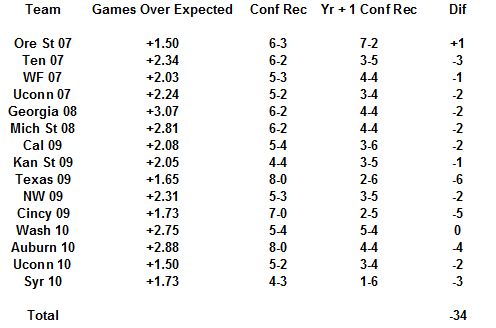
In 2007, Oklahoma State enjoyed a rather middling season in the Big 12. There were some highlights of course. They beat Nebraska in Lincoln for the first time since 1960, upended a Kansas State team ranked in the top-25 at the time, and gave Texas a run for their money in Stillwater. They were also trounced by Oklahoma and beaten by Kansas in Stillwater for the first time since 1995. All in all, the Cowboys went 4-4 in the Big 12. How did they do according to the Adjusted Pythagorean Theorem? Well, in their eight conference games, they scored 35 offensive touchdowns. Not bad. That tied for the third highest number in the conference. Unfortunately, teams also scored 35 touchdowns against their defense (tenth in the conference). All in all, the Cowboys record based on their offensive touchdowns scored and offensive touchdowns allowed was 4-4. And lo and behold, that was their record. Of course, this is just one cherry picked example. the Adjusted Pythagorean Theorem rarely hits the nail directly on the head. However, it does usually correctly predict a team's record within one game of their actual record. Since 2007, the Adjusted Pythagorean Theorem predicted each team's conference record within one game for nearly two-thirds (386 of 582 team seasons or 66.3%) of all teams. So if the Adjusted Pythagorean Theorem does a pretty good job of predicting a teams record based solely on how many offensive touchdowns they scored and allowed, what happened to those teams that significantly over or underperformed their APR? I thought you might ask that. To answer that question, I looked at all teams from 2007-2010 with a conference record at least one and a half games different (either better or worse) than their record as predicted by the Adjusted Pythagorean Theorem. I then looked at how they did in conference play the following season. And now I will share with you the results. As with the previous two blog entries, I have separated BCS and non-BCS conference teams to see if there appear to be any differences. First off, the BCS conference teams that exceeded their APR.
Of the 15 teams that exceeded their APR in conference, 13 declined the following season. One team stayed the same, and only Oregon State circa 2007 improved. Many of the declines were significant. 11 of the 15 teams declined by at least two games in conference play, and some (Texas, Auburn, and Cincinnati) totally fell off a cliff. On average, these teams declined by 2.27 games in conference play the following season.

Now the BCS conference teams that underperformed their APR.
Of the 20 teams that underperformed their APR in conference, 13 improved the following season. Three stayed the same and four finished with worse conference records. Overall, the teams improved by just a shade over one game (1.025) in conference play the following season.

Now the non-BCS conference teams that exceeded their APR.
Of the 15 teams that exceeded their APR in conference, 12 declined the following season. One team stayed the same and two improved. Overall, these teams decline by 1.8 games in conference play the following season.

Now the non-BCS conference teams that underperformed their APR.
Of the 14 teams that underperformed their APR in conference, 11 improved the following season. Two stayed the same and only one team (New Mexico circa 2008) declined. Overall, the teams improved by nearly two games (1.964) in conference play the following season.

So now the next question on your mind should be: Who under and over-performed their APR in 2011? Eight BCS conference teams exceeded their APR in conference play. In the ACC, Virginia allowed more offensive touchdowns than they scored, yet managed a 5-3 ACC record. Mike London may find it hard to take the Cavaliers to back-to-back bowl games for the first time since Al Groh did it in 2004 and 2005. In the SEC, Auburn allowed 10 more offensive touchdowns (27) than they scored (17), yet still somehow managed to win half their league games! With Texas A&M joining the SEC West and Clemson on the non-conference schedule, the Tigers could miss the postseason altogether in 2012. In the Big 12, Kansas State allowed more offensive touchdowns than they scored yet managed a 7-2 conference record, finishing all alone in second place. A reversal of fortune is almost certainly in store in 2012. The Big 10 had three teams drastically exceed their APR. Penn State won six Big 10 games and was in contention until the final weekend of the regular season. However, the Lions allowed more offensive touchdowns than they scored and will be breaking in a new coach for the first time since 1965. Michigan State won seven conference games and nearly earned their first Rose Bowl bid since 1987. However, based on APR, the Spartans should have only won a shade over five league games. Nebraska underachieved all season and actually allowed more offensive touchdowns than they scored. That should make Michigan the favorite in the Legends Division in 2012. UCLA 'won' their division in the Pac-12 despite allowing more offensive touchdowns than they scored. Jim Mora may be in for a long season during his first year at the helm. And finally, Louisville was a surprise co-Big East champ in Charlie Strong's second season. However, the Cardinals allowed more offensive touchdowns than they scored (sensing a theme?), so even with West Virginia out of the picture, a BCS bid is still likely a pipe dream.

Six BCS conference teams significantly underperformed their APR in conference play. Miami scored more offensive touchdowns than they allowed, yet finished with a losing record in the ACC. Perhaps Al Golden can coax a solid showing out of this under-performing group. North Carolina also scored more touchdowns than they allowed in league play, yet finished with a losing record. Larry Fedora steps into a pretty good situation assuming the NCAA investigation has run its course. In the SEC, Vanderbilt showed some moxie and was much better than their 2-6 SEC record. Could James Franklin take then to consecutive bowls for the first time ever? Texas A&M was expected to be a contender during their last run through the Big 12. A plethora of second-half collapses caused the Aggies to finish 4-5 despite scoring seven more touchdowns than they allowed. They move to an insanely tough division and must contend with Alabama, Arkansas, and LSU, but could position themselves in the middle of the division. South Florida lost seven of eight after a 4-0 start and finished tied for last in the Big East. No one would be shocked if the Bulls went from worst to first. Syracuse also drastically underperformed their expected Big East record. Syracuse probably won't be winning the league in 2012, but a return to the postseason is likely.

Five non-BCS conference teams exceed their APR in conference play. Marshall finished 5-3 in Conference USA despite allowing more offensive touchdowns than they scored. The Herd will find returning to the postseason quite challenging in 2012. UAB won three games in Conference USA despite allowing twice as many offensive touchdowns as they scored (those teams typically only win about one game). Despite the relative good fortune, the coach was still canned. New coach Garrick McGee has his work cut out for him. Northern Illinois won the MAC Championship despite posting the profile of a solid, but hardly elite MAC team. Dave Doeren deserves credit for leading the Huskies to the summit in his first season, but a repeat is highly unlikely. Arkansas State finished unbeaten in the Sun Belt and got coach Hugh Freeze a job with Ole Miss. New coach Gus Malzahn may yet make the Redwolves into a Boise State-like power, but there is likely to be some regression in his first season. And speaking of Sun Belt powers, Louisiana-Lafayette also significantly exceeded their expected Sun Belt record. A second straight bowl appearance would likely have coach Mark Hudspeth in line for some big time jobs.

Four non-BCS conference teams significantly underperformed relative to their APR in conference play. UCF followed up their top-25 final ranking in 2010 with a losing season in 2011. They'll be back at or near the top of the league in 2012. Miami of Ohio followed up their MAC Championship in 2010 with a losing season in 2011. With Temple gone to the Big East in 2012, the MAC East is wide open. Air Force scored more offensive touchdowns than they allowed, yet finished with a losing record in the Mountain West. The Falcons could be poised to take flight in 2012. And finally, Louisiana-Monroe scored more offensive touchdowns than they allowed in the Sun Belt, but finished just 3-5 in the league. With some breaks, they could overtake their in-state brethren and get to a bowl.

Saturday, March 03, 2012

Turnovers = Turnaround

Last time out, I published a piece examining how extremely lucky or unlucky teams perform the season after they experienced extreme fortune (either good or bad). Now I want to turn to another method that can be used to identify potential sleeper teams and teams that are likely to disappoint their collective fan base.

One of the preseason magazines I cannot do without is published by Phil Steele. In the fall, with the television on while on slaving away at this blog, I heard a commercial for a movie starring Hugh Jackman and thought they were making a documentary based on the college football guru. Imagine my disappointment when I discovered it was a derivative boxing movie featuring Rocky + robots. Oh well, I digress. One of the items Mr. Steele harps on in his preseason magazine is how big a role turnovers play in team performance. His magazine always features a section titled 'Turnovers = Turnaround'. Steele's contention is that teams with extreme turnover ratios (either good or bad) will see their margin trend back toward average the following season. Consequently, teams with great turnover margins tend to see their records decline and teams with poor turnover margins tend to see their records improve. I wanted to test his theory in a similar fashion to the way I tested close game performance. Thus, I looked at every college football team (excluding independents) from 2007-2010 and calculated their turnover margin in conference play. I looked only at conference games because teams often play extremely divergent non-conference schedules. Conference schedule strength on the other hand, remains relatively constant. I also decided to differentiate between BCS and non-BCS conferences based on the assumption that the non-BCS conferences would have greater shifts in year-to-year conference record thanks to a much less intrinsic ruling class. I then chose the most 'extreme' teams, those with a turnover margin greater than or equal to +10 or less than or equal to -10, and examined how they performed (in conference) in the season during which they had a great or poor turnover margin. Next I looked at how they performed the following season and calculated the difference. Here are the results. First the BCS conference teams with great turnover margins.
Of the 18 BCS conference teams with great turnover margins, 12 (or two thirds) declined by at least one game in conference play the next season. Four stayed the same and two improved. Overall, the teams declined by about 1.2 games in conference play the following season.

Now the BCS conference teams with poor turnover margins.
Of the 20 BCS conference teams with poor turnover margins, 14 improved by at least one game in conference play the next season. Two stayed the same and four declined. Overall, the teams improved by about 1.6 games in conference play the following season.

Now the non-BCS conference teams with great turnover margins.
Of the 19 non-BCS conference teams with great turnover margins, 13 declined by at least one game in conference play the next season. Three stayed the same and three improved. Overall, the teams declined by just a shade over one game in conference play the following season (-1.026). That number is not very far from the 1.2 game decline felt by similar BCS conference teams.

Now the non-BCS conference teams with poor turnover margins.
Of the 15 non-BCS conference teams with poor turnover margins, 11 improved by at least one game in conference play the next season. One team improved by half a game, two teams stayed the same, and only one declined. Overall, the teams improved by 2.3 games in conference play the following season. While the decline suffered by BCS and non-BCS conference teams was very similar, the improvement by the non-BCS conference teams is vastly superior (nearly 50% more) to that enjoyed by BCS conference teams.

So what teams should we keep an eye on in 2012? Who could be slated for improvement and who may fail to meet preseason expectations? BCS teams with great in-conference turnover margins last season include Oklahoma State (+17), Wisconsin (+13), Kansas State (+13), LSU (+12), and Arizona State (+10). Oklahoma State, Wisconsin, Kansas State, and LSU went a combined 29-5 against their conference foes, so some regression is certainly in order here. Meanwhile, Arizona State went just 4-5 in the Pac-12, so while they do not have as far to fall, they probably will not be contending for the division title either.

Only two BCS conference teams from last season meet the criteria for poor in-conference turnover margin. Ole Miss (-11) and Illinois (-10) went a combined 2-14 in their respective leagues. Perhaps not coincidentally, they also have new coaches for 2012. At the very least, those new coaches should see at least modest improvement (and they can take all the credit).

Six non-BCS conference teams had great in-conference turnover margins in 2011. Memphis (+12), Toledo (+12), Houston (+11), Louisiana Tech (+11), Arkansas State (+10), and Wyoming (+10) posted double-digit margins. Four of those teams (Arkansas State, Houston, Louisiana Tech, and Toledo) combined to lose just two conference games. Wyoming also had a solid year in the Mountain West, going 5-2. But Memphis...The Tigers went 1-7 despite a great turnover margin. Arkansas State, Houston, and Toledo all lost their head coaches after their successful seasons so the new hires may be unfairly evaluated if their teams dip somewhat.

Three non-BCS conference teams had poor in-conference turnover margins in 2011. SMU (-13), East Carolina (-11), and Florida Atlantic (-10) were all bitten by the turnover bug. Amazingly, East Carolina and SMU both finished with at least .500 marks in league play, a sign that they may be contenders in Conference USA in 2012. Meanwhile, the Owls from Florida Atlantic bottomed out at 0-8 in the Sun Belt, so there is no place to go but up for new coach Carl Pelini.

Saturday, February 18, 2012

Close Game Luck

Perhaps one of the more ubiquitous themes I have promulgated in the nearly seven years I have been writing this blog is that close game are a crap shoot. Good teams don't win more close games than bad teams. Close game success is not correlated across seasons, or even within seasons. Et cetera, et cetera. However, one of the things I have never analyzed is exactly many games teams that are either exceedingly lucky or unlucky tend to win the next season. Well, now I can cross one thing off my bucket list. In this analysis, I looked at all team seasons from 2005-2010 and calculated their performance in close conference games (games decided by one score -- eight points or less). Once this was complete, I looked at how the best and worst teams (in terms of close game record) fared in their conference during the season in which they had a great or poor record in close games and the subsequent season. In order to only examine those teams that enjoyed significant success or lack thereof in close games, teams had to be at least two games better or worse than expected (expected record .500). For example a team that goes 4-0 is two games better than expected (expected record of 2-2) as is a team that goes 5-1 (expected record 3-3) and vice-versa (0-4 and 1-5). I looked only at conference record in close games because teams often play extremely divergent non-conference schedules. Conference schedule strength on the other hand, remains relatively constant. I also decided to differentiate between BCS and non-BCS conferences based on the assumption that the non-BCS conferences would have greater shifts in year-to-year conference record thanks to a much less intrinsic ruling class. So with that out of the way, here are the results. First, the lucky BCS conference teams.Of the twelve teams that had a great record in close games, ten of them declined by at least one game the following season and only one (Cincinnati) improved. In the aggregate, the teams declined by about 1.6 games in conference play the following season.

Now the unlucky BCS conference teams.We're dealing with a much smaller sample size here, but four of the five teams improved, some (Arkansas and Michigan State) significantly. Only one team declined. In the aggregate, the teams improved on average by nearly two games in conference play the next season.

Now the lucky non-BCS conference teams.Of the seven lucky teams, five declined the following season and only one (East Carolina) improved. In the aggregate, the teams declined by about 1.7 games in conference play the following season. That's not very different from the decline enjoyed (or endured) by the BCS conference teams (1.6).

And finally the unlucky non-BCS conference teams.Of the ten unlucky teams, eight improved the following season and only one (UAB) declined. In the aggregate, the teams improved by 2.2 games in conference play the next season. That's higher, but not extremely different from the improvement by the BCS conference teams (1.9).

So, with this information at hand, who is poised to make a significant splash in 2012 and who may come in a little over-hyped and is likely to take a step back? The only lucky BCS team from last season was Kansas State. The Wildcats went 6-1 in close Big 12 games last season on their way to a 7-2 runner-up finish.

There were two lucky non-BCS conference teams, with Marshall (4-0) and Utah State (5-1) posting great close game conference records. Marshall needed every win they could muster as they went just 1-3 in conference games decided by more than one score.

The unlucky BCS conference teams were headlined by Ohio State. The Buckeyes went 1-5 in close Big 10 games (each of their league losses was close) as they finished below .5oo in the conference for the first time since 1999. With a new proven coach (Mr Meyer) the Buckeyes should be poised for a return to glory even if they are ineligible for the postseason in 2012. The Miami Hurricanes were also a tough luck 1-5 in close league games and the South Florida Bulls were 0-4 in close Big east games as they missed out on a bowl for the first time since 2004. Vanderbilt was also 0-4 in close SEC games, losing in heartbreaking fashion to Arkansas, Florida, Georgia, and Tennessee.

The only unlucky non-BCS conference team was Central Florida. The Knights dropped all four of their close Conference USA games and compounded their troubles by losing two close non-conference games (to BYU and Florida International) to miss out on a bowl for the first time since 2008. Look for the Knights to contend for the Conference USA crown in 2012.

Saturday, January 14, 2012

The Crimson Armada: Where Does 2011 Alabama Stand?

While calculating my mid-season SDPI ratings back in October, I got the notion that this year's Alabama team could be one of the best college football teams ever. Of course, almost immediately after that post, the Tide lost a tight home game to LSU and seemed doomed to be just another Sugar Bowl champion. After they were written off, all the other challengers faltered and the Tide ended the season ranked number two in the BCS. In the hyped rematch, the Tide dominated LSU and claimed their second BCS Championship in three years. Even with the loss, Alabama still enjoyed a dominant campaign. But how dominant? Where do the Tide rank in terms of recent national champion? To find out, I looked to see how Alabama compared to each national champion since 1993 in four different categories. Why 1993? Its completely arbitrary, but that is when I first began to follow college football.

The first category of dominance I looked at is scoring margin. The following table lists how the past 21 national champions (1997 and 2003 featured two champions) have fared in terms of per game scoring margin.By this measure, Alabama ranked eighth among the 21 teams. Their scoring margin was very good, but not quite ridiculous like that of 1995 Nebraska. Notice that if we take the scoring margin of the two worst teams (2006 Florida and 2002 Ohio State), and add them together, it still does not equal the margin of that Nebraska team. A few other tidbits from the table: Four of the top-eight teams on the chart actually lost a game (1993 Florida State, both Florida teams, and this year's Alabama). I think its a little ironic that the bottom two teams are Ohio State and Florida. As you may recall, Florida beat a solidly favored Ohio State to win the title in 2006.

The second category of dominance is scoring ratio. Scoring ratio is simply the number of points scored divided by the number of points allowed. A team with a ratio of 1 would have scored and allowed the same number of points. While scoring margin tends to favor teams with great offenses, teams with great defenses will fare well in scoring ratio. Here is how the past 21 champions have fared in scoring ratio.When you only allow a shade of eight points per game, your scoring ratio is bound to be pretty good. 2011 Alabama ranks second to the 2001 Miami Hurricanes in terms of scoring ratio and are one of just three teams to have scored more than four times as many points as their opponents. Once again, as in the previous table, a loss certainly does not preclude dominance. Four of the top-six teams (2011 Alabama, 1993 Florida State, 2008 Florida, and 2003 LSU) all lost a game.

The third category of dominance is number of wins by twenty or more points.Alabama ranks very highly by this measure. Ten of their twelve wins came by 20 or more points. The only victims that were able to hold the margin under 20 points were Penn State (16 points) and perhaps surprisingly, Mississippi State (17 points). 1995 Nebraska is tied with 2008 Florida atop the list. The Cornhuskers lone victory by fewer than 20 points in 1995 came against Washington State (14 points).

The final category of dominance is performance away from home. The table below ranks the 21 teams by their road/neutral field scoring margin. Their road/neutral field record is also listed.Once again, the Crimson Tide do not disappoint. Only 1995 Nebraska (sensing a trend?) and 2005 Texas fared better on the road than Alabama. Once again five of the top-eight teams in road scoring margin lost a game (2011 Alabama, 2008 Florida, 2003 LSU, 2003 Southern Cal, and 1993 Florida State). Perhaps more interestingly, 2011 Alabama, 2008 Florida, and 2003 LSU all lost at home! The most surprising number on this chart belong to 2001 Miami. The Hurricanes are widely regarded as one of the best champions of the BCS-era, and they do rank third in scoring margin, first in scoring ratio, and tied for third in wins by 20 or more points. However, their road/neutral field performance ranks only 15th. The Hurricanes struggled mightily in a pair of road games against decent, but hardly dominant conference foes. They beat Boston College 18-7, in a game with a misleading final thanks to a steal of an interception and return by Ed Reed. See below.

They also edged Virginia Tech 26-24. Both of those teams managed 8-4 marks, but neither was a great.

So where does 2011 Alabama rank in terms of champions of the past two decades? For my money, 1995 Nebraska is head and shoulders above everyone else. However, after the Cornhuskers, I think Alabama belongs in the conversation with 2008 Florida, 2005 Texas, 2001 Miami, and 1993 Florida State (a very underrated champion) as the second best champion. And who is the worst? No one team stands completely out, but two certainly do. Its a close race between either 2006 Florida or 2002 Ohio State.

Sunday, January 08, 2012

Bowl Preview: Part V

The Game: BCS National Championship Game
The Teams: Alabama vs LSU
The Line: Alabama -1
I'll say this for LSU, they have impeccable timing. They always seems to save their best teams when the national championship is in New Orleans. See 2003 and 2007. The difference this year though is that the Tigers actually avoided losing any games in the regular season. And what a regular season it was. The Tigers beat the Pac-12 champ (Oregon) at a neutral site, the Big East champ (West Virginia) on the road, and their opponents in this game (Alabama) on the road. Aside from the 9-6 win over Alabama, no opponent came closer than 13 points against the Tigers. Alabama had a similarly dominant season. While they lacked the non-conference scalps procured by LSU (Alabama's best win was at offensively inept Penn State), nine of their eleven wins came by at least 20 points, with the other two coming by 16 and 17 respectively. While it is likely we will see at least one touchdown in this game, it should be low-scoring like their initial encounter. Both these teams were uber-dominant on the defensive side of the ball in 2011. In their eleven games against BCS-conference teams, LSU allowed 12 offensive touchdowns. That's amazing! However, Alabama one-upped them, allowing just six offensive touchdowns in their nine games against BCS-conference teams. Both these teams are clearly the best the nation has to offer this year. LSU has the better scalps, but Alabama has the better statistical profile. Thus, the Tide are my final lock of the bowl season.

Monday, January 02, 2012

Bowl Preview: Part IV

The Game: Sugar Bowl
The Teams: Michigan vs Virginia Tech
The Line: Michigan -3
Congratulations are in order for Virginia Tech. The Hokies stole earned the ACC’s first ever at-large BCS bid. Did they deserve it? Probably not. However, every game that is not the BCS National Championship Game, be it the Rose Bowl or the Famous Idaho Potato Bowl, is nothing more than a glorified exhibition. The powers that be choose who they want to play in those games, and we the public have just three options available to us. To watch, to not watch, or to sort of watch while playing Words With Friends. While the Hokies may not deserve this bowl game, it still presents an intriguing matchup. Virginia Tech suffered two losses all season. Unfortunately, both defeats came at the hands (or paws) of the Clemson Tigers, preventing the Hokies from winning their fifth ACC Championship since joining the conference in 2004. While the Hokies won eleven games, their non-conference schedule was especially soft (Appalachian State, East Carolina, Marshall, and Arkansas State), and their only wins of note in the conference were over Georgia Tech and Virginia. Still, the Hokies were plenty dominant against their soft schedule, finishing with the third-best defense in the ACC and the second-best offense. The Hokies will be taking on a Michigan team making its first BCS bowl appearance since the Rose Bowl following the 2006 season. Michigan lost that game in unflattering fashion, lost the 2007 season opener to Appalachian State, pushed Lloyd Carr out the door, hired Rich Rodriguez, fielded the worst three defenses ever at the school under his watch, and culminated his tenure with a thrashing at the hands of an SEC also-ran. But now the Wolverines appear to be back on the right track under his successor Brady Hoke. The Wolverines maintained the offensive efficiency they developed under Rodriguez (finishing third in the twelve-team Big 10), and also improved their defense (finishing third after ranking last in 2010). The Wolverines also defeated Ohio State for the first time since 2003, though it should be noted the Buckeyes managed just a 6-6 record, so there was no parade. Michigan is probably the better team, but the Wolverines lack of a smooth passing attack has caused them to bog down (see games against Michigan State and Iowa) when facing a strong defense. For that reason, a play on the Hokies to win outright may not be a bad idea.

The Game: Orange Bowl
The Teams: Clemson vs West Virginia
The Line: Clemson -3
Clemson and West Virginia. A rematch of the 1989 Gator Bowl. Can the Mountaineers gain a measure of revenge for the Tigers abuse of Major Harris more than 20 years ago? Eh, maybe the rematch angle is a little overblown, seeing as how the majority of the key players in this game were not even in utero during that game. For Clemson, this Orange Bowl appearance is their first since they won the National Title in 1981 and their first conference title since 1991. After suffering their first losing season since 1998 last year, the Tigers hired a former high school offensive coordinator (Chad Morris) and played at a much faster pace. Add in a stud freshman receiver (Sammy Watkins), an NFL-bound tight end (Dwayne Allen), and a solid quarterback (Tajh Boyd), and voila—the best offense in the ACC. Despite their offensive firepower, the Tigers struggled at the end of the regular season, losing to Georgia Tech, barely escaping Wake Forest at home, getting annihilated at NC State, and struggling to find any semblance of an offense in their annual rivalry game with South Carolina. Then, in the ACC Championship Game, it was suddenly October again. The Tigers mauled Virginia Tech for the second time this season and secured their Orange Bowl bid. West Virginia did not wait quite as long between conference titles, though it must have seemed that way to fans. After three years of Bill Stewart (and just a share of one conference title), the Mountaineers brought in Dana Holgorsen to lead the offense and replace Stewart after this season. However, as to be expected, Stewart did not enjoy being a lame-duck coach, and long story short, Holgorsen took the big job a year earlier than expected. The Mountaineers posted the best offense in the Big East, and won the three-way tiebreaker with Louisville and Cincinnati to take the BCS bowl bid. For the most part, West Virginia won the games they were supposed to, save for a huge upset at the hands of Syracuse in the Carrier Dome. Clemson is probably a better team, and should certainly have sufficient motivation in playing in their first-ever BCS bowl game. However, ACC teams are just 2-11 in BCS bowl games. Keep that in mind if you plan on wagering on this game

The Game: Cotton Bowl
The Teams: Arkansas vs Kansas State
The Line: Arkansas -8.5
Win or lose, Kansas State will remain one of the most surprising teams of 2011. After failing to win more than seven games in any season since 2003, the Wildcats already have ten wins and will be clawing for their eleventh against Arkansas. The Wildcats won ten games despite ranking just ninth in the ten-team Big 12 on offense and fifth on defense. Their statistical profile befits a team that went 6-6 or 7-5, not 10-2. How did they do it? For starters, their turnover margin of +13 ranks sixth in the nation. They also added five non-offensive touchdowns and went an amazing 8-1 in one-possession games. That's not to say the Wildcats don't have players. Quarterback Calvin, err Collin Kelin ran for an amazing 26 touchdowns! Klein is somewhat limited as a passer, but the Wildcat offense is built around the running game. Arkansas on the other hand, is built around the passing game. Quarterback Tyler Wilson helped lead the third-best offense in the SEC (behind Alabama and Georgia). Wilson tossed 22 touchdowns and just six interceptions on the year. On paper, this seems like a walk in the park for Arkansas. However, Hogs were below average on defense, finishing ninth in the SEC. Plus, outside of South Carolina, the Hogs don't really have any great wins. Sure they beat bowl teams (Texas A&M, Auburn, Vanderbilt, and Mississippi State), but none of those teams were especially strong. Look for Kansas State to keep this one close, but I don't think they have the firepower to win outright.

The Game: BBVA Compass Bowl
The Teams: Pittsburgh vs SMU
The Line: Pittsburgh -3
SMU and Pittsburgh have quite a bit in common. At least more than you probably think. Both were college football powers in the late 1970's and early 1980's, with Pitt winning a national title in 1976 and SMU finishing in the top-10 in 1981, 1982, and 1984. Both went through serious dips in the 1990’s with Pitt suffering five straight losing seasons from 1992 through 1996. SMU was given the Death Penalty thanks to their cavalier attitudes toward boosters during their run in the early 80’s. They were forced to shutter the program for the 1987 and 1988 seasons. When they returned to playing football in 1989, they endured eight straight losing seasons and did not play in a bowl game until 2009. Both also had ties to the most recent Arizona State coaching search. SMU coach June Jones initially interviewed for the job, and was apparently ready to accept the position until the Sun Devils went in another direction. That direction was due northeast. Pitt coach Todd Graham accepted overtures from the Sun Devils to become their coach and left Pitt after just one season guiding the Panthers. Thus there is quite a bit of drama for a bowl game featuring teams that enter with a combined 13-11 record. Despite their 6-6 mark, Pitt actually performed quite well in Graham’s first and only season at the helm. The Panthers boasted the third ranked offense and second ranked defense in the Big East, but were undone by a poor record in close games (2-4). The Mustangs from SMU seemed poised for a breakthrough season when they upset TCU and beat defending Conference USA champ UCF on consecutive weekends to stand 5-1 in early October. They proceeded to win just two of their final six games, losing in non-competitive fashion to Houston, Tulsa, and Southern Miss (lost by 85 combined points in those games). Surprisingly, SMU has yet to feature the dynamic offense that Jones was known for at Hawaii. The Mustangs ranked just eighth in Conference USA on offense and have yet to finish higher than fourth in any of Jones’ four seasons (cue Frankie Valli) at the helm. Pitt is the better team and should win, but with the turmoil (on both sides) and the motivation factor (SMU would love to knock off a team from a BCS conference) I wouldn’t feel confident taking them to cover here.

The Game: GoDaddy.com Bowl
The Teams: Arkansas State vs Northern Illinois
The Line: Arkansas State -1
Very quietly, Arkansas State has positioned themselves to be a Sun Belt power for at least the next season or two. It started when they hired Hugh Freeze to direct the offense after a disappointing 2009 campaign. The 2009 team finished with the worst offense in the Sun Belt, and hired Freeze to heat things up. The Red Wolves responded by posting the third best offense in the Sun Belt in 2010. However, the team posted a poor record in close games (1-5) en route to a 4-8 finish and head coach Steve Roberts was canned. Freeze was promoted to the top job and the offense continued clicking, this time ranking first in the conference. The defense also improved (ranking first in the conference as well) and the team blitzed through Sun Belt play unbeaten. The Red Wolves became the first Sun Belt team to win ten games in the regular season (joining the 2009 Middle Tennessee State team as the only other Sun Belt team to win ten period). They are also ranked 28th in the latest AP Poll, so with a win here, they could conceivably become the first Sun Belt team to ever be ranked in the top-25 as a Sun Belt member (North Texas was ranked once back in the day). Of course, as is often the case at schools like Arkansas State, success usually means your coach is leaving. Sure enough, Ole Miss tabbed Freeze to become their next coach. Not to worry though, the Red Wolves pulled off one of the biggest coups in finding their next coach when Gus Malzahn agreed to lead the team. Malzahn is an offensive innovator, and while his offense at Auburn struggled in the SEC without Cam Newton, Malzahn’s previous track record at Arkansas and Tulsa indicates the offense should remain in good hands. Arkansas State will be battling a fellow mid-major conference champion in the Northern Illinois Huskies. The Huskies won the MAC for the first time since 1983 in Dave Doeren's first season as coach. The Huskies were especially good on offense, where they ranked second in the MAC, but much less so on defense, where they ranked just seventh. This is one of the better, more under-appreciated bowl matchups of 2011. It’s a little off the beaten path, but tune in to see a pair of established signal callers, Ryan Aplin of Arkansas State (can we call them the Aplin Dumpling Gang?) and Chandler Harnish of Northern Illinois (a poor man’s Dan LeFevour who was a poor man’s Tim Tebow), running a pair of entertaining offenses. If you feel like making a play, take the Red Wolves in this one.